
ROI Discovery over Protected Locations: Balancing Privacy and Personalization in LBSNS
Region of Interest Discovery in Location-Based Social Networking Services with Protected Locations
This paper introduces a Modified K-Anonymous Spatial-Temporal Cloaking Model (KSTCM) and associated discovery methods for identifying Regions of Interest (ROIs)—both popular and personal—from location-based social networking services (LBSNS) data where user locations are protected. The methodology demonstrates that high-quality ROI discovery is feasible even when individual precision is sacrificed for privacy.
TL;DR
As location-based social networking services (LBSNS) like Foursquare and Gowalla became ubiquitous, the tension between data utility and user privacy reached a breaking point. This paper proposes a dual-purpose framework: the KSTCM model for location cloaking and a robust ROI extraction pipeline that can "see through" the noise of anonymized data to identify significant geographical regions (Popular, Private, and Preference areas).
The Conflict: Data Mining vs. The Right to Privacy
In the realm of LBSNS, your "check-in" is more than a coordinate; it is a timestamped revelation of your social circle, work habits, and home life. While data scientists want precise coordinates to build recommendation engines, users require privacy.
Existing k-anonymity models often fail because:
- Data Dilution: Sticking strictly to k-anonymity in sparse areas results in "cloaking boxes" so large they are geographically meaningless.
- Semantic Leakage: Even if coordinates are blurred, a "Location ID" can often be reverse-engineered via database joins to reveal the exact spot.
Methodology: The KSTCM and Entropy-Based Discovery
1. The Modified K-Anonymous Model (KSTCM)
The authors transform a raw check-in into a KSTCM object. Instead of a point, a check-in becomes a rectangle defined by:
- TI (Time Interval): Generalizing specific moments.
- Spatial Box: A rectangle covering at least indistinguishable check-ins.
- Semantic Annotations: Replacing specific IDs with category-based descriptors.
2. Discovering Popular Regions
To find public hotspots (e.g., airports, malls), the authors utilize Grid Entropy. The intuition is that popular places are visited frequently by a diverse set of users. A grid cell with many check-ins from a single user has low entropy, whereas a cell with check-ins from 100 different users has high entropy.
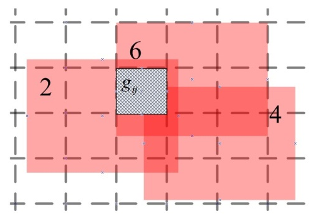 Four scenarios of grid check-ins: (d) represents the high-entropy signature of a popular ROI.
3. Personal ROI: Private vs. Preference Regions
Individual users have specific movement patterns. The authors distinguish between:
- Private Regions: High-frequency, low-diversity areas (e.g., Home).
- Preference Regions: Areas where users spend leisure time (e.g., CBDs).
To extract these from cloaked data, they use Voronoi-based Density Ranking and Routine Ranking (identifying pairs of locations visited on the same day).
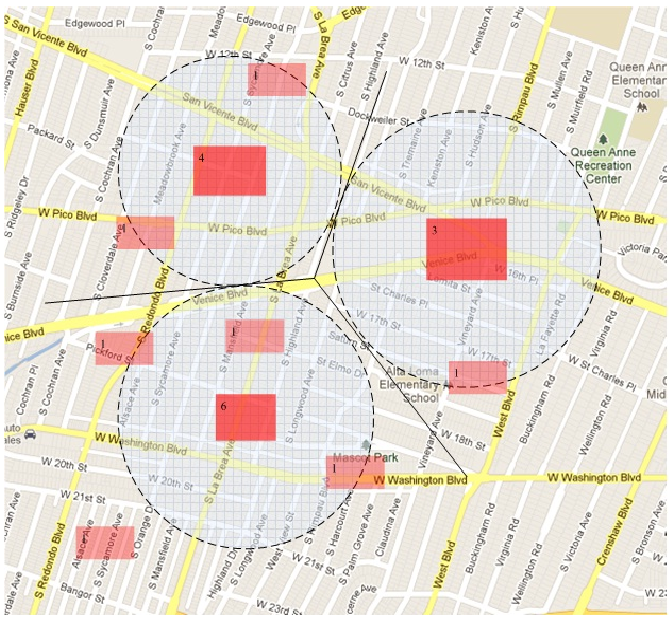 The Voronoi cell approach used to calculate regional density for personal ROI ranking.
Experimental Validation
Using 20 months of Gowalla data from California, the authors tested various "privacy intensities" ( values).
- Popular Region Success: At , the model perfectly identified major landmarks in Los Angeles.
- The Privacy Trade-off: As increased to 10, the accuracy of private region discovery dropped significantly (from 41% to 20%). Interestingly, Preference Regions remained easier to detect (holding at ~76% success), likely because they are naturally more "public" and less sensitive to cloaking.
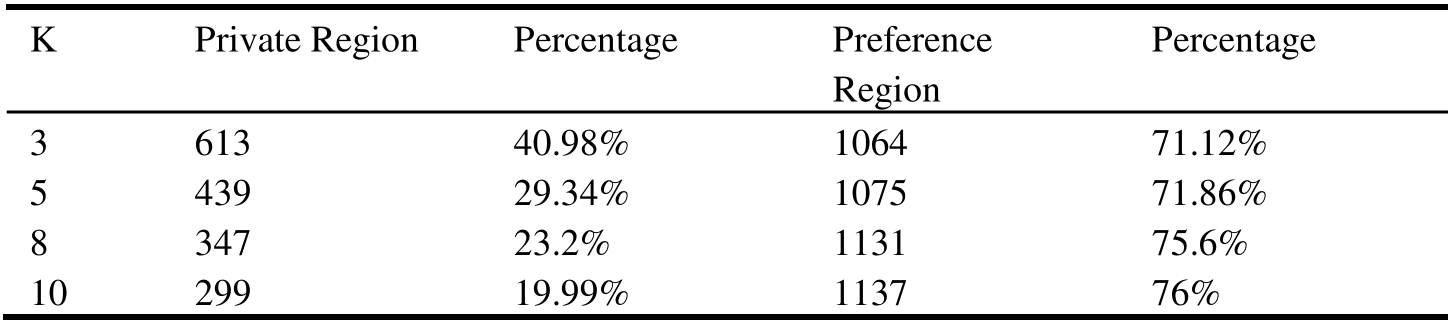 The impact of on ROI discovery percentage.
Critical Insight & Conclusion
This work challenges the notion that privacy-protected data is "garbage" for analytics. By shifting from point-based geometry to entropy-based spatial probability, the authors provide a pathway for LBSNS providers to respect user anonymity while still delivering the high-quality recommendations that drive user engagement.
Future Outlook: While KSTCM handles spatial-temporal privacy, the rise of "Re-identification Attacks" using social graphs suggests that future models must integrate these ROI discovery techniques with even more robust privacy frameworks like Differential Privacy.