
Deciphering the Sound of the Land: Active Feature Selection for Chinese Folk Song Identification
Regional Style Automatic Identification for Chinese Folk Songs
This paper introduces an automated framework for identifying the regional styles of Chinese folk songs across 10 geographical categories. By implementing a novel "ActiveSelection" feature selection algorithm and a prior-knowledge-based ensemble classifier, the study achieves a peak classification accuracy of 84.29% using SVM and multiple classifier fusion.
TL;DR
Researchers from Renmin University of China have developed a machine learning framework to automatically categorize Chinese folk songs into 10 regional styles (e.g., Mongolia, Tibet, Southwest China). By introducing an ActiveSelection algorithm to prune 74 acoustic features down to the 35 most relevant ones and using a prior-knowledge-based ensemble, they achieved a significant 84.29% accuracy, outperforming standard genre classification baselines.
Background: The Challenge of "Musical Geography"
Chinese folk music is deeply rooted in local dialects and regional cultures, often described by musicians as having a specific "geographical color." However, translating this artistic intuition into computational data is notoriously difficult. Unlike mainstream genres (Rock, Jazz, Pop) which are often defined by steady beats, regional folk styles rely on subtle nuances in timbre and tonal delivery.
Previous studies found that standard sampling and classification often resulted in low accuracy (around 47%). This paper identifies two fatal flaws in prior work:
- Feature Redundancy: Traditional rhythmic features are often irrelevant since every region has both fast and slow songs.
- Model Generalization: No single classifier (SVM, KNN, or Bayes) is the best at identifying all regions simultaneously.
Methodology: Active Selection & Smart Fusion
1. Feature Engineering
The authors extracted 74 dimensions of features, categorized into:
- Timbre-related: MFCCs, Spectral Centroid, Zero Crossing Rate (Critical for regional "voice").
- Rhythm-related: Beat sum, Strength of Strongest Beat (Hypothesized to be less important).
2. ActiveSelection Algorithm
Instead of just using standard filters (like ReliefF), the authors proposed ActiveSelection.
- Logic: It starts with a seed subset of features and iteratively adds the feature that has the strongest power to correct currently misclassified samples.
- Result: It reduced the feature set by over 50% while actually increasing accuracy, proving that "less is more" when dealing with noisy acoustic data.
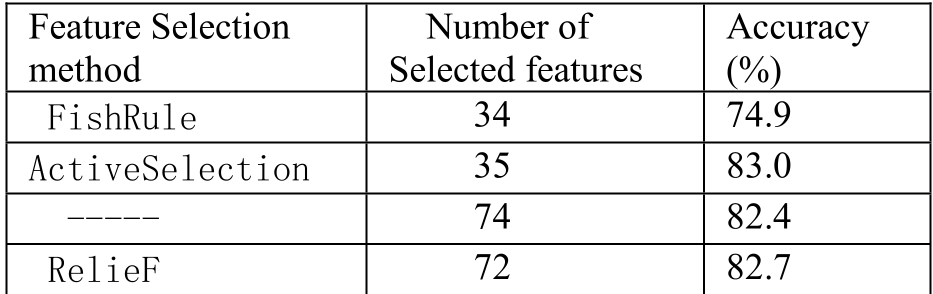 Table: Comparison of feature selection methods showing ActiveSelection's superiority.
3. Prior Knowledge Based Ensemble
The researchers observed that SVM was excellent for most regions, but KNN was superior for Class 9 (Sichuan), and the Fisher classifier was better for Class 10 (Guizhou). Instead of a simple majority vote, they built a "Knowledge-Based" combiner that routes the final decision to the classifier known to be the "expert" for that specific predicted class.
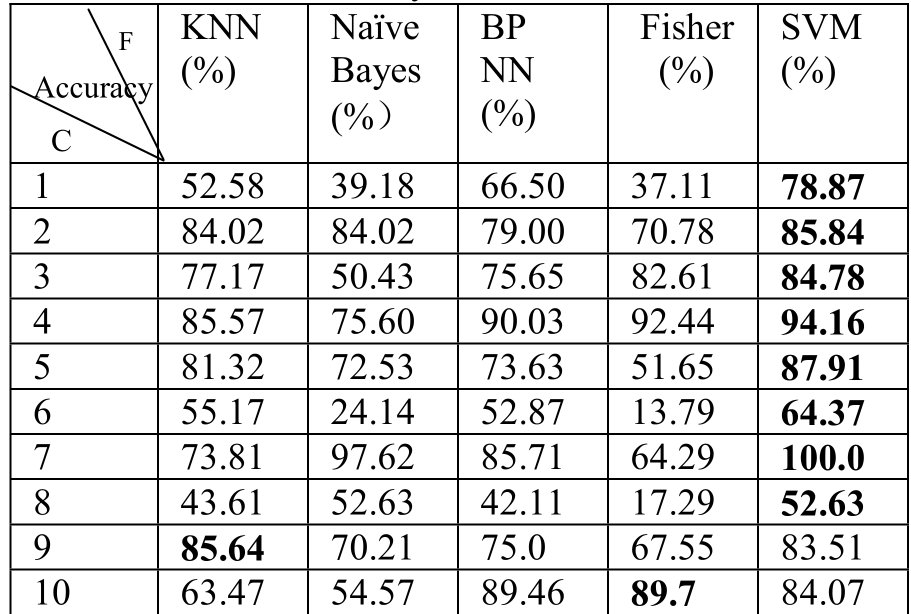 Table: The disparate performance of different classifiers across 10 regional categories.
Experimental Results
The findings confirmed that:
- SVM is the strongest individual baseline (83.0%).
- ActiveSelection successfully identified timbre (MFCC and Spectral Flux) as the "DNA" of regional style.
- Ensemble Accuracy reached 84.29%, a high mark for a 10-class classification problem in traditional music.
Furthermore, the team tested their method on the "George 2002" dataset for general genre classification, where they improved accuracy from 37.39% to 76.52%, proving the ActiveSelection algorithm's generalizability across the MIR (Music Information Retrieval) field.
Critical Analysis & Future Outlook
Summarizing the Contribution: This paper moves beyond simple "black-box" classification. By focusing on feature selection, it provides musicologists with a "shortcut" to understand which acoustic properties (timbre over rhythm) actually define a region's sound.
Limitations: The dataset relies on 10-second clips. In folk music, certain regional characteristics (like specific ornaments or melodic structures) might only appear in longer phrases. Future work should explore Sequential Modeling (like LSTMs or Transformers) to capture these temporal patterns.
Takeaway for Practitioners: When dealing with subjective cultural data, don't just throw more features at the model. Use error-driven selection (like ActiveSelection) and class-specific ensembles to let the data dictate the "expert" model.
Reference: Liu, Y., Wei, L., & Wang, P. Regional Style Automatic Identification for Chinese Folk Songs. Renmin University of China.