
PbLDext: Bridging the Gap Between Precision and Interpretability in Fuzzy Regression
On regression methods based on linguistic descriptions
The paper introduces a new regression method based on the PbLDext model, an extension of Perception-based Logical Deduction. It utilizes fuzzy partitions and linguistic semantics to perform regression tasks while maintaining high interpretability in natural language, achieving superior prediction precision over the original PbLD model across multiple UCI datasets.
TL;DR
In the world of regression, we usually choose between "black boxes" (high accuracy, low transparency) and "clear boxes" (low accuracy, high transparency). This paper introduces PbLDext, an evolution of Perception-based Logical Deduction that uses dense fuzzy partitions to dramatically increase prediction accuracy while remaining fully describable in natural language. Across multiple real-world datasets, PbLDext consistently outperformed its predecessor, proving that we don't have to sacrifice understanding for performance.
Background: The Interpretability-Accuracy Trade-off
Most regression models output numbers that are hard for humans to "read" as logic. Fuzzy logic approaches solve this by using Linguistic Descriptions (e.g., "IF Temperature is Very High THEN Energy Output is Small"). However, standard fuzzy models often use a small set of terms (Small, Medium, Big), which limits their precision. The authors argue that by refining these linguistic categories into more granular fuzzy partitions, we can model complex data more accurately.
Methodology: The Core Logic
1. From Atomic Expressions to Fuzzy Partitions
The original PbLD model relied on simple linguistic hedges like "very" or "more or less." PbLDext replaces this with a 9-set fuzzy partition. This allows for compound expressions like "very small but not significantly small."
2. Specificity Ordering ()
The authors introduce a "specificity ordering." A linguistic predication is considered more specific than if its membership function is tighter. This allows the deduction mechanism to prioritize more precise rules when they are applicable to the input data.
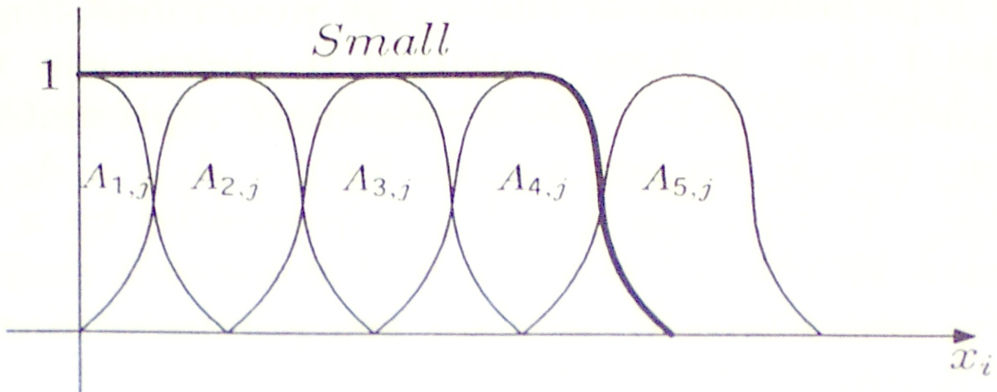 Fig 1: The extended model of linguistic predications showing how elementary fuzzy numbers are combined to create more granular categories.
3. Mining Linguistic Associations
Instead of manually defining rules, the model uses an automated mining process (based on the GUHA method and the OPUS algorithm) to find "IF-THEN" relationships in the data. It calculates Support and Confidence for these rules using t-norms, effectively converting a numerical dataset into a structured linguistic text.
Experiments and Results
The authors tested the model on five diverse datasets from the UCI repository, including Airfoil Self-Noise and Energy Efficiency.
- Quantity vs. Quality: The PbLDext model generated significantly more rules (often 10x more) than the original model. For instance, in the Energy Efficiency dataset, PbLDext produced over 3,500 rules compared to the original's ~300.
- Significant Precision Gains: In almost all cases, the Root Mean Squared Error (RMSE) dropped sharply.
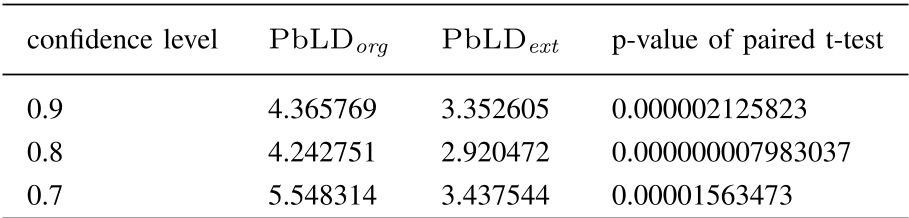 Table 1: Statistical comparison on the Combined Cycle Power Plant dataset. PbLDext consistently achieves lower RMSE with high statistical significance ().
Critical Analysis & Conclusion
Takeaway
The primary contribution of this paper is the demonstration that semantic interpretability is not a bottleneck for performance. By increasing the "resolution" of our linguistic terms, we can achieve results that rival standard regression methods while providing a model that a human can actually read and verify.
Limitations & Future Work
The main drawback of this method is the massive increase in the number of rules. While the individual rules are interpretable, a model with 5,000 rules presents a different kind of complexity. Future research will likely focus on Rule Pruning and redundancy removal to ensure the model remains manageable for human experts without losing its new-found precision.
This paper represents a significant step forward for Perception-based logic, moving it from a theoretical framework into a robust tool for real-world regression analysis.