
Social Media as a Dissipative System: Modeling the Transition from Order to Chaos
Investigation into the Regular and Chaotic States of Microblogging Networks as Applied to Social Media Monitoring
This paper proposes a macroscopic evolutionary dynamics model for social microblogging networks (MSNs), treating them as point-dissipative systems. By mapping network behaviors to the Lorenz system and Duffing equations, the authors identify transition thresholds between regular equilibrium and chaotic states driven by external information intensity.
TL;DR
Is social media activity predictable, or is it fundamentally chaotic? This research treats microblogging networks like physical thermodynamic systems. By applying the mathematics of the Lorenz System, the authors demonstrate that when external information intensity (like a major sports event) hits a critical threshold, the network moves from stable "regular" patterns into a state of deterministic chaos.
Background: Beyond Simple Diffusion
Most social media monitoring tools treat "trends" as simple linear curves. However, anyone managing a brand during a crisis or a viral event knows that engagement feels less like a curve and more like a storm. This paper shifts the perspective from "Information Diffusion" to Non-linear Dynamics, viewing a network as a macroscopic system of "atoms" (users) that can be excited by external energy (information).
Methodology: The "Thermodynamics" of Tweeting
The authors propose a model where users exist in two states:
- Ground State: Users who haven't received enough information to act.
- Excited State: Users primed by mass media to tweet/retweet.
By defining the system through three dynamic variables—the variation in tweets (), retweets (), and the density difference between excited and ground-state users ()—they construct a system of first-order differential equations.
The Core Model Architecture
The system is mathematically equivalent to the Lorenz system, a cornerstone of chaos theory:
In this context, represents the intensity of external information. As increases, the system undergoes a series of bifurcations.
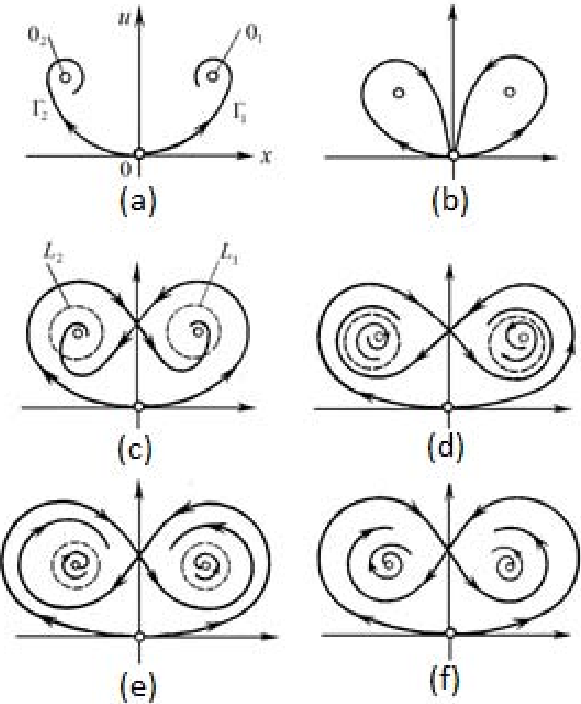 Fig. 2. Diagrams of transition processes: From stable equilibrium (a) to limit cycles (c) and eventually to the chaotic attractor (f).
Experimental Evidence: Real Madrid vs. Barcelona
To prove that this isn't just theoretical math, the authors analyzed real Twitter data from major football clubs during high-stakes tournaments. They utilized the Lyapunov coefficient—a measure used in physics to determine if a system is chaotic (positive value) or stable (negative value).
- Theoretical Chaos (Fig 1): 1.23
- @realmadrid activity: 1.33
- @fcbarcelona activity: 0.88
- TOP 100 Popular Accounts: 1.52 ± 0.82
The results are clear: high-intensity social interaction is inherently chaotic.
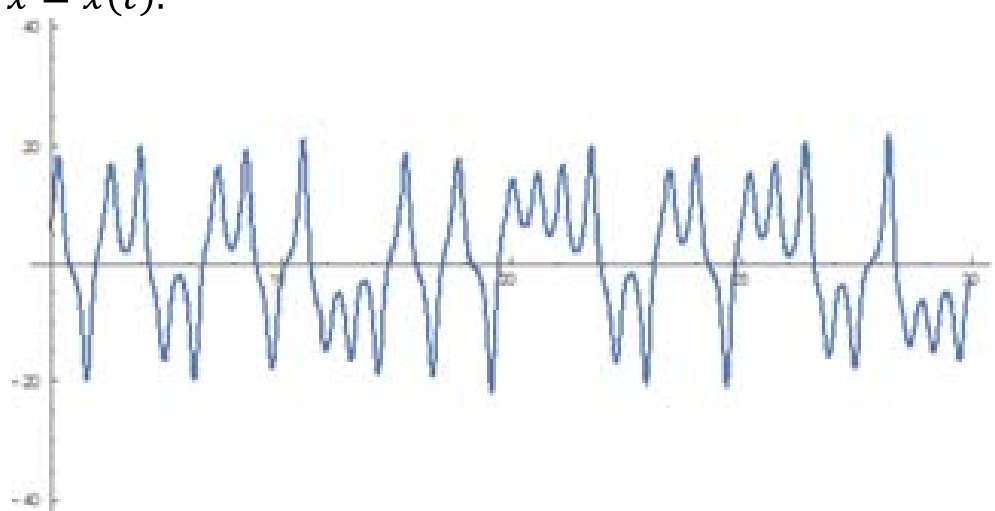 Fig. 1. Simulated Lorenz attractor showing the "butterfly" pattern of chaotic tweet fluctuations.
Deep Insight: "Managed Chaos"
The most profound takeaway is the social implication of chaos. The authors argue that regular, ordered oscillations only occur in totalitarian systems where preferences are dictated or restricted. Deterministic chaos, while difficult to control, is an indicator of user freedom and a competitive market.
For business intelligence and social media monitoring, this means:
- Traditional "averaging" of data during peak events is misleading because the system is in a non-equilibrium state.
- We should monitor the intensity of exchange rather than trying to predict exact volumes once the "chaos threshold" is crossed.
Conclusion
This paper provides a robust "bridge" between the individual user (micro-local dynamics) and the global trend (holism). By recognizing that social networks are dissipative systems that export entropy and import information, we can better design monitoring tools that respect the non-linear reality of human interaction. The future of SMM lies not in controlling the chaos, but in understanding its boundaries.