
Inferring Social Fabric: Detecting Group Identities via RL and Evolution
Using reinforcement learning and artificial evolution for the detection of group identities in complex adaptive artificial societies
The paper introduces a Group Modelling (GM) framework to infer social group identities in Complex Adaptive Artificial Societies (CAAS). By integrating Reinforcement Learning (RL) to learn cooperation levels from agent interactions and Evolutionary Computation to partition these agents, the method successfully identifies group structures without direct querying.
TL;DR
How do you know who is friends with whom just by watching them trade? This paper presents a Group Modelling (GM) framework that infers hidden social group identities in artificial societies. By observing the "altruism" in economic interactions (the Ultimatum Game), the system uses Reinforcement Learning to map out social bonds and Evolutionary Algorithms to cluster them, effectively "reverse-engineering" the social network of a complex adaptive system.
The Challenge: The "Hidden" Nature of Identity
In any complex adaptive society—whether a digital game world or a real-world community—individuals form groups based on reciprocal friendship. This Group Identity creates a behavioral bias: people are more generous to "in-group" members and more stingy to "out-group" members.
The problem is that these identities are often invisible to outside observers. Most researchers rely on direct queries (surveys), which are intrusive and often impossible in large-scale AI simulations or online games. The authors ask: Can we detect these social structures purely by observing how agents behave?
Methodology: From Interactions to Identities
The authors propose a modular framework that treats group detection as a two-stage pipeline:
1. The Cooperation Learning (CL) Module
Instead of assuming a static friendship graph, the CL module watches agents play the Ultimatum Game (UG). It assumes that if Agent A consistently offers more to Agent B than the "rational" minimum, there is a hidden friendship link.
- The Math: They tested several update rules, but the standout was the (\alpha)-constant Monte Carlo ((\alpha)-cMC). It allows the system to update the "cooperation value" between agents dynamically, handling the non-stationary nature of evolving friendships.
2. The Group Identity Detection (GID) Module
Once the learning module has a matrix of cooperation values, the GID module treats the grouping task as an optimization problem. It uses an Evolutionary Algorithm (EA) to find the best way to partition agents into groups that reflect the learned altruism levels.
 Figure 1: Conceptual overview of the CAAS interaction and inference loop.
Experiments: Proving the Concept
The researchers tested the framework on societies of 20 and 50 agents. They used the Barabási-Albert algorithm to grow a social network and the Clauset-Newman-Moore algorithm to define the "Ground Truth" groups.
Key Findings:
- Superiority of RL: The (\alpha)-constant Monte Carlo method outperformed Ant Colony-inspired pheromone evaporation.
- Scalability: The mismatch error (the difference between inferred and true groups) remained impressively low even as the society size increased to 50 agents.
- Friendship Consolidation: The framework became significantly more accurate after the "consolidation phase," where early-stage social fluctuations settle into stable clusters.
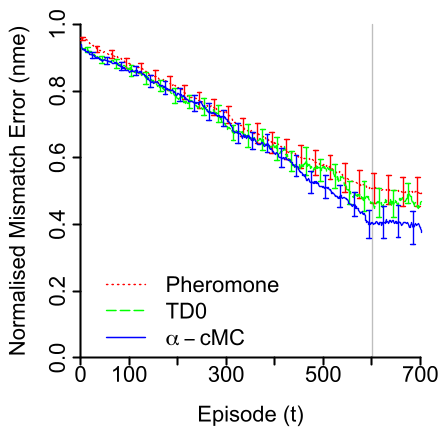 Figure 2: Mismatch error over time for a 20-agent society. Lower values indicate higher accuracy in detecting group identities.
Critical Insight: Why it Works
The brilliance of this approach lies in the Agent-Preference (AP) reward function. It doesn't just look at a single transaction; it measures altruism as a general property of the agent's behavior compared to the population average. This provides the "signal" needed to distinguish between a generally generous agent and one who is specifically generous to a friend.
Conclusion & Future Outlook
This work provides a robust template for understanding social dynamics in black-box environments. By moving from "raw interactions" to "latent cooperation values," the authors have created a way to see the invisible lines of social networks.
What's next? The authors intend to apply this to collaborative multiplayer games. Imagine an MMORPG where the game engine automatically identifies "guilds" or "cliques" of players based on their trading habits, and then tailors the narrative or difficulty based on these emergent social identities.
Limitations: The study currently operates in a controlled CAAS. In real-world scenarios, the "noise" of irrational behavior or strategic deception might require even more complex Reward Functions in the RL module.