
PPO-Powered Scheduling: Bridging the Gap Between AI and Industrial Efficiency
Development of a Reinforcement Learning System to Solve the Job Shop Problem
The paper introduces an innovative Reinforcement Learning (RL) based system architecture for solving Job Shop Scheduling Problems (JSSP). By integrating Proximal Policy Optimization (PPO) with a custom OpenAI Gym environment, the system achieves near-instantaneous scheduling solutions, significantly outperforming traditional optimization methods in inference speed.
TL;DR
Solving Job Shop Scheduling Problems (JSSP) has traditionally been a choice between high-quality "slow" solutions and low-quality "fast" heuristics. This paper presents a Deep Reinforcement Learning system using the Proximal Policy Optimization (PPO) algorithm that effectively crashes the time-to-solution barrier. By solving complex instances in seconds—tasks that usually take nearly half an hour—this architecture enables real-time response to factory floor disruptions.
Problem & Motivation: The Latency of Optimality
In modern manufacturing, scheduling isn't just a math problem; it's a race against time. The Job Shop Scheduling Problem (JSSP) is NP-hard, involving jobs across machines with strict precedence constraints.
Current SOTA methods, such as Tabu Search (TS) or Simulated Annealing (SA), are iterative. They explore a massive search space to find the absolute minimum makespan (total completion time). However, if a machine breaks down or a rush order arrives, a factory cannot wait 30 minutes for a re-optimization. There is a desperate need for "good enough" solutions delivered in real-time.
Methodology: The Intelligent Agent Architecture
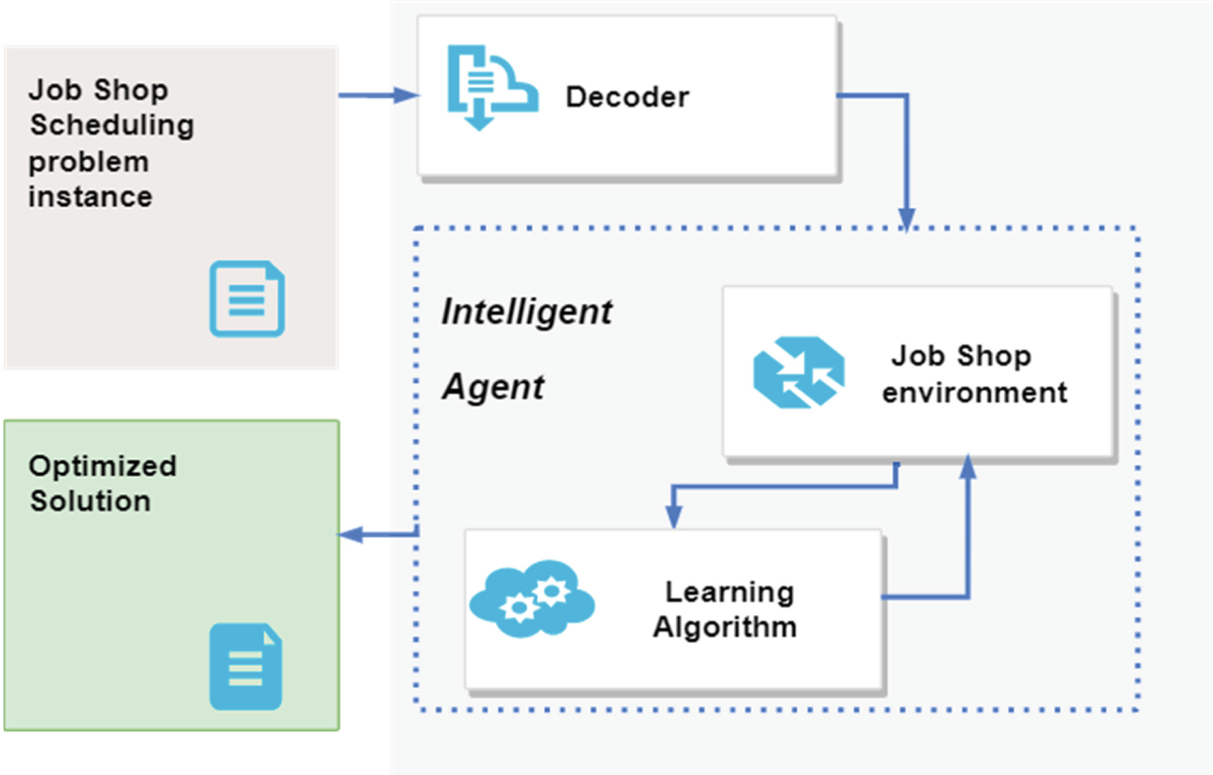
The authors developed a comprehensive system that transforms the JSSP into a Markov Decision Process (MDP). The architecture is divided into five logical blocks:
- JSSP Instance: Input via standardized Taillard (TAI) formats.
- Problem Decoder: Converts raw text into memory-efficient objects (Jobs, Operations, Machines).
- Job Shop Environment: A custom environment built on the OpenAI Gym standard, facilitating the interaction between the agent and the shop floor logic.
- Learning Algorithm (PPO): The "brain" that learns the sequencing policy.
- Optimized Solution: The final output consisting of start/end times and makespan metrics.
Why PPO?
The choice of Proximal Policy Optimization (PPO) is strategic. Unlike older RL methods, PPO offers a balance between ease of implementation, sample efficiency, and ease of tuning. By using a "clipped" objective function, it ensures that the policy updates aren't so large that they collapse the learning process, which is vital when dealing with the rigid constraints of a job shop.
Experimental Insights & Performance
The system's performance was validated using the Taillard benchmark suite. The most striking result isn't just that it works, but how fast it is.
- Speed Benchmark: For the TAI50 instance, the proposed RL system generated a plan in 5.5 seconds.
- Comparison: Traditional high-performance methods took between 900 and 1700 seconds.
 (Note: While the RL approach provides a significant speedup, the authors acknowledge a potential trade-off in makespan optimality—a common characteristic of inference-based RL solvers.)
Critical Analysis & Conclusion
Takeaway
The real value of this work is the decoupling of training and inference. While training the agent on millions of JSSP instances takes time, once trained, the agent can "see" a problem and "decide" the sequence almost instantly. This is a game-changer for Dynamic Scheduling.
Limitations & Future Work
One limitation noted is the current focus on "static" evaluation—benchmarking against academic instances. The authors plan to:
- Implement a Graphical User Interface (GUI) for non-expert planners.
- Conduct Usability Tests in real industrial settings.
- Further analyze the Efficiency-Quality tradeoff to ensure the makespan remains competitive while retaining the speed advantage.
In conclusion, as industries move toward "Industry 4.0," the integration of Reinforcement Learning into the production pipeline is no longer optional—it is the only way to maintain agility in an increasingly volatile global market.