
ReLearn: Decoding the "Why" Behind Social Connections via Multi-Modal Edge VAEs
Relation Learning on Social Networks with Multi-Modal Graph Edge Variational Autoencoders
The paper introduces ReLearn, a multi-modal graph edge variational autoencoder (VAE) designed to profile social relations as edge semantics. By integrating network proximity, user attributes, and information diffusion, it achieves state-of-the-art performance on relation learning tasks across DBLP and LinkedIn datasets.
TL;DR
While we often know who is connected on a social network, we rarely know why. ReLearn is a novel framework from UIUC and LinkedIn researchers that treats user relations as latent variables. By combining GCNs with a Gaussian Mixture Variational Autoencoder, it integrates noisy attributes, network structure, and information diffusion to profile relationships (like "colleagues" vs. "schoolmates") even with minimal labeled data.
Background: Beyond the Binary Link
In most graph neural networks (GNNs), an edge is just a 0 or 1. However, real-world social links are multi-faceted. You might be connected to someone because they are your coworker (80% probability) but also because you attended the same university (20%).
Existing methods fail because:
- Data is Noisy: User profiles are often incomplete or fake.
- Labels are Scarce: Users rarely label their friends as "colleagues" or "relatives" explicitly.
- Signals are Multi-Modal: The way you interact (diffusion) and what you say (attributes) both hint at the relation, but they are hard to fuse.
The Core Insight: Edge Semantics as a Latent Mixture
The authors propose that every edge has a latent representation that is a weighted sum of global relation prototypes.
- : A local distribution (mixture weight) indicating the strength of each relation type for that specific link.
- : Samples from global Gaussian distributions representing the "essence" of a relation (e.g., the general vector for "Schoolmate").
The ReLearn Architecture
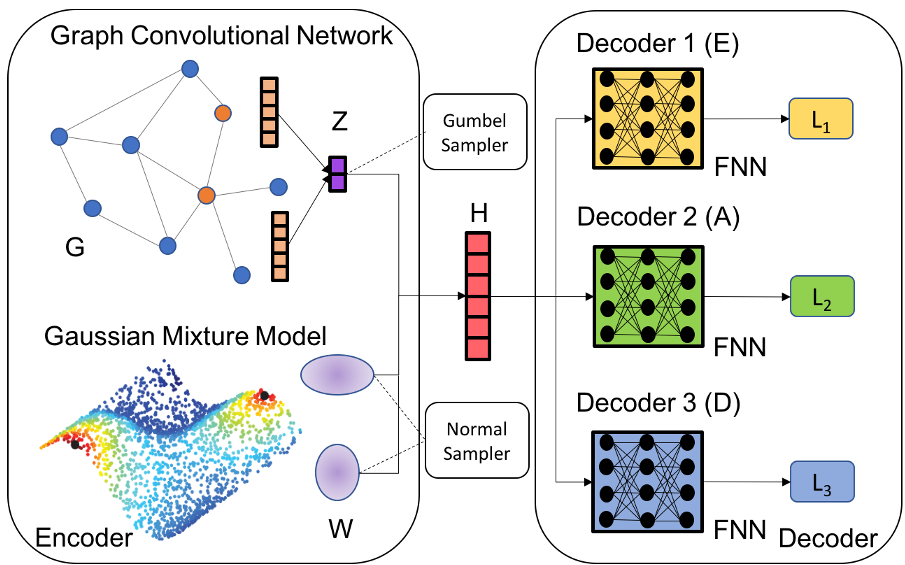
ReLearn employs a Single-Encoder, Multi-Decoder strategy.
- Encoder: A GCN processes node attributes and the graph structure to generate node embeddings, which are concatenated into edge features.
- Latent Space: The model samples from the Gaussian mixtures using the Gumbel-Softmax trick (to keep it differentiable) to determine the relation distribution.
- Decoders: Three separate "heads" try to reconstruct:
- Proximity: Is there a link at all?
- Attributes: Can we predict the users' traits from the edge?
- Diffusion: Did information flow between these users consistently with this relation?
Experimental Breakthroughs
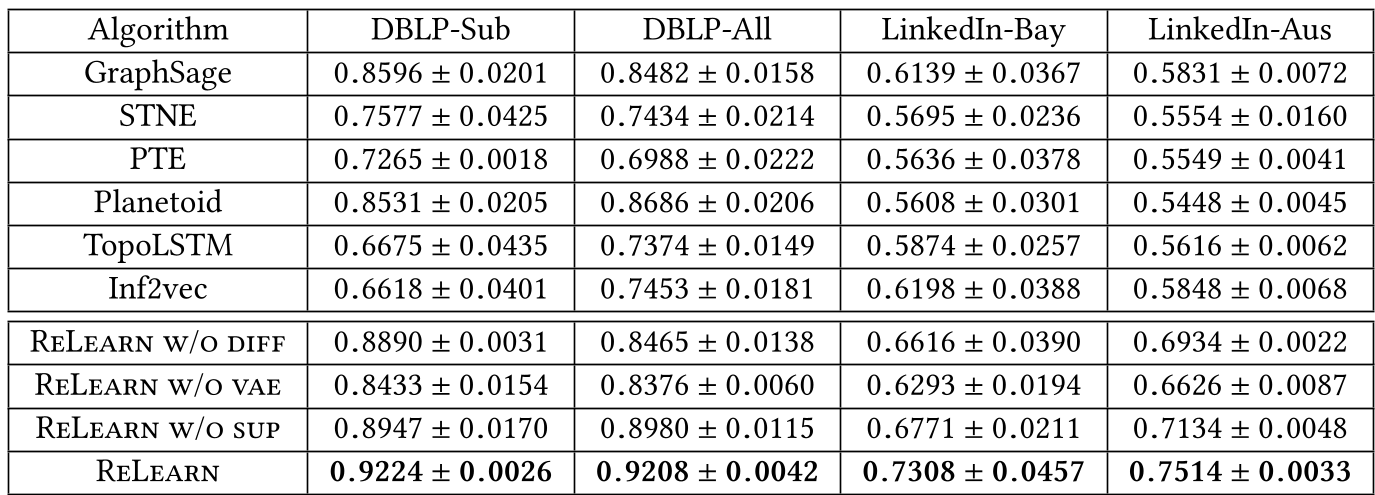
The model was tested on massive datasets, including LinkedIn member networks representing the Bay Area and Australia.
- Performance: ReLearn achieved up to 28.5% improvement over strong baselines like GraphSage and Planetoid.
- Robustness: Most GNNs suffer when links are missing. ReLearn's generative nature allows it to stay stable even when 10% of edges are removed, as the other modalities (attributes/diffusion) compensate for the structural gap.
- Interpretability: Because it's a generative model, you can "sample" from the learned relation clusters and decode them back into keywords.
Deep Insight: Why VAE?
The use of a Variational Autoencoder here isn't just for show. By modeling edges as probability distributions rather than point vectors, the model inherently accounts for uncertainty. In noisy social environments, "Schoolmate" isn't a fixed coordinate; it’s a region in space. The VAE's KL-divergence term acts as a powerful regularizer that prevents the model from overfitting to the noise of a single user's profile.
Critical Analysis & Future Outlook
Strengths:
- Modularity: You can add a new decoder (e.g., for image data or geolocation) without changing the core encoder.
- Scalability: By using neighborhood sampling, it handles millions of nodes.
Limitations:
- The number of relations must be predefined. In a truly open-world social network, might be unknown or evolving.
- It assumes undirected links; however, social media "Following" is inherently directed.
Conclusion: ReLearn shifts the focus of Graph Learning from "who is connected" to the "semantics of intimacy." For product teams, this means better friend recommendations (recommending a "Colleague" for work-related networking) and more precise content routing.