
RBMA: Boosting Sentiment Analysis by Linking the Dots in Social Networks
Relational Bayesian Model Averaging for Sentiment Analysis in Social Networks
The paper introduces Relational Bayesian Model Averaging (RBMA), a novel ensemble learning framework for Sentiment Analysis in social networks. By integrating Relational Classifiers with Bayesian Model Averaging, the method achieves significant performance gains, notably reaching an F1-score of 0.903 on the Barack Obama Twitter benchmark.
TL;DR
Social media data is rarely independent. Between retweets, mentions, and replies, there is a rich web of relationships that standard AI often ignores. Relational Bayesian Model Averaging (RBMA) bridges this gap by combining ensemble learning with relational classification. It doesn't just look at what you said—it looks at who you are talking to, resulting in a staggering 50% performance improvement over traditional methods.
Background: The "Independence" Fallacy
Most sentiment analysis tools treat every tweet as an isolated island. In academic terms, they assume data is IID (Independent and Identically Distributed). But in a social network, if your friends are all cheering for a specific candidate, there is a high "homophily" (tendency to associate with similar others) that suggests your sentiment might be similar.
The authors argue that by ignoring these links, we are throwing away half the evidence. They propose a model that filters both data uncertainty (noise in the text) and model uncertainty (errors in the classifier) by treating the network as a graph .
Methodology: Bayesian Logic Meets Graph Theory
The core of RBMA is a two-step synergy:
- Bayesian Model Averaging (BMA): Instead of picking one "best" classifier, RBMA uses an ensemble (Naive Bayes, Logistic Regression, J48). Each classifier's vote is weighted by its Model Likelihood (), which is estimated using a k-fold cross-validation F1-measure.
- Relational Integration: Unlike standard BMA, the base learners here are Relational Classifiers. They use the features of neighboring nodes in the graph to refine the prediction of the target node.
Handling the Dynamic Graph
One of the most elegant contributions of this paper is how it handles Dynamic Data. Social networks aren't static; new users join and new comments appear every second. Typical models require expensive retraining to incorporate new nodes.
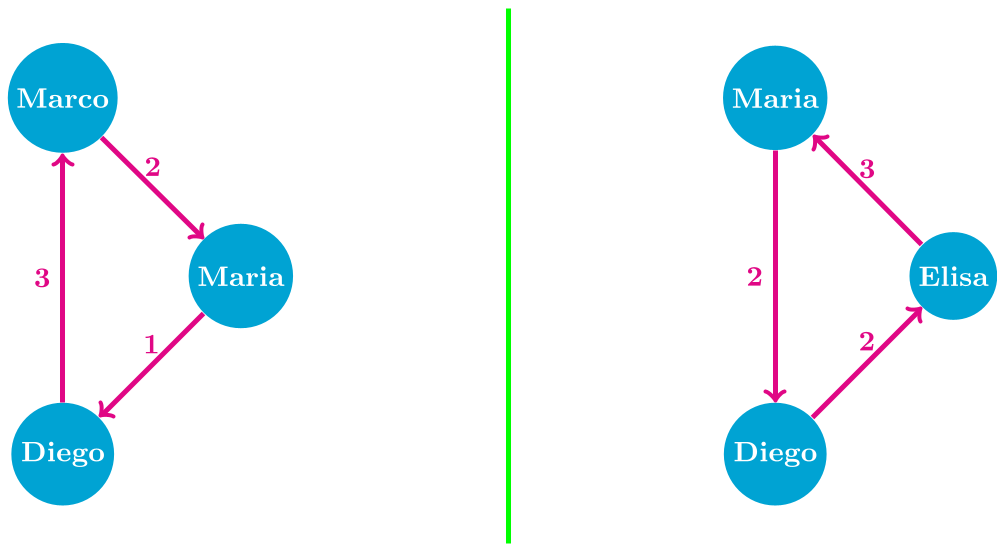
The authors introduce Dummy Edges. When a new user (Elisa) interacts with an existing user (Maria), the system creates a link that allows the sentiment to "flow" from the known training set to the unknown test set without re-running the entire training phase.
Experiments: The Power of Relations
The team tested RBMA on a benchmark dataset concerning Barack Obama. The results were definitive.
Performance Breakthrough
The transition from a standard classifier to a relational ensemble (RBMA) provided a massive boost:
- F1-Measure: Rose from ~0.60 to 0.903.
- Improvement: Up to 106% in Recall for certain base classifiers.
| Classifier | Non-Relational F1 | Relational F1 | % Improvement |
|---|---|---|---|
| Naive Bayes | 0.552 | 0.867 | 57.0% |
| BMA / RBMA | 0.600 | 0.903 | 50.5% |
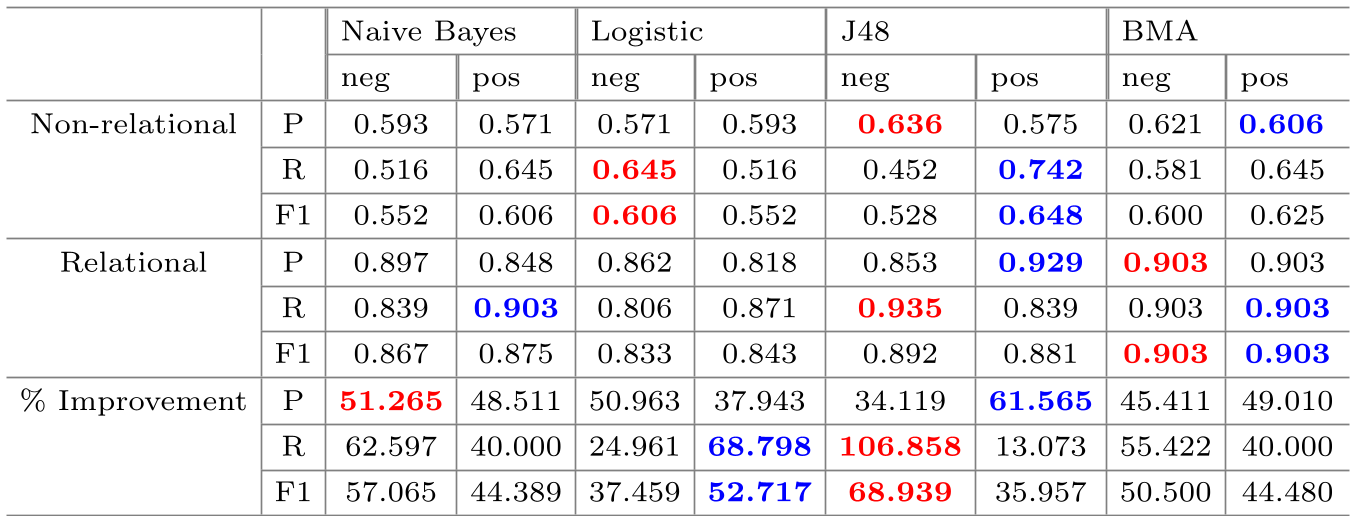
The table shows that while BMA is a strong baseline, the addition of Relational logic acts as a multiplier, pushing the accuracy into a league that non-relational models simply cannot reach.
Critical Insight & Conclusion
The success of RBMA isn't just about "better math"; it's about better inductive bias. By designing the model to expect connections, the authors aligned the algorithm with the reality of human interaction.
Takeaway for Practitioners: If your data comes from a social source, stop treating it as a flat spreadsheet. Even a simple relational wrapper around your existing classifiers—weighted by Bayesian probability—can yield performance gains that hyperparameter tuning alone will never achieve.
Future Outlook: The next step for this research is scaling. The current complexity is manageable for small benchmarks, but applying this to millions of nodes will require more efficient sparse-matrix techniques or Graph Neural Network (GNN) approximations.