
Relationship Algebra: Turning Social Connections into Computable Logic
Relationship Algebra for Computing in Social Networks and Social Network Based Applications
This paper introduces "Relationship Algebra," a formal mathematical framework designed to represent and reason with complex social relationships in digital communities. By treating social networks as matrices of entities and relationship strengths, the authors provide a programmable approach to infer hidden connections and perform automated reasoning for applications like reviewer selection and virus immunization.
TL;DR
As digital social networks like LinkedIn and MySpace (at the time of writing) started capturing massive amounts of human interaction data, a critical question emerged: how do we programmatically reason about these links? This paper proposes Relationship Algebra, a matrix-based mathematical framework that allows developers to calculate hidden relationships—like identifying clinical trial reviewers without conflicts of interest or predicting the spread of a virus—using formal algebraic operators.
Problem & Motivation
Most social network tools only look at the "surface" (who are your immediate friends?). However, the real value lies in the derived relationships. For example:
- If A is a friend of B, and B is a coworker of C, what is the relationship between A and C?
- How do we systematically exclude people with "Conflicts of Interest" from a massive dataset?
The authors argue that we need more than just a graph; we need a formal algebra that treats social links as variables in an equation. Without this, computing complex social logic remains an ad-hoc, error-prone task.
Methodology: The Core of Relationship Algebra
The methodology treats entities (Authors, Papers, Individuals) as members of sets. Relationships are represented as Relationship Matrices (), where the value represents the strength of the bond between entity and entity .
Key Algebraic Operators
The paper defines several critical operations that go beyond standard matrix math:
- Synthesis (): Uses matrix multiplication to find "friends of friends" or indirect connections.
- Quantization (): A filtering step where links below a certain strength threshold () are discarded, turning a fuzzy network into a crisp binary one.
- Exclusion (): Vital for privacy or conflict-of-interest checks, where you remove specific known relationship sets from a larger pool.
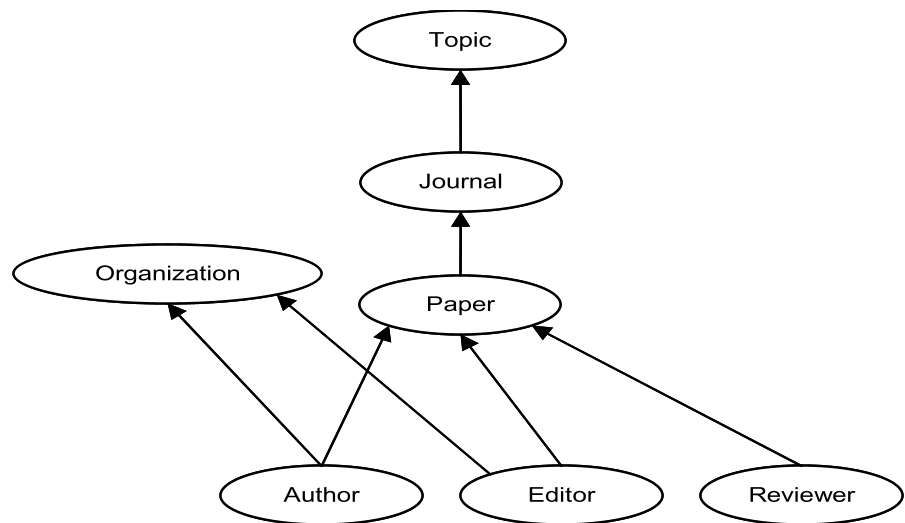 Figure 1: The schema defining how different entities like Authors, Journals, and Topics interact.
Application 1: Automated Reviewer Selection
Finding a reviewer for a paper isn't just about expertise; it's about avoiding bias. The authors demonstrate that the "Reviewer Set" can be calculated by a single complex algebraic expression:
By identifying "co-author" and "co-worker" matrices through synthesis (multiplying the Author-Paper matrix by its transpose), the system can automatically subtract these individuals from the available pool, leaving only qualified, unbiased candidates.
Application 2: Virus Immunization Logic
In a social epidemic scenario, the algebra determines who needs a vaccine.
- Direct Contact: 1-hop neighbors (Spouse, Family).
- Probabilistic Contact: Using the Quantization operator, the system identifies neighbors-of-neighbors where the "relationship strength" exceeds 0.6.
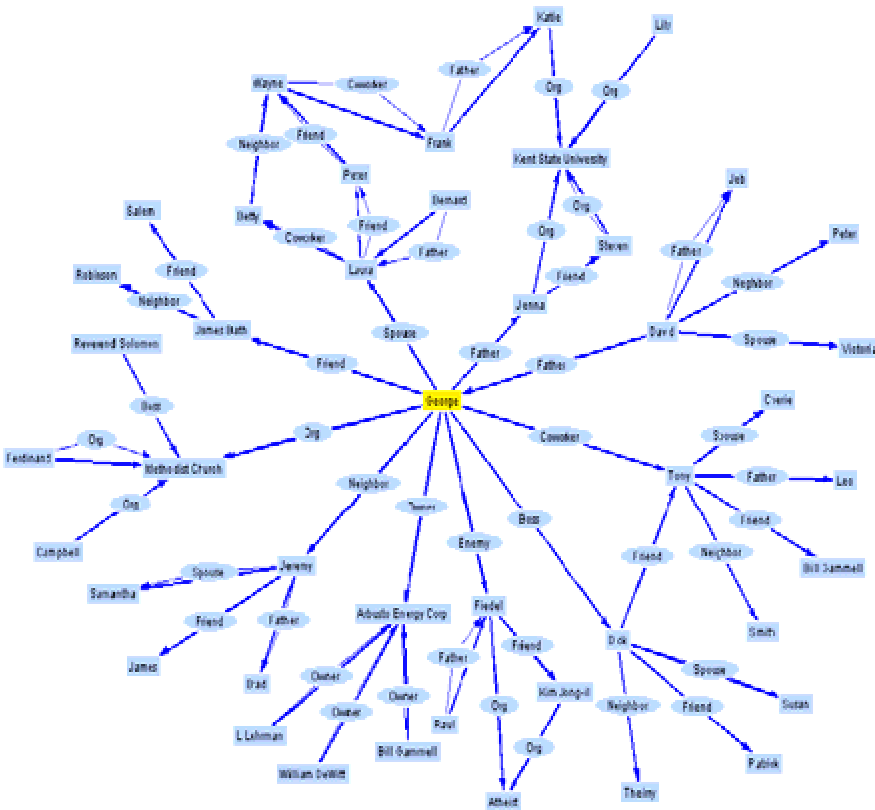 Figure 2: An instance graph showing the heterogeneous links (Spouse, Friend, Coworker) used to compute immunization sets.
Experimental Insight
The paper utilizes "Instance Graphs" to prove that logical constraints—which are usually written in natural language—can be mapped perfectly to matrix operations. The result is a system that can handle "Conflict of Interest" definitions mathematically: a conflict exists if there are two distinct relationship trails between and that share common nodes.
Critical Analysis & Conclusion
Takeaway
This work was a precursor to the modern "Knowledge Graph" movement. It shifts social networks from "collections of profiles" to "computable logic engines." By formalizing these relationships, we can automate trust propagation and risk assessment.
Limitations
- Computational Complexity: Large-scale matrix multiplication for millions of nodes ( in basic form) was a major bottleneck not fully addressed.
- Dynamic Nature: Social networks change every second; the algebra assumes a static snapshot for its calculations.
- Data Quality: The relationship "strength" index is highly subjective. How do we objectively quantify a "0.6 strength" friendship?
Future Outlook
The authors correctly predicted that such algebra would lead to significant privacy implications. Today, this logic is used by social media algorithms to suggest people you may know, and by financial institutions to detect fraud through "circular" relationship patterns.