
RIEA: Decoding Human Relationships Through the Lens of AI Emotion Analysis
Relationship Identification Between Conversational Agents Using Emotion Analysis
The paper introduces RIEA (Relationship Identification using Emotion Analysis), a novel framework that classifies interpersonal relationships between conversational agents by mapping textual emotion intensities to psychological models. Leveraging a large corpus of movie dialogues and supervised learning, it achieves a SOTA accuracy of 85% in identifying complex relationship combinations.
TL;DR
Researchers have developed RIEA, a cross-disciplinary framework that uses Natural Language Processing (NLP) and cognitive psychology to identify relationships between conversational agents. By analyzing the intensity of emotions like joy, sadness, and fear in text, the model can categorize relationships into styles such as "Family-Secure" or "Unpleasant-Dismissing" with 85% accuracy.
Integrating Psychology into the Machine
The fundamental limitation of current AI assistants is their "emotional vacuum." While they can answer questions, they fail to perceive the underlying social fabric of a conversation. Most prior work treated sentiment as a binary (positive/negative), which is insufficient for characterizing a relationship.
The authors of RIEA argue that to truly "humanize" agents, we must look at:
- Association Styles: The type of bond (Close: Family/Friend vs. Distant: Pleasant/Unpleasant).
- Attachment Styles: The psychological level of anxiety and avoidance (Secure, Preoccupied, Dismissing, Fearful).
Methodology: From Words to Bonds
The RIEA workflow bridges the gap between raw text and abstract social structures.
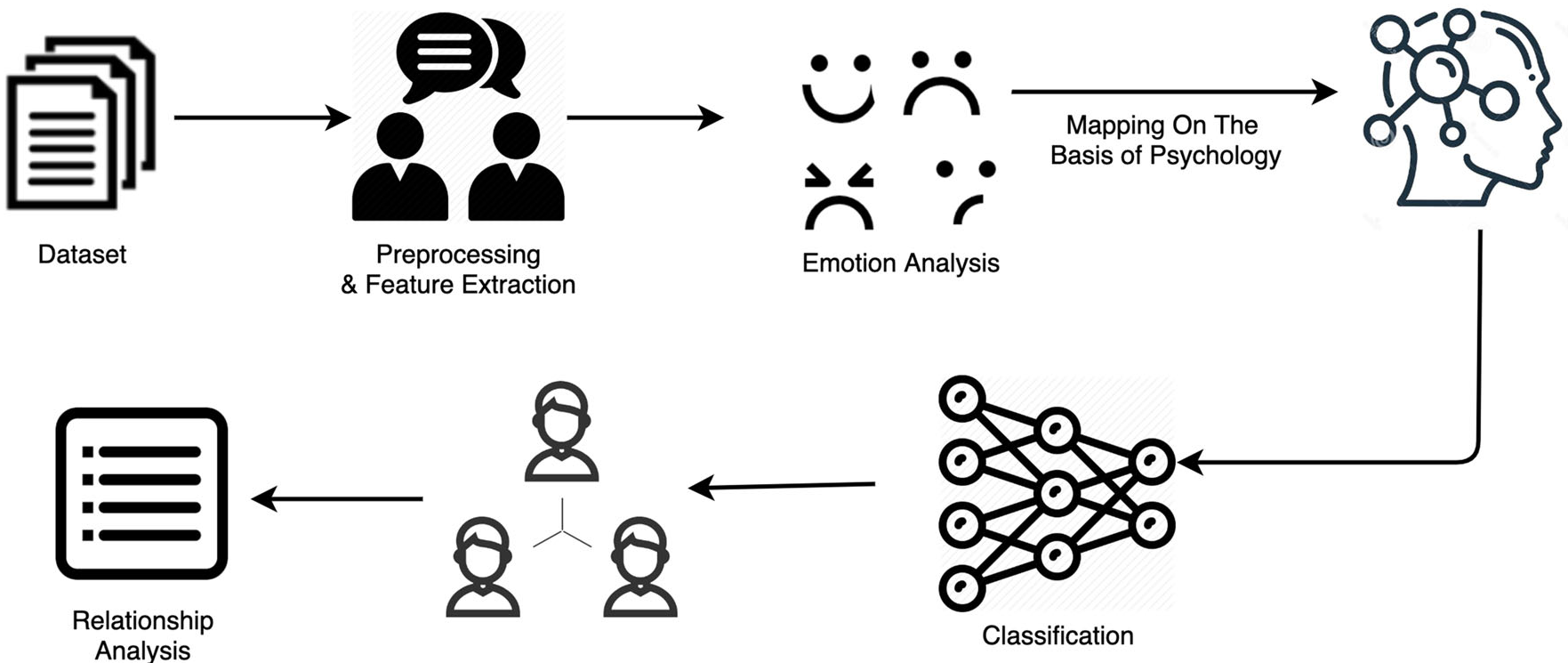 Figure 1: The RIEA system architecture, from pre-processing movie dialogues to relationship classification.
The Core Engine
- Emotion Extraction: Instead of just detecting a "sad" word, RIEA uses the NRC-EIL Lexicon to assign a real-valued intensity score [0, 1].
- Feature Mapping: These intensities are aggregated across dialogue turns.
- Classification: The system uses a Neural Network to map these emotional fingerprints to 16 possible relationship combinations (4 associations × 4 attachments).
Experimental Breakthroughs
The researchers tested RIEA on the famous Cornell Movie Dialogues Corpus. The results were telling: human relationships are too complex to be defined by a single metric.
| Feature Set | Classifier | Accuracy |
|---|---|---|
| Attachment Style Only | Neural Network | 78% |
| Association Class Only | Neural Network | 52% |
| Combined (RIEA) | Neural Network | 85% |
This demonstrates that association and attachment are synergistic; you cannot accurately predict one without the context of the other.
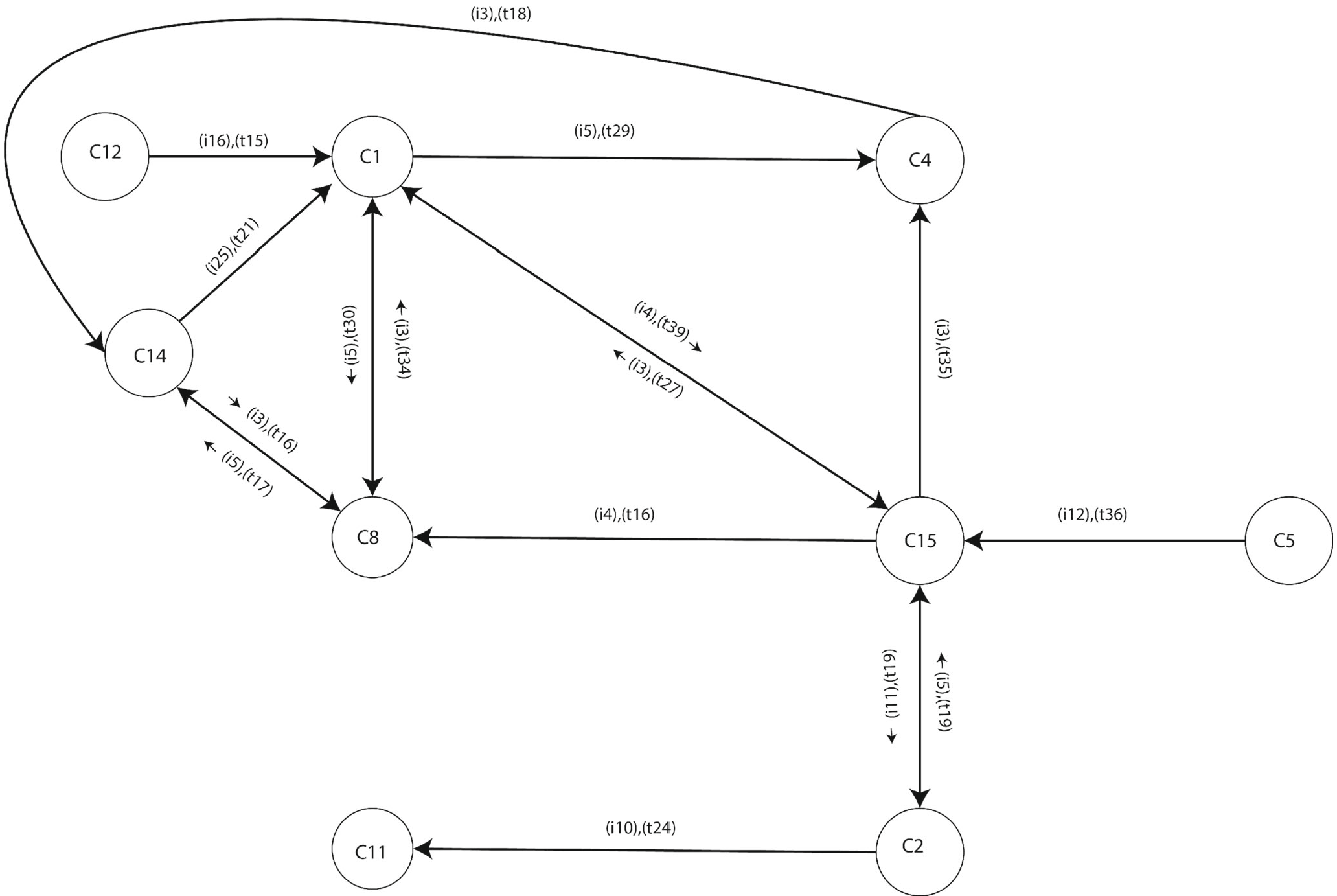 Figure 2: A directional graph illustrating how relationships evolve. For instance, "Family-Secure" frequently transforms into "Unpleasant-Dismissing" following specific emotional decay.
Deep Insight: The Anatomy of Change
One of the most fascinating aspects of this research is the Relationship Transformation Analysis. The study found that:
- The "Stranger to Friend" Threshold: It takes an average of 25 interactions for agents to establish a "familiar" association.
- Emotional Volatility: Negative transformations (moving toward "Dismissing" or "Fearful" states) are often preceded by specific spikes in "Anger" and "Fear" intensities.
Critical Analysis & Conclusion
RIEA moves beyond "what was said" to "what it means for the bond."
Value: This has massive implications for customer service bots, social simulations, and even mental health monitoring tools.
Limitations: The model currently relies on a discrete set of four emotions. Expanding this to include "nuance" emotions like contempt or empathy could further refine the 85% accuracy. Furthermore, manual annotation by students, while rigorous, introduces human bias that could be mitigated with more diverse labeling sets.
The Future: Imagine a chatbot that realizes your relationship has shifted from "Pleasant-Secure" to "Unpleasant-Fearful" based on your tone and adjusts its dialogue strategy to de-escalate. RIEA brings us one step closer to that reality.