
Beyond Data Lock-in: A Systematic Approach to Social Relationship Migration
A Study on Relationship Migration among Social Networking Providers
This paper introduces a Relationship-Migration tool designed to transfer user profiles and social connections between different social networking providers. By utilizing a combination of web crawling, XML-RPC protocols, and CSV-based contact matching, the authors demonstrate a successful migration path from RenRen to a testbed server, myElgg, achieving a friendship recovery rate of up to 40.68%.
TL;DR
In the wake of platform-level conflicts (like the infamous Tencent vs. 360 dispute), users often find themselves held hostage by their own data. This paper presents a specialized Relationship-Migration tool that extracts hierarchical data (blogs, photos) and social graphs from platforms like RenRen and reconstructs them in new environments using XML-RPC and recommendation-driven recovery.
The "Walled Garden" Problem
The motivation for this research is deeply rooted in digital sovereignty. When service providers conflict, users face a zero-sum choice: lose their digital history or stay trapped in a platform they no longer trust.
The technical challenge is twofold:
- Data Complexity: Traditional CSV exports handle email contacts but fail at preserving the hierarchical nature of blog posts, comments, and photo albums.
- Relationship Entropy: Simply moving data isn't enough; a social network is dead without the social graph. Re-establishing hundreds of connections manually is a primary barrier to user migration.
Methodology: The Migration Pipeline
The authors propose a modular architecture to handle the "harvesting, storing, and recovering" cycle.
1. Hybrid Data Harvesting
Since many platforms restrict their APIs (e.g., RenRen's API limits contact field access), the authors developed a C# Web Crawler. To handle anti-crawling mechanisms like IP banning or CAPTCHAs, the tool mimics browser behavior and implements "sleeping times."
2. Hierarchical Storage (XML vs. CSV)
The system makes a tactical choice in data formats:
- XML: Used for blogs and status updates because it preserves nested structures (Title -> Content -> Comments).
- CSV: Reserved for contact lists to maintain compatibility with legacy email service providers for the "invite" phase.
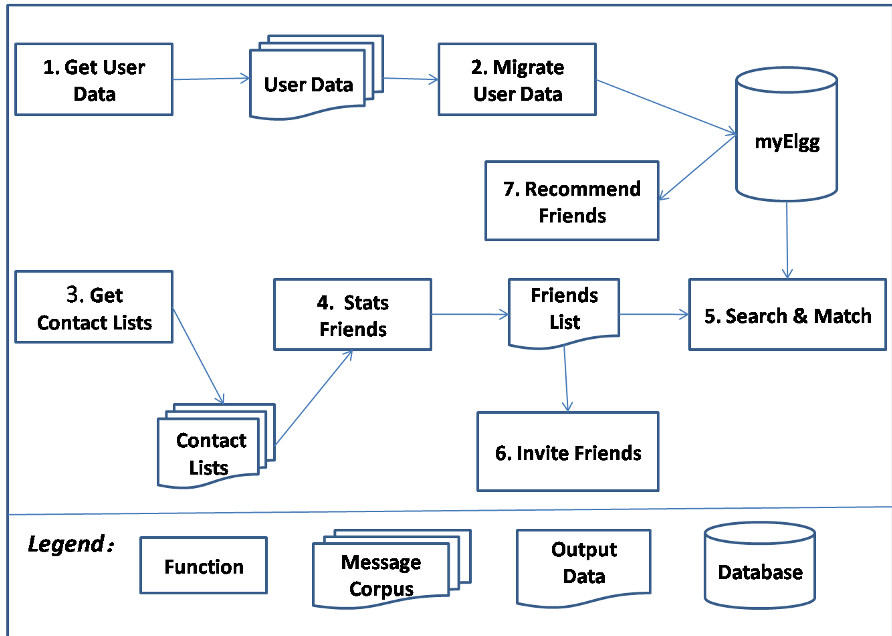 Fig 1. The Relationship-Migration Framework showing the flow from original SNS to target site.
3. Friendship Recovery via XML-RPC
To inject data into the target provider (myElgg), the tool uses XML-RPC. The most innovative part is the relationship establishment, which doesn't just rely on manual searching but uses:
- Identity Matching: Automated lookup of unique email addresses.
- Recommendation Widgets: Using the "Friends-of-Friends" logic to suggest connections that might have been lost during the transition.
Experimental Results
The authors tested the tool with real users from the RenRen network. The results prove that while crawling is the most time-consuming phase (taking ~5-15 minutes depending on photo volume), the actual migration to the new server happens in under 2 minutes.
 Table 1. Relationship recovery success rates across five test partners.
The success rate () peaked at 40.68%. While this indicates that not all friends can be recovered (often because they haven't moved to the new platform yet), it represents a massive leap over manual account rebuilding.
Critical Insight: The Future of Data Liberation
This paper serves as an early blueprint for what we now discuss as Interoperability. While the 2011-era technology relied on C# scrapers and XML, the underlying philosophy remains the same: user data should be portable.
Limitations:
- The system is still vulnerable to aggressive anti-crawling measures.
- The "success rate" is heavily dependent on the "network effect"—if your friends don't migrate, the graph remains broken.
Future Outlook: With the rise of the fediverse (e.g., Mastodon) and protocol-based social media (e.g., AT Protocol/Nostr), the "Migration Tool" of the future might not need to crawl at all—it will simply point to a decentralized data vault.
Conclusion
The study successfully demonstrates that technical barriers to social migration can be lowered through automated harvesting and recommendation-assisted relationship recovery. It moves the conversation from "Can we move the data?" to "How quickly can we rebuild the community?"