
Engineering the Crowd: A Systematic Methodology for IR Relevance Assessments
Design and Implementation of Relevance Assessments Using Crowdsourcing
The paper introduces a structured methodology for conducting IR relevance assessments via Amazon Mechanical Turk (AMT). It demonstrates that non-expert crowdsourced workers can achieve quality comparable to TREC experts for binary relevance tasks when experiments are designed with rigorous interface guidelines and quality controls.
TL;DR
Relevance assessment is the backbone of Search Engine evaluation, but it is traditionally expensive and glacial. This paper provides a blueprint for using crowdsourcing (specifically Amazon Mechanical Turk) to match TREC-expert quality at a fraction of the cost. The secret sauce? It’s not higher pay—it’s UI design, worker filtering, and granular task scheduling.
The "Cheap Labor" Trap
The central motivation of Alonso and Baeza-Yates is to move beyond the "ad-hoc" nature of early crowdsourcing. Prior work often assumed that if you pay people, they will provide quality data. However, the authors argue that without a rigorous methodology, crowdsourcing results in noise. They identify a critical gap: we know crowdsourcing is fast, but we didn't have a standardized process to make it reliable for academic IR standards.
Methodology: The Three-Parameter Model
The authors define a methodology based on three variables:
- P (People): How many workers per task? (They suggest 5 for a stable majority).
- T (Topics): The breadth of the query set.
- D (Documents): The depth of the judgment per query.
1. Interface Matters (The Cognitive Load)
One of the most insightful parts of the study is the transition from "Expert Instructions" to "Plain English." TREC instructions are often four pages of technical jargon. The authors simplified these into web forms that emphasize intuition over technicality.
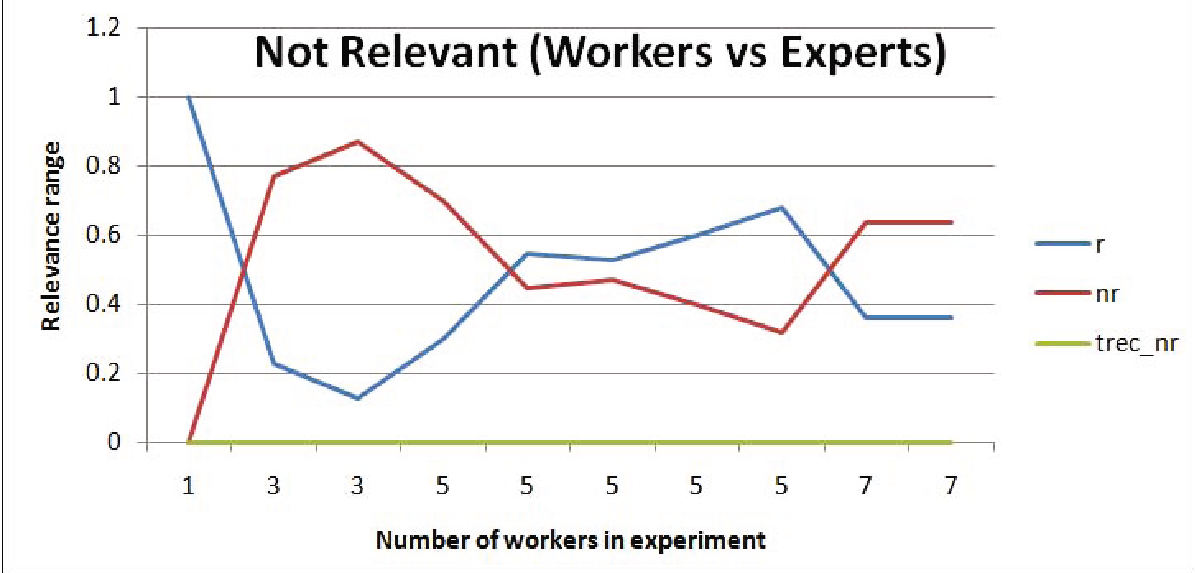 The figure shows that highlighting query terms (yellow background) leads to higher and more consistent relevance votes, suggesting that UI assistance reduces worker fatigue and improves focus.
2. The Multi-Stage Filtering
To fight "spammers" and "bots," the authors implemented:
- Qualification Tests: 10 questions to ensure the worker understands the topic.
- Honey Pots: Interleaving documents with known relevance to catch random clickers.
- Approval Rates: Leveraging AMT’s built-in reputation system.
Experimental Insights
The authors ran 7 iterations (E1-E7) with a fixed $100 budget.
Worker Distribution
They observed a "Double Power Law" in worker participation. A small group of "super-workers" completes the majority of tasks. This implies a need to manage "worker fatigue" by splitting large experiments into smaller batches.
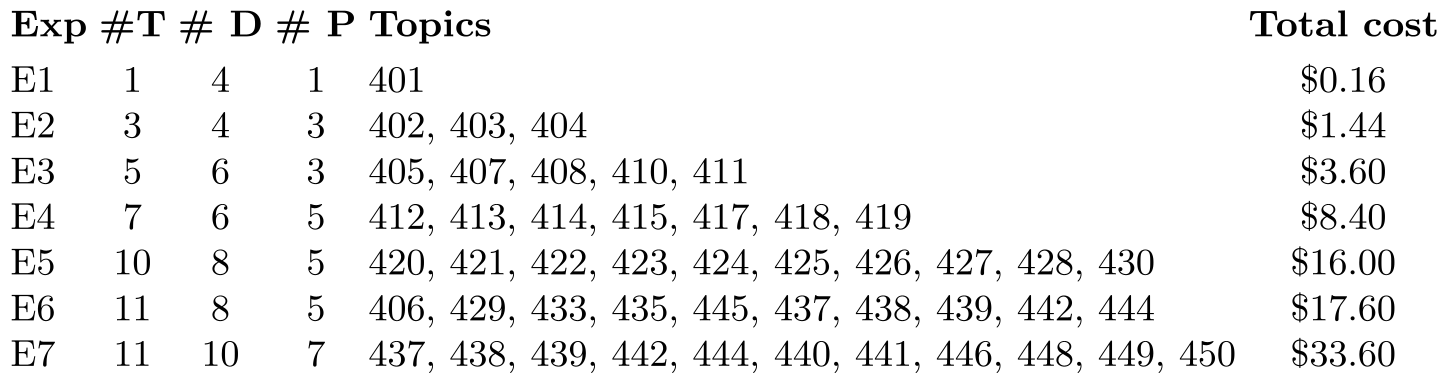 The incremental approach allowed the authors to tune parameters and observe how agreement levels (Kappa) fluctuated with topic difficulty.
The Feedback Loop
An ingenious discovery was made regarding worker comments. When comments were mandatory, quality dropped as workers typed gibberish just to submit. By making comments optional but incentivized with a $0.01 bonus, the median comment length skyrocketed by 30x, providing rich qualitative data on why a document was relevant.
Deep Insight & Conclusion
The fundamental takeaway is that human factors trump financial incentives. Increasing pay increases the speed of completion but doesn't fix quality. Quality is a function of the user interface and the clarity of the task.
Limitations: The study focuses on binary relevance (Yes/No). In modern IR, graded relevance (e.g., "Highly Relevant" vs "Partially Relevant") is standard, which introduces higher variance and requires more complex agreement metrics than the simple majority vote used here.
Future Outlook: As we move toward using LLMs (like GPT-4) as "silver standard" evaluators, the principles of this paper—instruction clarity and systematic filtering—remain highly relevant for validating AI-generated labels against human ground truth.