
Beyond Majority Voting: High-Precision Vector Aggregation for Crowdsourcing
Reliable Aggregation Method for Vector Regression Tasks in Crowdsourcing
The paper introduces a novel iterative message-passing algorithm specifically designed for vector regression tasks in crowdsourcing, such as object localization and pose estimation. It reliably aggregates high-dimensional real-valued responses by simultaneously estimating task ground truths and worker reliability through an alternating update mechanism.
TL;DR
As AI training data moves from simple labels to complex annotations like object bounding boxes and human skeletons, traditional aggregation methods like Majority Voting fail to handle the noise of low-paid human workers. This paper proposes a message-passing algorithm that iteratively estimates worker reliability and task truth for vector regression, achieving state-of-the-art performance with faster convergence and lower error bounds than previous EM-based approaches.
Background: The Limits of Discrete Labels
Crowdsourcing platforms like Amazon Mechanical Turk have long relied on "Wisdom of the Crowds." However, when a task requires a worker to draw a bounding box (a 4D vector) rather than pick a category, the definition of "consensus" becomes blurry. Standard Majority Voting (MV) treats all workers as equal, meaning a single "spammer" providing random coordinates can drastically pull the mean away from the truth.
The Core Insight: Iterative Geometry-Based Weighting
The authors argue that a worker’s expertise is inversely proportional to the geometric distance between their response and the collective estimate. Instead of using a heavy Probabilistic Graphical Model (which often breaks with sparse data), they propose a bipartite graph approach where information flows between Task Nodes and Worker Nodes.
1. The Task Message (Finding the Center)
The task message represents the current best estimate of the ground truth for task , excluding the contribution of worker to maintain unbiasedness. It is a weighted average where the weights are determined by the estimated reliability of the workers.
2. The Worker Message (Measuring Trust)
The worker message captures a worker's reliability. It is calculated as the reciprocal of the distance between the worker's response and the task consensus: If a worker is consistently "close" to the group average across multiple tasks, their weight increases in the next iteration.
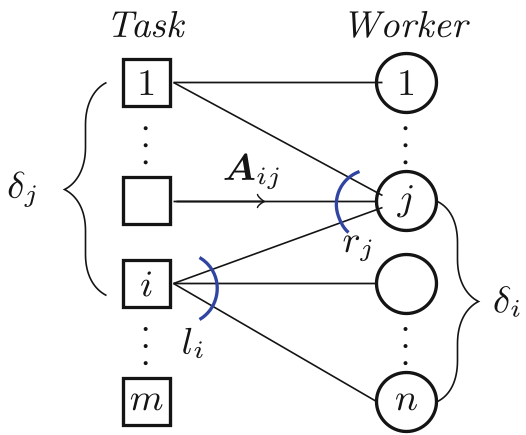 Fig 1: Bipartite graph model showing the task-worker assignment logic.
Experiments: Superiority in the Real World
The researchers tested their algorithm against top-tier competitors like the DALE model and Welinder’s EM.
- Object Localization (MSCOCO): Drawing bounding boxes. The algorithm achieved an IoU (Intersection over Union) of 0.934, compared to the 0.896 of Majority Voting.
- Human Pose Estimation (LSPET): Marking 14 joints. The algorithm proved robust even for angular data and complex skeleton structures.
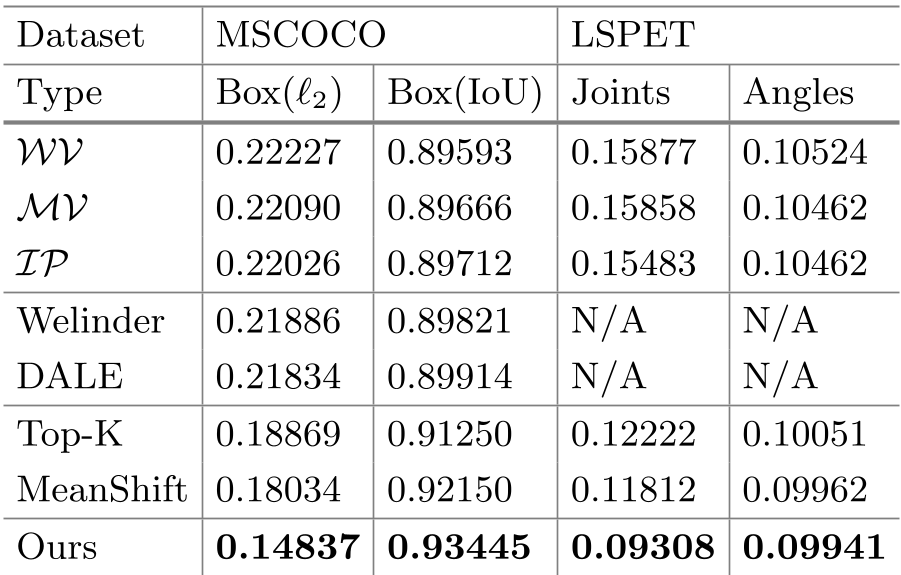 Table 1: Quantitative comparison showing that the proposed method "Ours" consistently yields the lowest error (L2) and highest overlap (IoU).
Theoretical Guarantees: Reaching the "Oracle"
One of the paper's strongest contributions is the proof of an Error Bound. The authors demonstrate that as the number of tasks and worker quality increase, the algorithm's performance approaches that of an Oracle Estimator—one that knows exactly how reliable every worker is beforehand. This gives practitioners confidence that the iterative process isn't just a heuristic, but mathematically sound.
Critical Analysis & Future Outlook
Strengths:
- Efficiency: Unlike EM models that may require hundreds of iterations or massive memory to store confusion matrices, this method converges in fewer than 20 iterations.
- Flexibility: The similarity measure can be generalized to any norm (L1, Linf) depending on the task's spatial properties.
Limitations:
- Sparse Regularity: The performance relies on workers solving multiple tasks (). If each worker only solves one task, the reliability estimate cannot be refined.
- Cold Start: While the authors show robustness to initialization, the "first guess" still impacts early-stage convergence speed.
In conclusion, this work provides a vital bridge between theoretical message-passing and the practical needs of modern AI data labeling. As we move toward 3D computer vision and fine-grained robotic control data, reliable vector aggregation will be the cornerstone of high-quality training sets.