
Reliable Multiple-choice Iterative Algorithm: Moving Beyond Binary Decisions in Crowdsourcing
Reliable Multiple-choice Iterative Algorithm for Crowdsourcing Systems
The paper introduces a "Reliable Multiple-choice Iterative Algorithm" for aggregating noisy responses in crowdsourcing. It extends binary-choice message-passing techniques to multi-class scenarios and short-answer questions, achieving order-optimal results that outperform EM-based methods and majority voting.
TL;DR
Crowdsourcing systems like Amazon Mechanical Turk often suffer from "noisy" data due to unmotivated or low-skilled workers. This paper proposes a robust iterative algorithm designed specifically for multiple-choice and short-answer questions. By using a message-passing approach on bipartite graphs, it simultaneously estimates task truth and worker reliability, proving that accuracy can improve exponentially with increased task redundancy.
Problem & Motivation: The Multi-Class Bottleneck
In crowdsourcing, the simplest way to find the truth is "Majority Voting." However, this assumes all workers are equally reliable—a dangerous assumption when dealing with spammers or novices.
More advanced methods like Expectation-Maximization (EM) are popular but face significant scaling issues and sensitivity to initial parameters. Early breakthroughs by Karger et al. introduced iterative algorithms that were mathematically "order-optimal," but they were strictly limited to binary choices (Yes/No). Previous attempts to adapt these to multi-class problems involved splitting one question into many binary ones, which is budget-expensive and unnatural for human workers.
Methodology: The Core Mechanism
The authors represent the crowdsourcing system as a bipartite graph where tasks and workers are nodes. The edges represent assignments.
1. The Message-Passing Intuition
The algorithm revolves around two alternating messages:
- Task to Worker (): The task "tells" the worker what the current collective belief is regarding the correct answer, excluding that specific worker's input.
- Worker to Task (): The worker "tells" the task how reliable they are, calculated by how well their past answers align with the current group consensus.
2. Physical Intuition of the Update Rule
The update rule uses an inner product in a vector space to measure similarity. If a worker's response vector aligns with the weighted sum of other workers (), their reliability score () increases. If they consistently pick "distractors" (wrong answers), their score stays low or becomes negative (indicating potential malicious intent).
 The worker reliability update formula using the inner product between the worker's response and the task's likelihood vector.
Experiments & Results: The Exponential Edge
The authors validated their method against EM and Majority Voting across various dimensions of (number of choices).
- Phase Transition (): The algorithm exhibits a "critical point." Once the density of tasks or the quality of workers passes a certain threshold (), the error rate collapses toward zero exponentially.
- Superiority over EM: Unlike EM, which can get stuck in local optima, this iterative algorithm is robust and faster, particularly as the number of choices increases.
- Short-Answer Flexibility: By treating characters in a short answer (like a zip code) as individual micro-tasks, the algorithm successfully handles open-ended text entry.
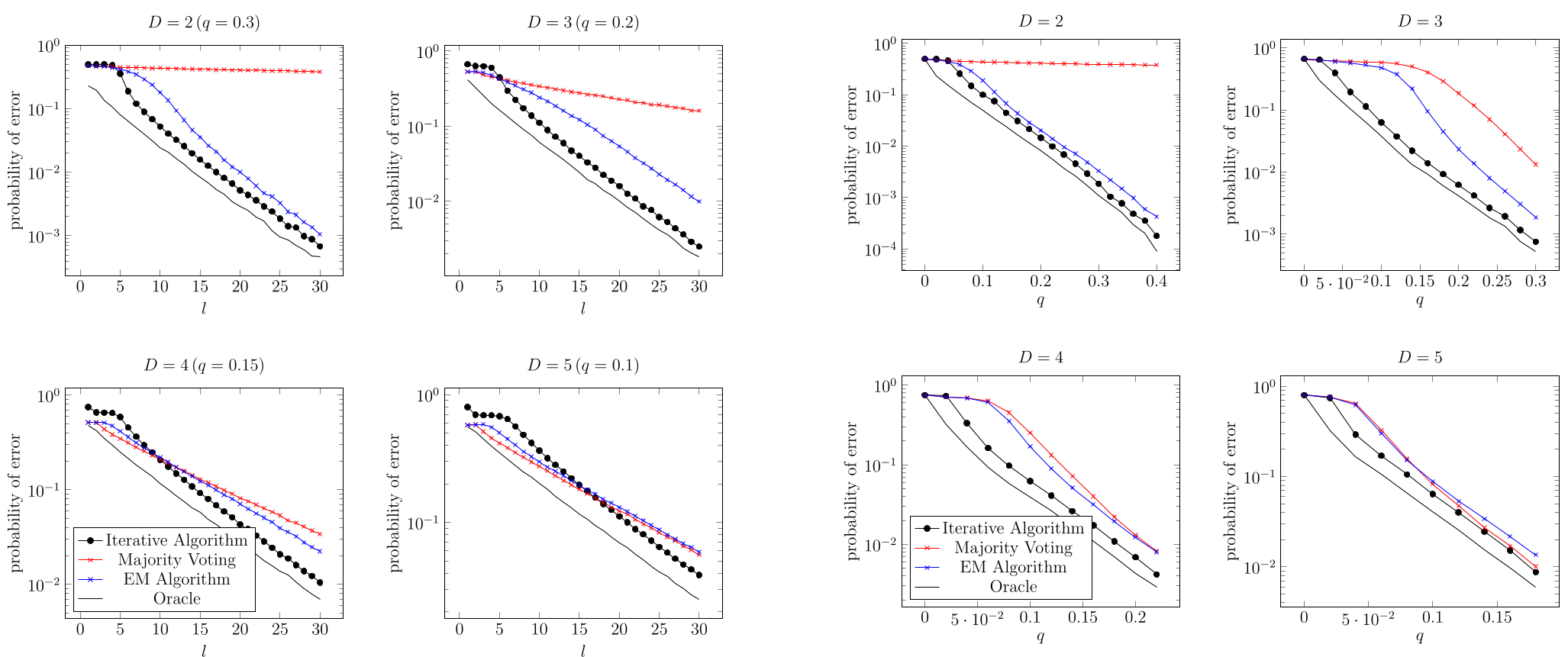 Experimental results showing the error rate decreasing as tasks per task (l) increase. Note how the iterative algorithm (red/blue) drops significantly faster than majority voting (green).
Adaptive Strategy: The Expert Finder
An exciting application discussed is Adaptive Task Allocation. Instead of giving every worker the same number of tasks, the system uses a "pilot phase" to identify highly reliable workers (high ) and then channels the remaining budget to these "experts." This maximizes accuracy while respecting a fixed budget.
Critical Analysis & Conclusion
Takeaway
The value of this work lies in its generalization. It takes a theoretical breakthrough in binary classification and makes it applicable to the messy, multi-choice reality of digital labor markets. It provides a formal proof that information-theoretic "Negative Entropy" is the fundamental limit of worker quality.
Limitations
The model assumes that if a worker is wrong, they pick a distractor uniformly at random. In reality, certain distractors are "easier" or more "tempting" than others. Future work could incorporate a more complex confusion matrix to account for "clever" distractors that fool even average workers.
Future Outlook
As AI training (RLHF) requires massive amounts of human-labeled data, algorithms like this are essential for ensuring that the "ground truth" used to train LLMs is actually true.