
Breaking the Lab Bottleneck: Scaling Control Engineering via Remote Hardware
16030_A Remote Laboratory as an Innovative Educational Tool for Practicing Control Engineering Concepts.
The paper presents a cross-university Remote Laboratory (RL) framework for automatic control education, featuring two distinct pilot plants: a mobile robot formation system and a ball-and-plate system. It leverages a client-server architecture built with "Easy Java Simulations" (EJS) to enable students to perform real-time identification and PID control experiments remotely, resulting in a 15% improvement in high-grade distributions.
TL;DR
This paper introduces a sophisticated Remote Laboratory framework designed to solve the capacity issues of modern engineering departments. By providing remote access to high-fidelity setups like mobile robot formations and ball-and-plate systems, the authors demonstrate how students can master complex Control Engineering concepts—from system identification to PID auto-tuning—without being physically present in the lab. The result? A measurable 15% boost in top-tier student performance.
Background: The Scalability Crisis in Engineering Education
In the modern academic landscape, control engineering is a "must-have" course for mechanical, electrical, and computer engineers. However, labs are expensive, space is limited, and professors are increasingly pressured to balance research with heavy teaching loads.
While Virtual Laboratories (simulations) offer unlimited scale, they lack the "grit" of reality. A student doesn't learn about sensor noise, actuator saturation, or non-linear friction from a perfect MATLAB script. The authors argue that Remote Laboratories (RL)—real hardware controlled over the internet—provide the perfect middle ground: the safety and flexibility of simulation with the physical integrity of a real pilot plant.
The Architecture of Connectivity
The system relies on a robust Client-Server-Plant model.
- The Client: A Java-based applet created with Easy Java Simulations (EJS). It’s the cockpit for the student, providing real-time plots and a live video feed.
- The Server: Acts as the bridge. For the robot formation, it uses a Java Internet MATLAB (JIM) server. For the ball-and-plate, it utilizes serial communication via C++.
- The Plant: The actual physical hardware—Surveyor SRV-1 robots or a servo-tilted plate.
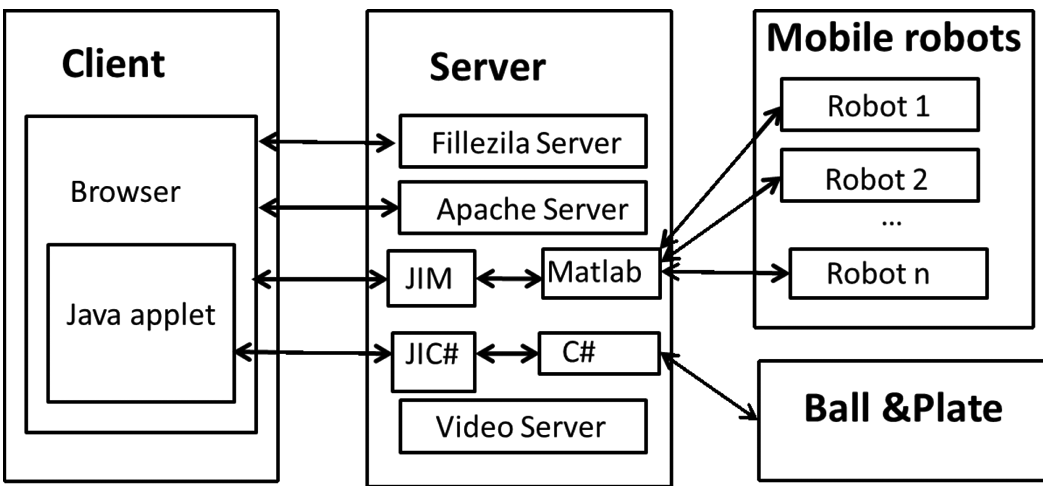 Figure 1: The schematic overview of the software architecture, designed for modular expansion.
Methodology: Two Paths to Mastery
The lab is structured to teach two dominant philosophies in control design:
1. Model-Based Control
Students must first identify the system. Using techniques like step-response identification or Pseudo-Random Binary Signals (PRBS), they derive a transfer function (e.g., ). Once the model is built, they use tools like the Frequency Response Tool (FRTool) to design a controller (PID or PD) that meets specific phase and gain margins.
2. Non-Model-Based (Auto-Tuning)
For systems where modeling is too complex, the lab facilitates relay experiments. By observing the amplitude and period of oscillations under relay control, students can calculate critical gain () and critical period (), allowing them to tune PID parameters using the Ziegler-Nichols or similar methods.
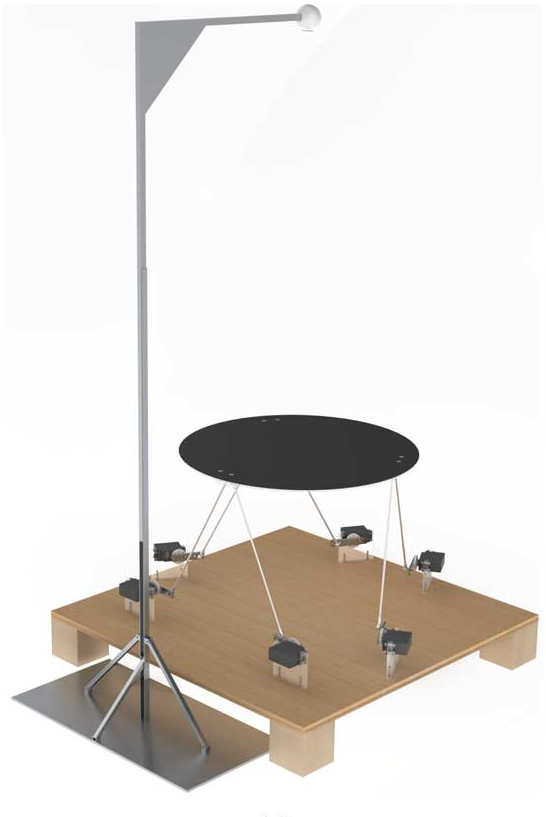 Figure 2: The leader-follower formation geometry used in the mobile robot experiments.
Experimental Evidence & Educational Impact
The authors deployed this system at Ghent University and UNED. The ball-and-plate system, famously open-loop unstable, served as the ultimate test for student-designed PD controllers.
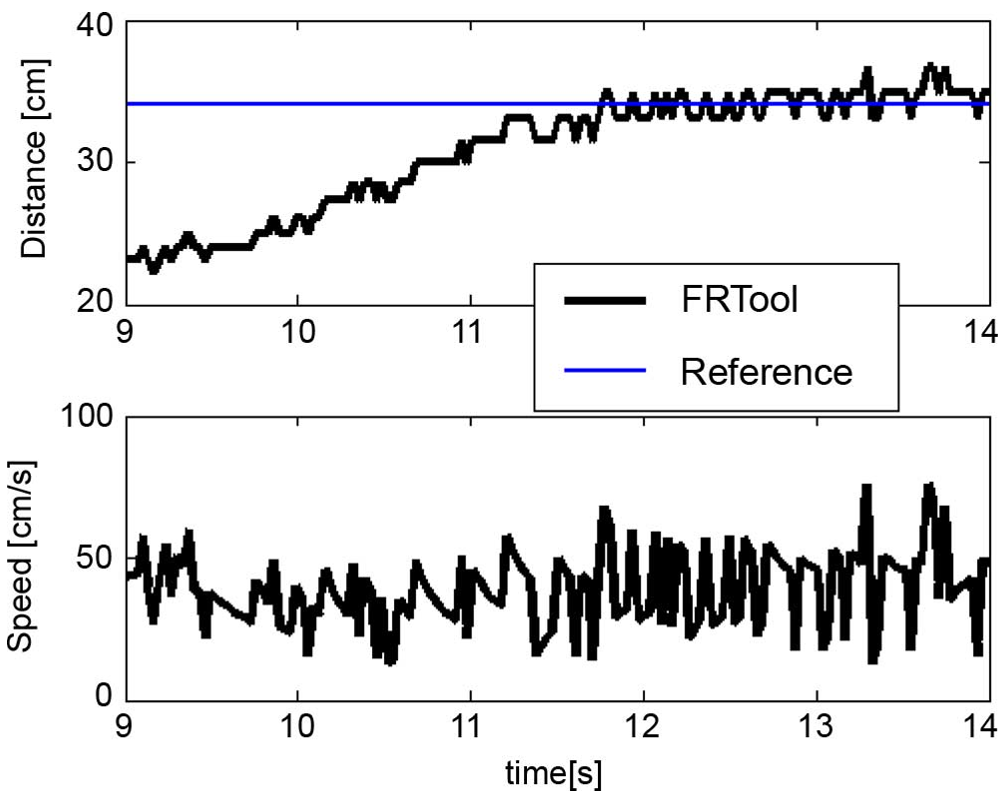 Figure 3: A successful closed-loop step response showing the stabilized position of a ball on the tilted plate.
Key Outcomes:
- Performance: There was a 15% increase in students achieving the highest grade bracket, suggesting better cognitive assimilation.
- Efficiency: Teaching assistants shifted from "manual instructors" to "remote supervisors," allowing them more time for research.
- Engagement: Students reported higher motivation when dealing with real-world issues like image processing delays in robot formations.
Critical Analysis & Future Outlook
The beauty of this work lies in its inter-university collaboration. By sharing a repository of 45 different labs, institutions can offer a variety of experiments that no single department could afford.
Limitations: However, the "finite" nature of hardware remains. Since experiments cannot be run in parallel on the same device, scheduling is required. Furthermore, the system relies heavily on the stability of the campus network—a "laggy" connection could lead to unstable control in fast-growing systems like the ball-and-plate.
Takeaway: This paper is a blueprint for the future of STEM education. It proves that the "distance" in distance learning does not have to mean a distance from reality. The future of the "Interactive Engineer" lies in the cloud, but their feet (or robots) remain firmly in the physical world.