
Beyond the Diagnosis: Leveraging Big Data to Predict Renal Failure Before it Hits
Risk Prediction of Renal Failure for Chronic Disease Population Based on Electronic Health Record Big Data
Researchers developed a machine learning-based framework to predict the 3-year risk of renal failure in chronic disease patients (hypertension and diabetes) without requiring a prior diagnosis of Chronic Kidney Disease (CKD). Leveraging EHR data from over 42,000 patients, the study identifies XGBoost as the superior model, achieving an impressive AUC of 0.9139.
TL;DR
Renal failure is often a "silent killer" because its precursor, Chronic Kidney Disease (CKD), frequently goes undiagnosed. This study introduces a machine learning framework—specifically utilizing XGBoost—to predict renal failure risk in hypertension and diabetes patients without needing a CKD diagnosis. With an AUC of 0.9139, it offers a high-precision tool for preemptive screening in routine healthcare.
The "Missing Diagnosis" Trap
The current clinical paradigm for preventing renal failure is reactive. Most models are built for patients already in the "CKD bucket." The flaw? Up to 90% of CKD patients don't know they have it. By the time a patient is officially diagnosed, irreversible damage is often already done.
The researchers’ core insight was to bypass the diagnostic label entirely. Instead of asking "Does this CKD patient have a risk of failure?", they asked: "Based on the routine lab tests of a diabetic or hypertensive patient, can we predict renal failure within three years?"
Methodology: Taming Heterogeneous EHR Data
The team analyzed records from 42,256 patients in the Shenzhen Health Information Big Data Platform. This is "Real-World Data"—messy, inconsistently coded, and filled with missing values.
The study utilized a sophisticated pipeline (Fig. 1) to clean and standardize this data, translating diverse Chinese clinical text and varying unit codes (like mg/dL vs. μmol/L for Creatinine) into a unified dataset.
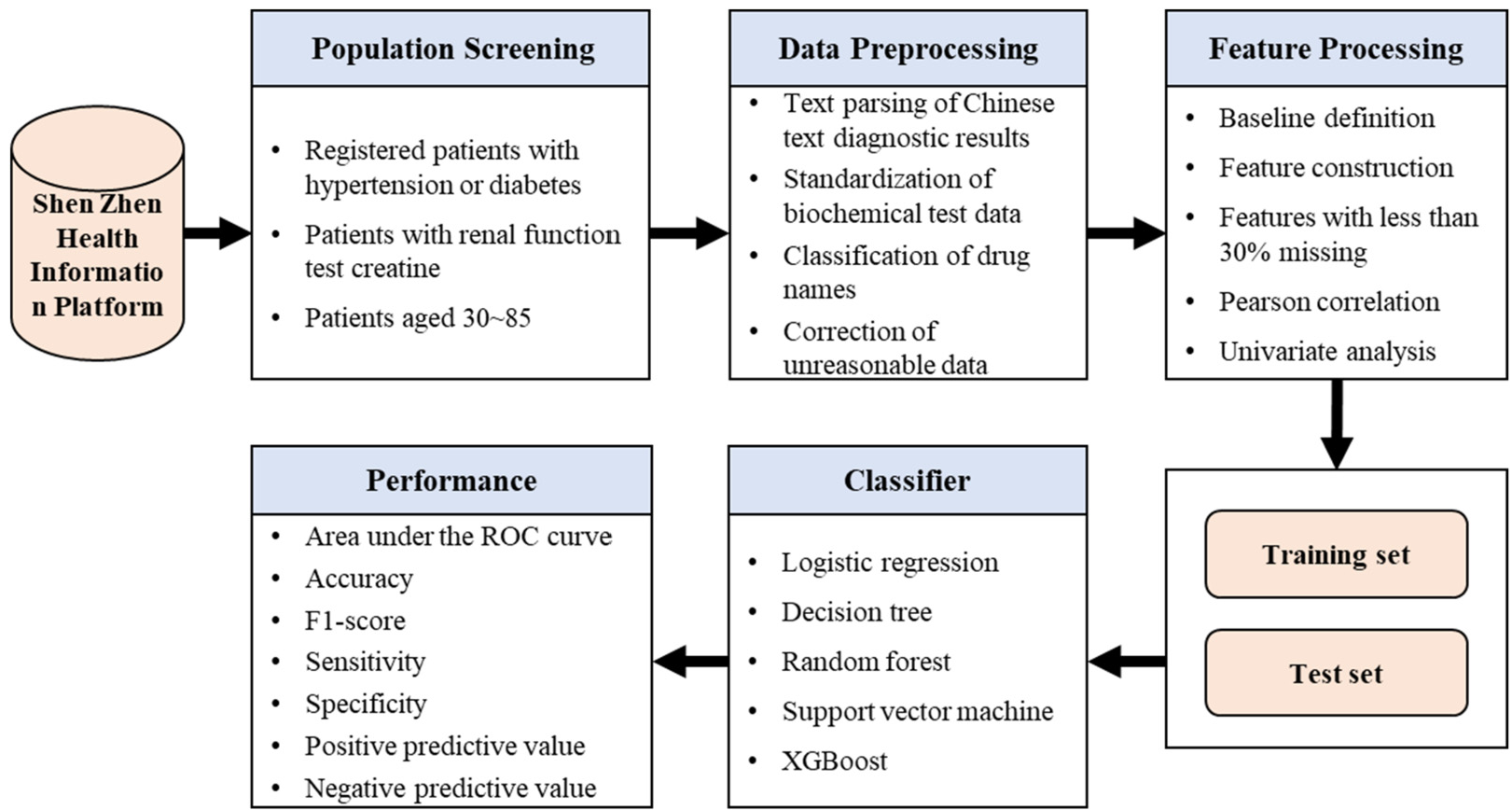
They compared five state-of-the-art algorithms:
- XGBoost: Handles sparse data and captures non-linear trends.
- Random Forest (RF): Robust to overfitting.
- Support Vector Machine (SVM): Effective in high-dimensional spaces.
- Logistic Regression (LR): The clinical gold standard for interpretability.
- Decision Tree (DT): Simple but prone to high variance.
Results: XGBoost Takes the Lead
The experiments proved that non-linear ensemble methods are significantly better at capturing the complexity of renal decline. XGBoost achieved the highest AUC (0.9139), accurately identifying high-risk patients even when the clinical "label" of CKD was missing.

Deep Insight: The Non-Linear Nature of Risk
One of the most fascinating aspects of this paper is the discovery of non-linear biomarkers. The researchers found that factors like Uric Acid (UA), AST, and ALT exhibit a "U-shaped" risk profile.
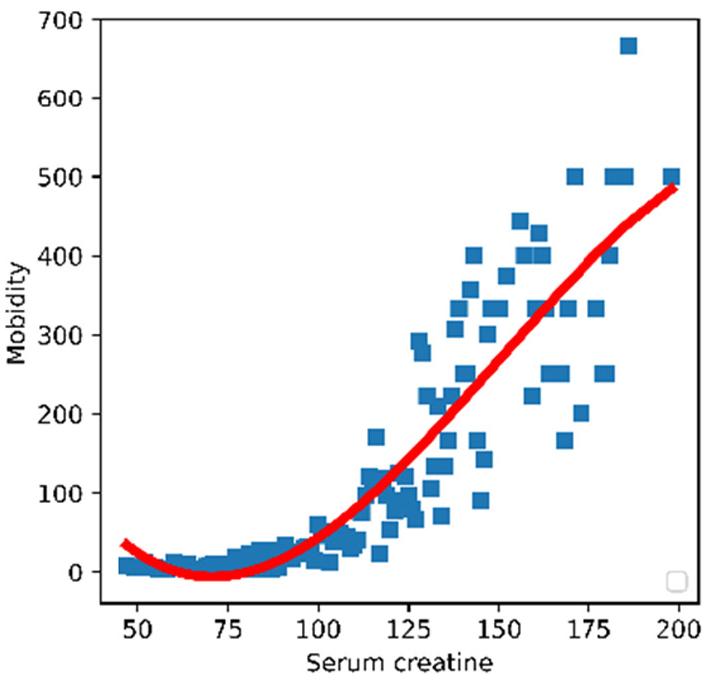
- The Hinge Effect: For factors like Age and Creatinine, risk remains flat until a "tipping point" (threshold), then climbs rapidly.
- The U-Shape: For Uric Acid, both extremely high and extremely low levels correlate with renal failure risk. This suggests that "too low" can be just as much of a warning sign as "too high."
Summary and Future Outlook
This work demonstrates that we no longer need to wait for a specialist's diagnosis to identify high-risk patients. By applying XGBoost to routine physical examination data, healthcare systems can move from "Reactive Treatment" to "Proactive Prevention."
Limitations: While the AUC is high, the dataset is imbalanced (fewer positive cases than negative ones). Future work needs to validate this model across diverse global populations to ensure generalizability.
Takeaway: The future of nephrology lies in the "invisible" data of chronic disease management.