
Scaling Search Evaluation: Is the Crowd as Reliable as the Experts?
Repeatable and reliable search system evaluation using crowdsourcing
This paper presents a framework for the repeatable and reliable evaluation of search systems using crowdsourcing via Amazon Mechanical Turk. Focusing on the "ad-hoc object retrieval" (AOR) task over Semantic Web (RDF) data, it demonstrates that non-expert crowd workers can produce system rankings consistent with expert judges and that these results remain stable when repeated over long intervals.
TL;DR
In the world of Information Retrieval (IR), the "Gold Standard" has traditionally been set by a small circle of expert judges. This paper challenges that bottleneck by proving that crowdsourcing is not just a cheap alternative, but a repeatable and reliable scientific instrument. Using a case study on Semantic Search (RDF object retrieval), the authors demonstrate that system rankings produced by Amazon Mechanical Turk workers remain stable over six-month intervals and correlate significantly with expert judgments.
Background: The Scalability Crisis in IR Evaluation
Evaluation campaigns like TREC have driven IR progress for decades. However, they face a three-pronged crisis:
- Scalability: As the Web expands to include structured data (RDF, Linked Data), creating new evaluation tracks for every niche task is prohibitively expensive.
- Repeatability: If we cannot access the original judges from three years ago, can we trust a new group to validate the old results?
- Reliability: Can we trust anonymous digital laborers who are incentivized to finish tasks as quickly as possible?
Methodology: High-Quality Data from "Noisy" Workers
The authors tackled the problem of Ad-Hoc Object Retrieval (AOR)—searching for specific real-world entities (e.g., "Santana band") within 1.4 billion RDF triples. To make this work for the "crowd," they implemented several critical controls:
1. The Rendering Algorithm
Raw RDF is unreadable to non-experts. The authors developed a logic to convert URIs and triples into clean, label-based tables.
 Figure 1: Example of how a structured RDF object is rendered into a human-readable interface for Amazon Mechanical Turk workers.
2. The "Gold Standard" Trap
To combat "bogus" workers, every set of 12 tasks (HITs) contained 2 hidden "gold standard" results—items with known relevance levels previously judged by experts. If a worker failed these, their entire batch was rejected. Notably, the rejection rate jumped from 5% in the first run to 54% six months later, highlighting the volatility of the worker pool and the absolute necessity of these traps.
Experiments: Repeatability vs. Reliability
The study compared three primary groups:
- MT1: Original crowd evaluation.
- MT2: Identical evaluation performed 6 months later with new workers.
- EXP: Professional expert judgments.
Key Findings
- System Ranking Stability: Despite the raw scores (MAP, NDCG) fluctuating slightly, the rank order of the six tested search systems remained exactly the same across MT1, MT2, and EXP.
- Expert Pessimism: Experts were found to be "pessimists." They often marked a result as irrelevant if it was only related to the object but not specifically about it, whereas crowd workers were more lenient.
- The Power of Three: Increasing the number of judges from 1 to 3 significantly reduced the standard deviation of results. However, going beyond 3 judges yielded diminishing returns for most metrics.
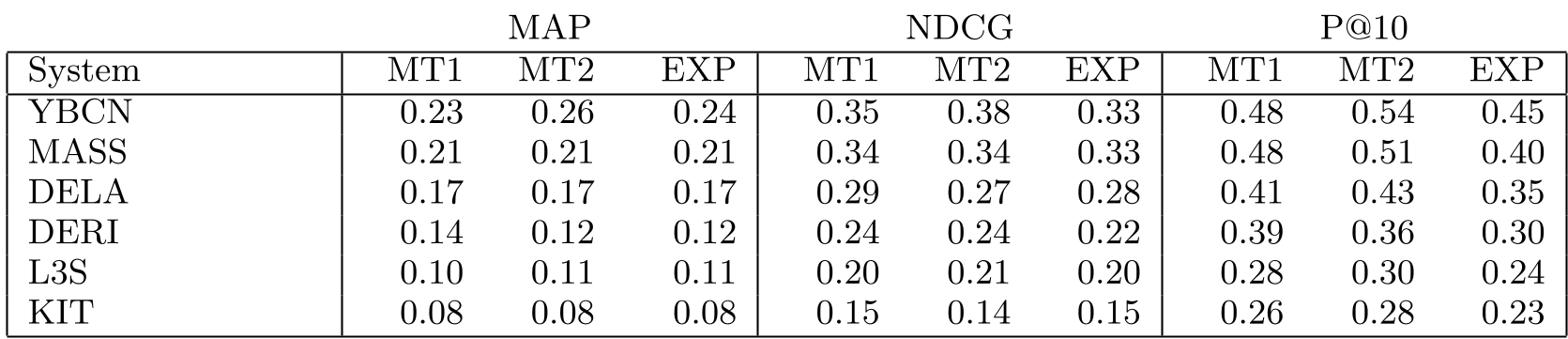 Table 3: Comparison of MAP, NDCG, and P@10 across different judge groups. Note the consistency in relative performance between systems.
Critical Insight: Why Does This Work?
The genius of crowdsourcing in IR isn't that any single worker is "as good" as an expert; it's that the aggregate error of many semi-reliable workers is consistent. As long as the relative performance gaps between search systems are captured, the absolute relevance score matters less.
However, the paper warns that P@10 (Precision at 10) is more "brittle" than MAP (Mean Average Precision). If you are building a system where top-of-page precision is the only goal, you will need more crowd workers (5+) to achieve the same level of reliability that 3 workers provide for overall ranking.
Conclusion & Future Outlook
This work provides the empirical backbone for "Just-in-Time" evaluation. Instead of waiting for annual conferences, researchers can now deploy an evaluation service that benchmarks new algorithms against existing baselines in 48 hours for a few hundred dollars.
Limitations: The study primarily focused on entity/object queries. The authors suggest that for highly ambiguous or subjective queries, the "gap" between experts and the crowd may widen, requiring more sophisticated instructions or specialized worker pre-screening.
Takeaway for Practitioners: When using crowdsourcing for data labeling or evaluation, focus less on absolute agreement percentages and more on system-level correlation. And never, ever forget to include your "Gold Standard" traps.