
Coded Content: The Key to Robustness in Crowdsourcing-Based CDNs
Replicating Coded Content in Crowdsourcing-Based CDN Systems
The paper proposes a coded content replication strategy for crowdsourcing-based Content Delivery Networks (CDNs). By caching coded segments on volatile mini-servers, the system achieves a lower bound on file downloading time (Tc) compared to traditional uncoded methods, effectively handling unstable bandwidth oscillation.
TL;DR
Crowdsourcing-based CDNs use ordinary user devices (mini-servers) to distribute content, drastically reducing costs but introducing massive bandwidth volatility. This paper demonstrates that by replicating coded content rather than raw file segments, systems can circumvent the "bottleneck segment" problem. The coded approach allows users to adapt to fluctuating speeds automatically, achieving significantly faster download times.
Problem: The Volatility of the "Crowd"
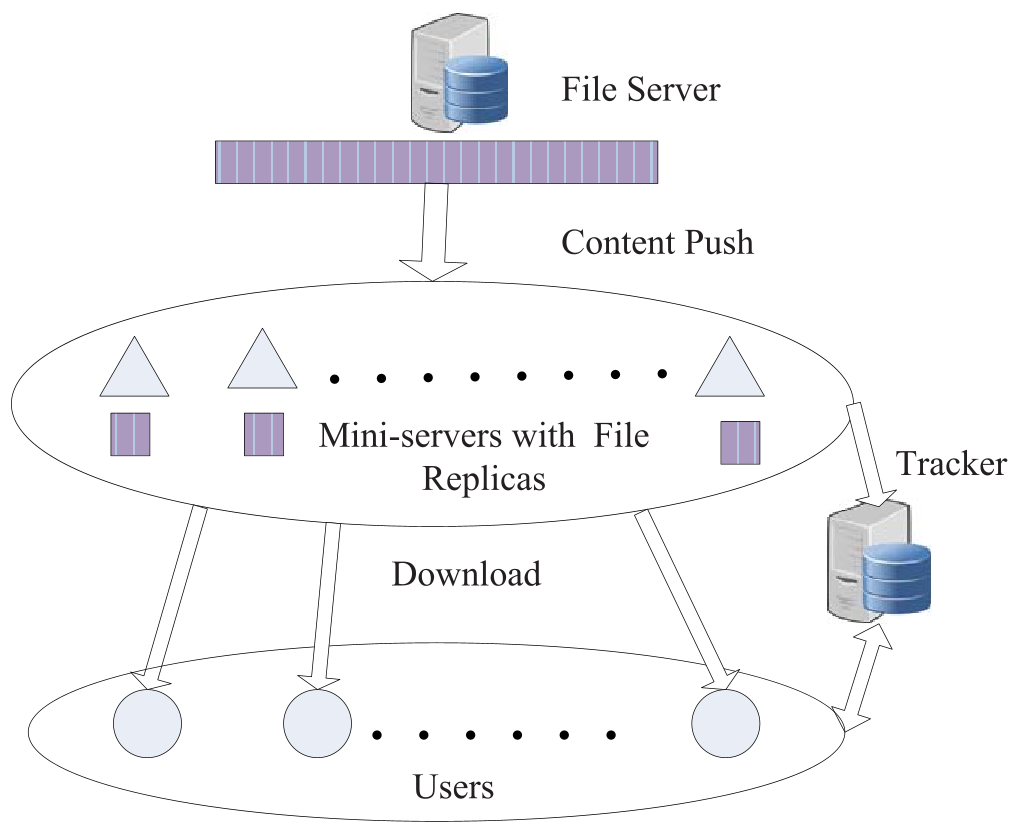
Traditional CDNs (like Akamai or Cloudflare) use dedicated edge servers with stable, high-speed pipes. In contrast, crowdsourcing-based CDNs (e.g., Xiaomi MI WiFi, Thunder Crystal) recruit "mini-servers" from the public.
The pain point is twofold:
- Bandwidth Oscillation: A mini-server's upload speed fluctuates because the owner might start gaming or streaming locally.
- The Bottleneck Effect: If a file is split into segments A, B, and C, and the server holding segment B becomes slow, the entire download stalls even if servers for A and C are lightning-fast.
Methodology: From Segments to Coded Blocks
The authors propose moving away from simple replication. By using Maximum Distance Separable (MDS) codes, the file is transformed into coded symbols.
The Intuition
Think of it as filling a bucket with water from multiple leaky faucets. In the uncoded world, you need specific "colored drops" to fill the bucket. If the "blue drop" faucet clogs, you can't finish. In the coded world, any drop is as good as any other. You just need a total volume of water to finish.
The paper proves that the downloading time for the coded scheme () is a lower bound. It uses a piecewise linear function to model how the fraction of the file stored on each server () impacts the total time.
Experimental Validation: Static vs. Dynamic
The researchers compared the two schemes across various scales.
1. Static Scenario
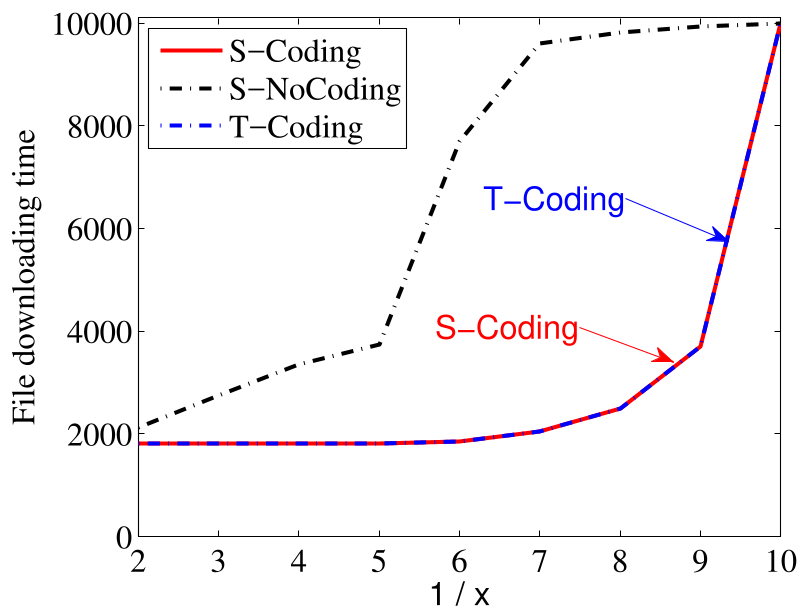
Even with fixed bandwidth, the coded scheme wins because it solves the "knapsack problem" of scheduling perfectly. As shown in the simulation of 1000 mini-servers, when each server only stores a small fraction of the file, the uncoded scheme's download time can be twice as long as the coded version.
2. Dynamic Scenario
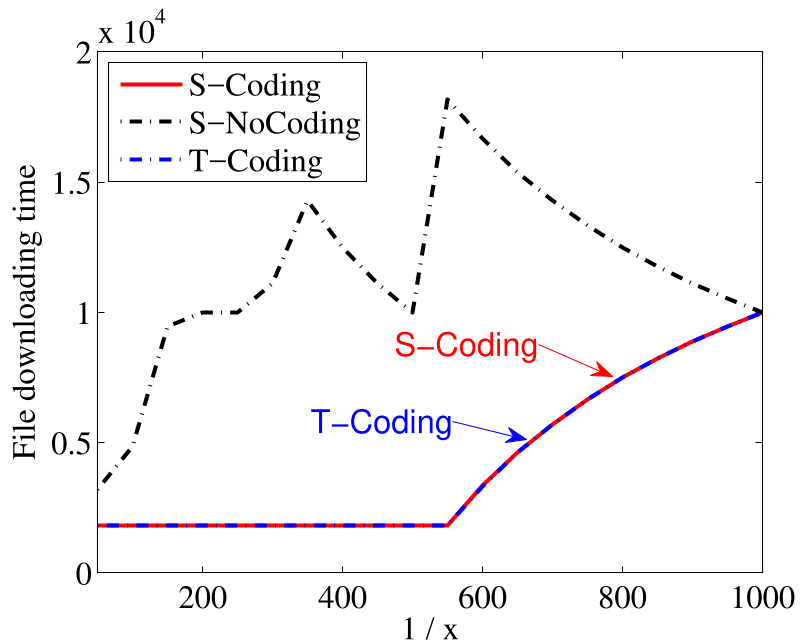
In real-world dynamic networking, where bandwidth follows a probability distribution, the gap widens. The paper provides a rigorous mathematical derivation (using the Law of Large Numbers) to show that while the uncoded scheme asymptotically approaches the coded scheme's performance if you split the file into infinite segments, the overhead of managing those segments becomes unbearable.
Deep Insights & Future Work
The core takeaway is that Coded Replication provides "Insurance against Volatility." It eliminates the need for the central tracker to predict which server will be fast or slow in the next second.
Limitations:
- The current study focuses on file downloading (completion-oriented).
- Video Streaming (latency-sensitive and sequential) remains a frontier. Coding for streaming requires maintaining the sequential order while still gaining the benefits of MDS codes.
Conclusion: For any developer building "Edge" or "Crowdsourced" infrastructure, coding isn't just a mathematical exercise—it's a critical tool for performance stability in an unstable world.