
Reputational Heuristics: Why Online Feedback Systems May Be Governed by Bias Rather Than Facts
“Reputational Heuristics” Violate Rationality: New Empirical Evidence in an Online Multiplayer Game
This study investigates "Reputational Heuristics" in online multiplayer environments, revealing that users often base feedback on an interactor's existing reputation rather than their actual current behavior. Utilizing a custom-built Bargaining Game, the researchers demonstrate how reputation systems can perpetuate biases and violate the principles of rational decision-making.
TL;DR
Is a 5-star rating a reflection of a user's recent actions, or just a self-fulfilling prophecy? New research published in Complex Dynamics suggests that humans are fundamentally "irrational" when it comes to online reputations. Through a controlled multiplayer bargaining game, researchers found that we are more likely to reward a high-rated player even when they give bad advice, and punish a low-rated player even when they are helpful.
The "Rational Agent" Myth
In the world of classical economics and game theory, humans are often viewed as rational agents. If someone helps us, we give them a "Like"; if they hurt us, we give them a "Dislike." This mechanism is the bedrock of modern digital trust, powering everything from Uber and Airbnb to Amazon and Fiverr.
However, the authors of this study argue that in the digital wild, this logic breaks down. Due to the anonymity and physical isolation of the web—a state called de-individuation—we stop looking at the person and start looking at the "score."
Methodology: The Bargaining Game
To test this, the researchers recruited 113 participants into a "Bargaining Game." The roles were divided into:
- Donors: Proposing deals.
- Receivers: Deciding to accept or decline based on suggestions.
- Observers: Providing suggestions to Receivers.
The critical point: Receivers could see the Observer's prior reputation (Like/Dislike count) but only found out if the suggestion was truly "good" or "bad" after the interaction.

The Core Insight: Reputation Has Inertia
The results from the General Linear Mixed Models (GLMM) were striking. The study found that:
- Status over Substance: The prior reputation of the Observer was a stronger predictor of the rating they received than the actual quality of the advice they gave.
- The Penalty of a Bad Start: If an Observer had a negative reputation, they were rated poorly even when they provided a "Good Suggestion" (an objectively fair and helpful move).
- The Halo Effect: Observers with positive reputations were "forgiven" for bad suggestions far more often than those with low scores.
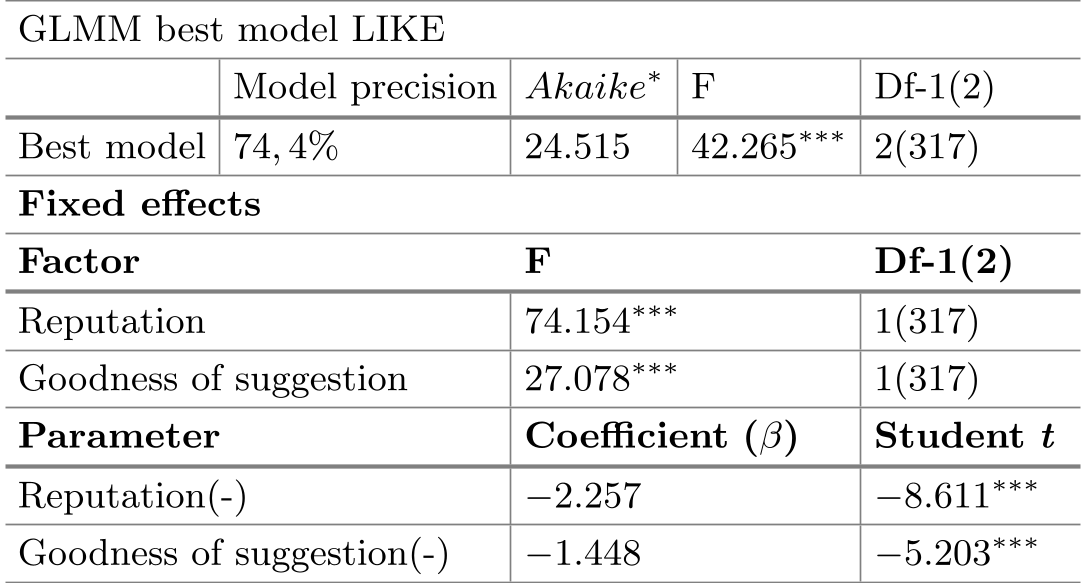
As shown in the table above, the coefficient for Reputation (-) is significantly higher (Absolute value 2.257) than Goodness of suggestion (-) (1.448), indicating that the "heuristic" (shortcut) of looking at reputation is the dominant force.
Critical Analysis: The Danger of "Reputational Heuristics"
The researchers call this phenomenon Reputational Heuristics. It suggests that once a reputation is established—whether through luck or early performance—it becomes incredibly difficult to change.
Key Implications:
- Systemic Bias: This "inertia" means that early movers in a system who get lucky with a few positive reviews might dominate the market regardless of their declining quality.
- Breaking the Cycle: For developers of online platforms, these findings suggest that simply displaying a cumulative score is not enough. Systems might need to "weight" recent interactions more heavily or hide prior scores during the feedback phase to ensure objective ratings.
Conclusion
This paper provides a sobering look at the digital social contract. Our online feedback isn't just a record of behavior; it's a cognitive shortcut. While reputation systems are designed to foster cooperation, they may unintentionally bake in "arbitrary inequality," rewarding the already-famous and punishing those trapped by a poor start.
Limitations and Future Work
The study was conducted with a relatively small sample (113 subjects) consisting mostly of students. Future research should investigate if these "heuristics" change in high-stakes environments (e.g., platforms where real money is involved) and whether providing more granular behavioral data can override the reputation bias.
Takeaway: In the digital age, your "score" is not just what you've done; it's what people expect you to do, regardless of the truth.