
Precise Bank Marketing: Deciphering Customer Behavior via C5.0 Decision Trees
10845_Research on Bank Marketing Behavior Based on Machine Learning.
This paper presents a machine learning framework for bank direct marketing using the C5.0 decision tree algorithm on the UCI Bank Marketing dataset. By implementing under-sampling for data balancing and rigorous feature selection, the study develops a set of eight actionable classification rules to identify high-potential customers for fixed deposit subscriptions.
TL;DR
In an era where customer attention is the scarcest resource, banks must pivot from "mass broadcasting" to "precision targeting." This paper demonstrates a machine learning pipeline using the C5.0 algorithm to predict whether a customer will subscribe to a fixed deposit. By balancing data and optimizing decision rules, the research identifies that call duration and occupation are critical pivot points for marketing success, achieving an accuracy of over 80%.
Background & Motivation: The Data-Driven Banking Pivot
Commercial banks sit on goldmines of data, yet most struggle to convert this into marketing ROI. The primary challenge lies in the imbalance of marketing outcomes—most customers say "no," making it difficult for models to learn the characteristics of a "yes." This paper addresses the fundamental need for a systematic way to filter "high-quality" leads from thousands of entries in a Portuguese bank's telemarketing records.
Methodology: Beyond Simple Classification
The author doesn't just "plug and play" a model; the workflow follows a rigorous data science cycle:
- Outlier Correction: Instead of deleting outliers (which could represent valuable niche markets), the author replaced them with the "closest normal data" to maintain dataset size while reducing noise.
- Feature Engineering: Using a Filter node, the study removed redundant variables. It found that
pdays(days since last contact) andpreviouswere highly correlated, leading to a refined set of 10 core variables includingage,job,housing, andduration. - The Under-Sampling Strategy: To fix the skewed distribution, the author used random under-sampling to achieve a 43:56 ratio, ensuring the model wouldn't simply default to predicting "No subscription."
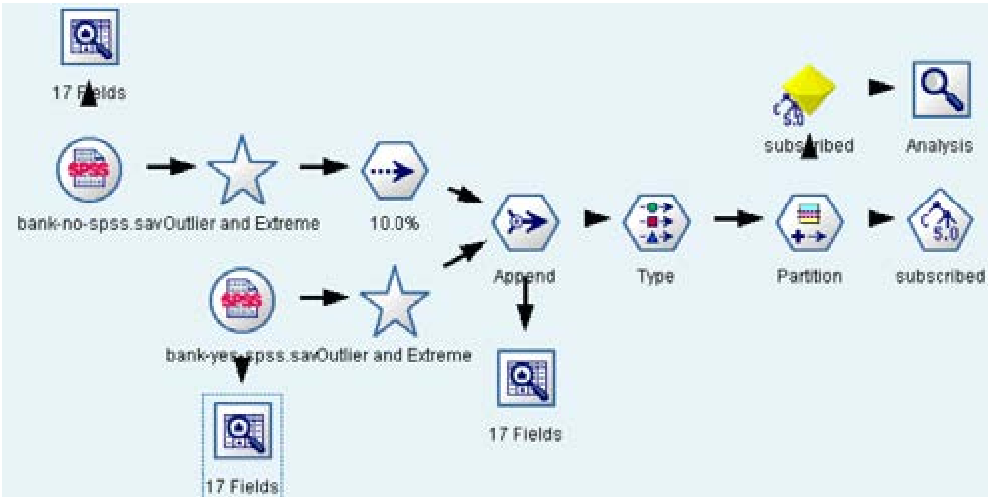 Figure: The data flow diagram for building the C5.0 classification model, showing the partition between training, testing, and validation sets.
The "Golden Rules" of Marketing
One of the most valuable outputs of this research is the translation of a complex tree into human-readable rules. The C5.0 algorithm identified "Duration" as the most critical root node.
Key Insights from the Rule Set:
- The 75-Second Threshold: If a call lasts less than 75 seconds, the customer is almost certain not to subscribe.
- The 430-Second Conversion: If a marketer can keep a customer engaged for more than 430 seconds (approx. 7 minutes), the probability of subscription spikes, regardless of demographic background.
- High-Value Segments: Managers, students, and retired individuals showed significantly higher conversion rates when they did not already have a housing loan.
Performance & Competitive Benchmarking
The study didn't stop at C5.0. It compared the results against four other architectures: C&T, QUEST, CHAID, and Neural Networks.
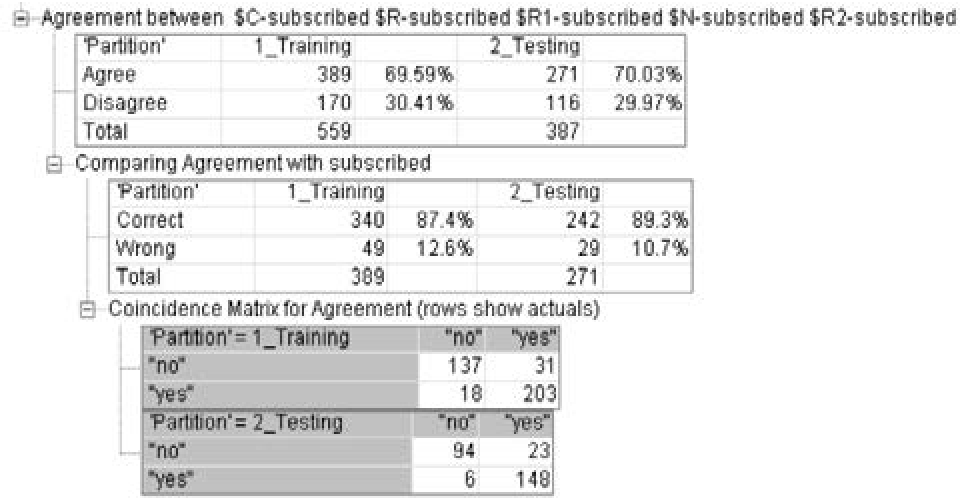 Table: Comparison of algorithm agreement. Over 70% of the test samples saw total agreement across all 5 models, indicating high reliability in the underlying data patterns.
While Neural Networks offer high potential, the C5.0 and C&T models were preferred for this specific task because they provide "White Box" transparency. In banking, understanding why a customer is targeted is often as important as the prediction itself for regulatory and strategic reasons.
Critical Perspective: Limits and Prospects
Takeaway: This work proves that even with classic algorithms like C5.0, high-precision marketing is achievable if the data is balanced and cleaned properly.
Limitations:
- The dataset is from 2008-2010. Consumer behavior post-digitalization (mobile apps vs. telephone) has shifted significantly.
- Under-sampling, while effective for training, discards a large portion of the "No" samples, which might contain subtle patterns of rejection that are useful for "Do Not Call" list optimization.
Future Outlook: The next step for this research would be move from "static" classification to "dynamic" reinforcement learning, where the model suggests the best time to call or the specific script to use based on live customer responses.