
Deciphering the Participatory Culture: How Social Media is Rewiring Software Engineering
Selecting research methods for studying a participatory culture in software development
This keynote paper explores the shift toward a "participatory culture" in software engineering driven by social media. It proposes a pragmatic "mixed methods" research framework that combines Mining Software Repositories (MSR) with social science techniques to understand the human-centric impact of modern social tools (e.g., GitHub, Slack, Stack Overflow) on developer productivity and knowledge sharing.
TL;DR
The landscape of software development has shifted from siloed coding to a vibrant, transparent Participatory Culture. Dr. Margaret-Anne Storey argues that to truly understand this "Social Programmer" era, researchers must move beyond mere repository mining and embrace a mixed-methods approach borrowed from social sciences. This isn't just about new tools; it’s about a fundamental change in how knowledge is created, assessed, and shared within the global developer ecosystem.
The Motivation: Why Code Mining Isn't Enough
For years, the "gold standard" of software engineering research was Mining Software Repositories (MSR). By analyzing commit histories and bug reports, researchers could predict failures or measure velocity. However, this method has a massive blind spot: it ignores the "Invisible Work."
The author highlights a critical gap:
- The "Why" Problem: Trace data shows what happened but can't explain the human motivation or the barriers that prevented a developer from contributing.
- The "Dark Matter" Factor: Many developers (lurkers) derive immense value from social platforms without ever leaving a digital footprint (no commits, no comments).
- Knowledge Fragmentation: Expertise is now scattered across Slack, Stack Overflow, and GitHub, making it impossible to reconstruct the "theory of the program" from code alone.
Methodology: Bridging the Divide
To capture the full picture, Storey proposes a pragmatic Mixed-Methods Framework. This framework treats the software ecosystem as a socio-technical manifold.
1. The Knowledge Architecture
The paper categorizes tools not just by function, but by the type of Knowledge Transfer they facilitate. This is visualised in the "Media Channels" progression:
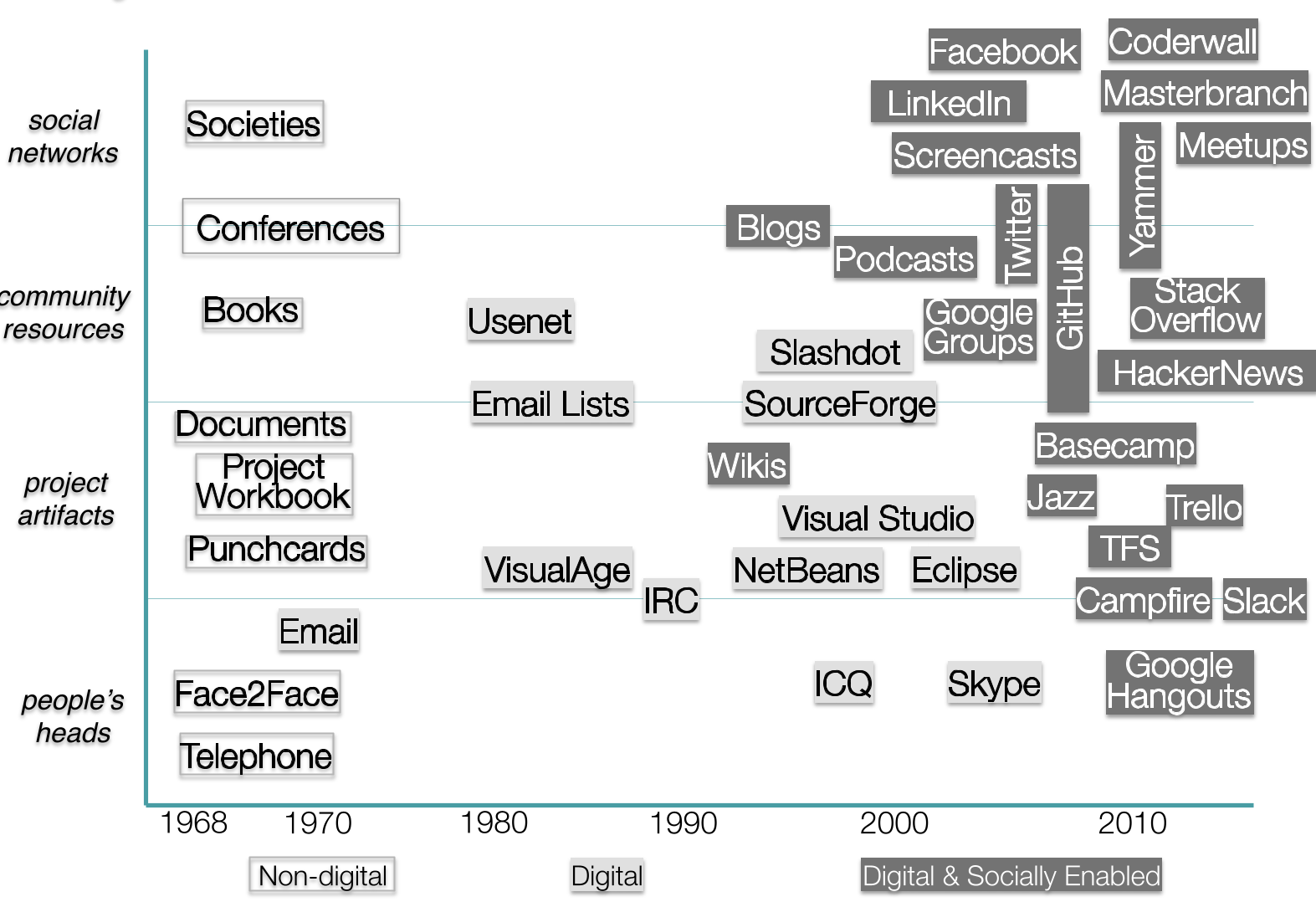
- Tacit Knowledge: Resides in heads (exchanged via Slack/chat).
- Artifact Knowledge: Embedded in code (GitHub/BitBucket).
- Community Resource: Socially generated (Stack Overflow/Wikis).
- Social Network Awareness: Knowledge about who knows what (Twitter/Developer Profiles).
2. Pragmatic Mixed Methods
The core insight is that Triangulation is necessary. By combining large-scale surveys () with deep-dive interviews and repository analytics, researchers can achieve both Generalizability (from large datasets) and Internal Validity (from human insights).
Experiments and Observations: The "Social Programmer"
The author’s research into platforms like GitHub and Twitter revealed several paradigm shifts:
- Mutual Assessment: Developers no longer rely on resumes; they use "Social Profile Aggregators" to assess peer reputation based on activity traces.
- Speed of Light Learning: Twitter has become a vital "awareness" tool, allowing developers to filter the massive influx of new technologies through their trusted social graph.
- Lowered Barriers: Participatory culture fosters mentorship and co-creation, making it easier for novices to join complex ecosystems (like Ruby on Rails).
Performance in Research Dissemination
A fascinating "meta-experiment" discussed in the paper is the use of social media for Academic Outreach. The researchers found that blogging their preliminary results led to:
- Rapid Validation: Immediate feedback from thousands of practitioners.
- Massive Reach: 8,000+ views on a blog post vs. much lower engagement for a traditional PDF.
Critical Analysis & Conclusion
The Double-Edged Sword
While a participatory culture accelerates innovation, Storey warns of several risks:
- Fragmentation: Knowledge being spread over too many channels can lead to information overload.
- Ethics: The "Facebook effect"—where researchers might inadvertently cause harm or "spam" developers on public platforms like GitHub for data.
- Literacy Gap: Researchers who do not master these social tools risk obsolescence, as they will be unable to access the primary nodes of modern development discourse.
Summary (Takeaway)
The "Social Programmer" is here to stay. Software Engineering research must transition from a "closed-loop" academic exercise to a Participatory Research Culture. By blending data science with social science and engaging directly with the community via social channels, we can bridge the gap between academic theory and industrial practice.
Future Outlook: As AI begins to participate in these cultures (e.g., LLMs contributing to GitHub), the "social features" of our tools will likely evolve from human-to-human interaction to human-to-AI collaboration, requiring even more sophisticated mixed-method frameworks.