
XAS: The Hidden "Cross-API" Trap in Social Ecosystems
RESEARCH PAPER . SCIENCE CHINA Information Sciences
This paper introduces Cross-API Scripting (XAS), a specialized form of XSS that leverages Web APIs within social ecosystems. By analyzing 11 major social networks and 143 third-party apps, the authors demonstrate how insecure API design allows malicious scripts to bypass traditional Web UI defenses.
TL;DR
While we have spent a decade hardening website front-ends against XSS, a back-door has been left wide open: Web APIs. This paper defines Cross-API Scripting (XAS), a vulnerability where malicious scripts travel through API data exchanges between social networks (like Facebook) and third-party apps (like TweetDeck). The authors found that 75% of analyzed third-party apps are vulnerable, proving that the "Social Ecosystem" has created a massive, interconnected attack surface.
Problem & Motivation: The Security Gap in Connectivity
The modern web is no longer a collection of "silos." It is an ecosystem where your Facebook feed shows up in your Gmail, and your Twitter posts sync to LinkedIn. This connectivity is powered by RESTful APIs.
The authors observed a critical Inductive Bias in security: developers assume that if data is coming from a "trusted" provider's API, it must be clean. However, social networks often apply rigorous sanitization to their Web UI but neglect their API channels. This creates a "sanitization mismatch" where an attacker can inject a payload via an API that would have been blocked by a browser form, which then triggers when a third-party app renders that data.
Methodology - Tracking the Taint
To systematically map this threat, the authors built an automated detection framework.
1. The XAS Attack Process
The attack typically follows a multi-step propagation path:
- Injection: Attacker stores a payload in a social network (e.g., in a "Group Name" field).
- Retrieval: A victim uses a third-party app that calls the Social Network's API.
- Execution: The API returns the "tainted" raw data, and the third-party app renders it as HTML, executing the script in the victim's browser.
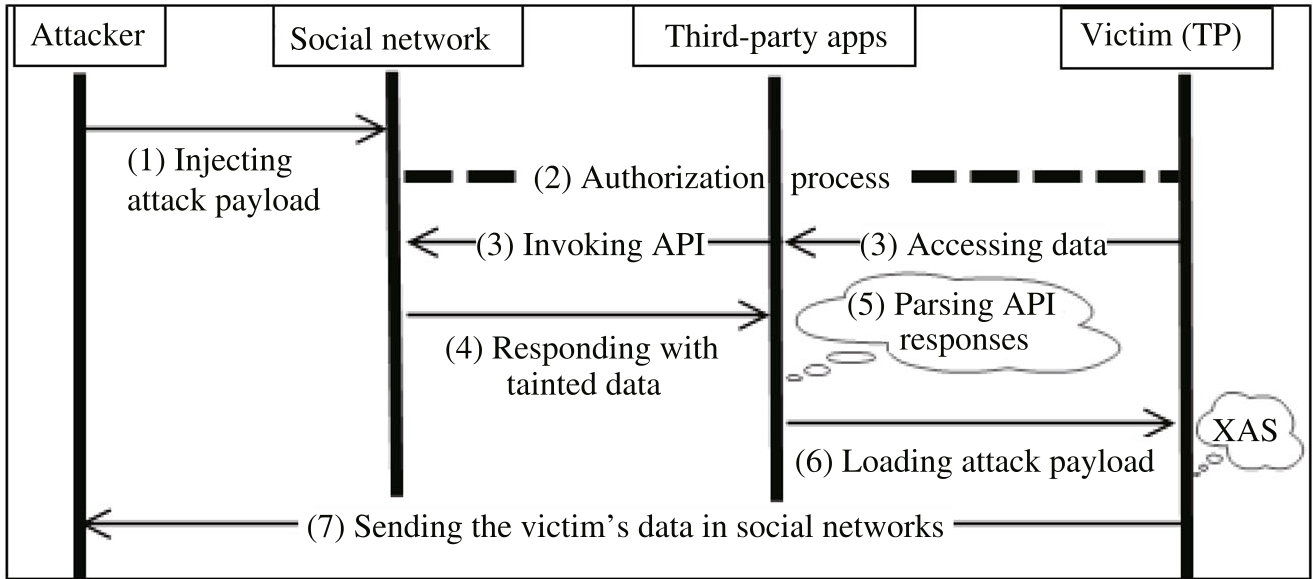 Figure: The data flow from malicious injection to client-side execution via API responses.
2. Detection Tooling
The tool focuses on identifying three fatal API flaws:
- Tainted API Output (TAO): Returning raw, unescaped user data.
- Inconsistent Schemes: Using different sanitization rules for JSON vs. XML.
- Insecure Headers: Setting
Content-Type: text/htmlfor data that should be pure JSON, tricking browsers into executing contents.
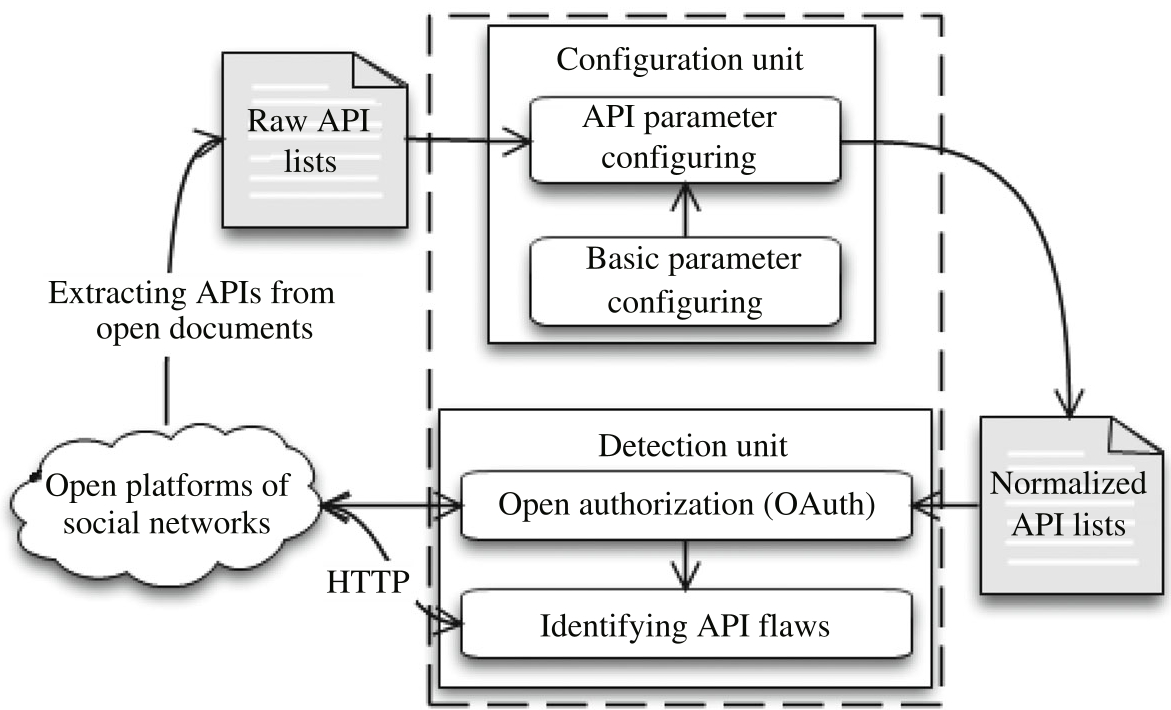 Figure: The architecture of the XAS identification tool.
Experiments & Results: A Pervasive Threat
The authors tested 11 major platforms and 143 apps. The findings were alarming:
- Universal Vulnerability: Every social network tested had at least one API flaw.
- Implementation Gaps: Platforms like Facebook and Renren were found to escape XML responses correctly while leaving JSON responses "naked" (Scheme II).
- Third-Party Failure: Out of 143 apps, 107 failed to sanitize API data. Apps connecting to Facebook and Weibo were among the most vulnerable.
Performance Comparison of Platforms
The paper provides a detailed breakdown of which platforms use "Scheme I" (Sanitize at input/output) vs "Scheme II" (Sanitize at display).
 Table: Comparison of flaws across major Social Networks.
Critical Analysis & Conclusion
Takeaway
The core insight is that security state is not shared across the ecosystem. A social network might assume the app will sanitize the data, while the app assumes the social network already did. This "diffusion of responsibility" is the root of XAS.
Limitations & Future Work
The study focuses primarily on RESTful APIs. As the industry moves toward GraphQL, which allows for even more complex nested queries, the "attack depth" of XAS could increase. Furthermore, the mitigation proposed—a simple whitelist function—might be difficult to enforce across the millions of independent third-party developers globally.
Prediction
In the coming years, we expect to see "API Security Gateways" become a standard for any third-party integration, moving away from the "Implicit Trust" model to a "Zero Trust API" architecture.