
The Structural Armor of Social Networks: Why Density Beats Geometry
Resilience of Social Networks under Different Attack Strategies
The paper investigates the resilience of four semantically different social networks (Political Blogs, Twitter, Epinions, and Co-authorship) against six attack strategies. The study utilizes a comparative analysis between real-world social data and synthetic models (Small World, Scale-Free, etc.), concluding that high average connectivity is the primary driver of robustness in social networks.
TL;DR
Is the "Achilles heel" of the Internet—fragility to targeted attacks—equally fatal for social networks? This study proves that while social networks are vulnerable to targeted node removal, their high edge-node ratio (density) provides a "graceful degradation" that synthetic models fail to capture. Surprisingly, the highly-touted clustering coefficient (the "friends of friends" triads) has almost no impact on a network's survival.
Problem & Motivation
Since the early 2000s, the consensus in network science was clear: Scale-Free networks (like the Internet) are robust against random failures but collapse if you remove the top "hubs." However, social networks like Twitter or Epinions aren't just Scale-Free; they are "Small World" and extremely dense.
The authors noticed a contradiction: the World Wide Web, despite being Scale-Free, was found to be robust against targeted attacks. They hypothesized that the high average degree (edge-node ratio) of social structures might nullify the structural weaknesses identified in previous literature.
Methodology: Testing the Stress Points
The researchers compared four real social networks—Political Blogs, Twitter, Epinions, and an Author network—against four synthetic models:
- Random (RD): Poisson distribution.
- Scale-Free (SF): Power-law via preferential attachment.
- Small World (SW): High clustering, low path length.
- Holme-Kim (HK): Combined Small World and Scale-Free.
They tested six attack strategies, notably distinguishing between Node attacks and Edge attacks.
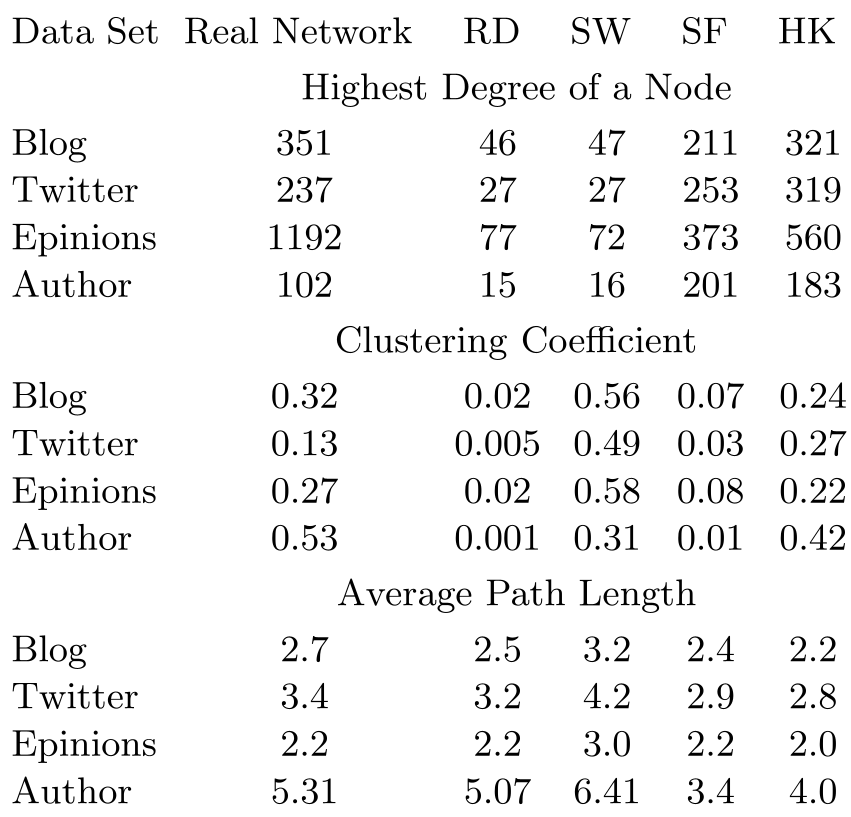 The table above highlights the stark differences in degree and clustering between real social data and synthetic models.
Key Insights: Density is the Ultimate Defensive Layer
1. The Clustering Myth
A common assumption is that the high clustering of social networks (triads) helps them stay connected. This study debunked this: even when clustering increased from 0.001 to 0.5, resilience under most attacks remained unchanged. Topology matters less than the sheer volume of connections.
2. The Power of the Edge-Node Ratio
The "Author network" (co-authorship) was the most fragile, disintegrating after just 10% node removal. Why? It has the lowest edge-node ratio (2.6). Meanwhile, Epinions (ratio 24.3) survived massive targeted strikes. This suggests that redundancy in paths is the primary contributor to social resilience.
3. Model Failure
A critical finding is that current network models are flawed. Real social networks disintegrated faster than synthetic ones under targeted node attacks. In real social life, many low-degree nodes are isolated once their central "bridge" (hub) is removed, whereas synthetic models have more "accidental" random connectivity.
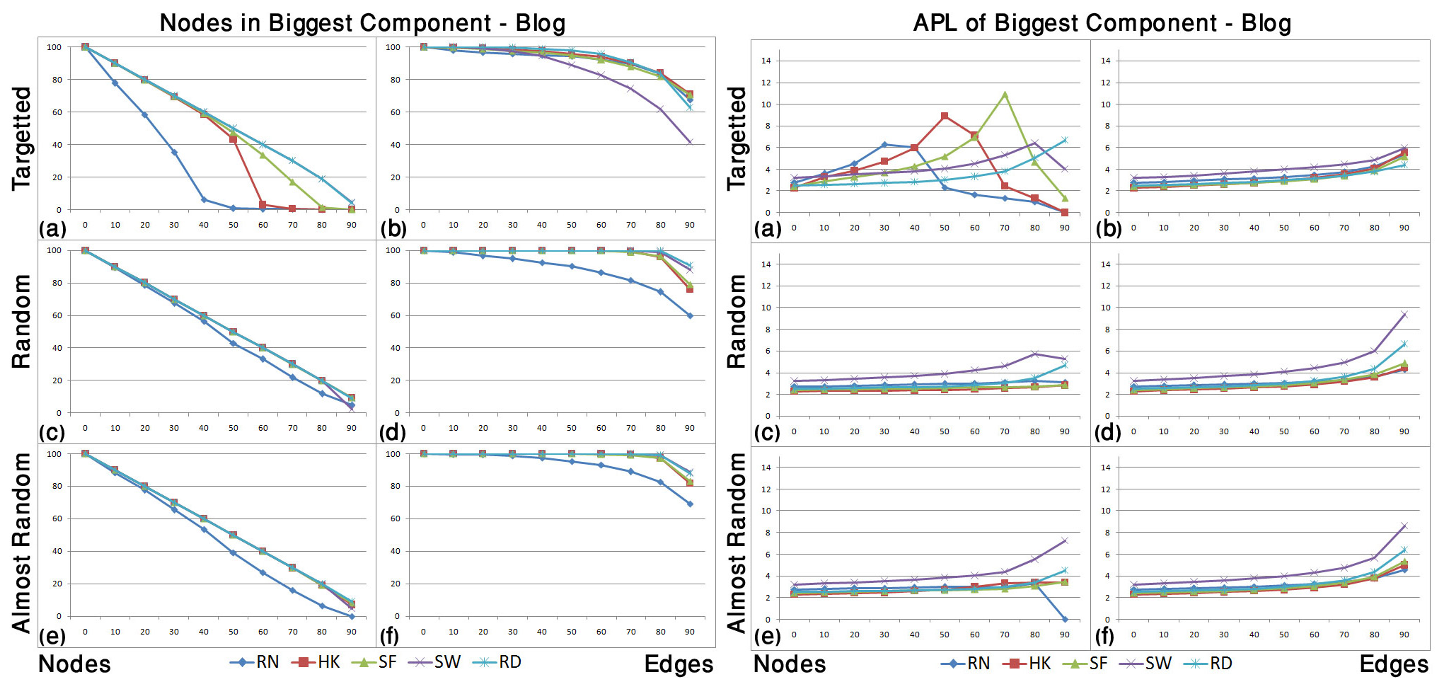 The breakdown curves show that while models (RD, HK, SF) provide an approximation, the real Network (RN) often drops more sharply, indicating a unique structural vulnerability in human-organized systems.
Critical Analysis & Conclusion
This paper shifts the focus from distribution types (Scale-Free vs. Random) to density metrics. It provides a sobering look at how dependent our communication is on high-degree nodes, yet also offers hope: the natural density of online social networks creates a buffer that prevents total collapse even under high-stress scenarios.
Limitations: The study treats networks as static and undirected. In reality, social influence is often directional and changes over time.
Future Work: The next frontier involves studying "Temporal Resilience"—how social networks heal or adapt over time as users form new links to replace lost ones.