
Bridging the Silent Divide: Resolving Cross-Cultural Gaps via Experience Corpora
Towards Resolution Support to Cross-Cultural Communication Gaps: Using Partially Bilingual Experience Corpus
The paper proposes a novel framework for identifying "communication gaps" in cross-cultural dialogues by leveraging a "Partially Bilingual Experience Corpus" derived from User-Generated Content (UGC). It introduces the concept of Gap-Arousing Phrases (GAP) and outlines a proactive support system integrated with automatic interpretation tools to mitigate cultural misunderstandings.
TL;DR
Even with near-perfect machine translation, we often find ourselves "lost in translation." This paper explores a method to detect Gap-Arousing Phrases (GAP)—words that cause cultural confusion—by mining social media and blog data where users recount their real-world misunderstandings. The goal is to create an intervention system that provides real-time cultural context alongside literal translations.
Contextual Positioning: This work transitions from Syntactic/Semantic Translation to Pragmatic Interpretation, targeting the subtle "usage-based" friction points identified in Cognitive Linguistics.
The Problem: When Meaning is More Than the Sum of Words
Modern translation apps are excellent at telling you that the German word "Mahlzeit" means "mealtime." However, they fail to tell you that in a German office, it is a standard lunchtime greeting. For a Japanese traveler, being told "mealtime" by a colleague in a hallway leads to confusion: "Should I agree? Is it a question? Is it an invitation?"
The authors argue that the current SOTA in automatic interpretation ignores pragmatic usage. The pain point isn't a lack of vocabulary; it's the lack of "Dominant Association"—the emotional and social context that native speakers take for granted.
Methodology: Mining Human Confusion
The core insight of this research is that humans are vocal about their confusion. When people encounter a cultural gap, they often write about it in blogs or social media (UGC).
1. Identifying GAPs (Gap-Arousing Phrases)
The authors propose a "Partially Bilingual Experience Corpus" approach. The system looks for:
- Foreign Quotes: A foreign word (e.g., "Mahlzeit") embedded in a native-language text (Japanese).
- Affective Triggers: Words indicating a "puzzle-like feeling" (maze, embarrassment, inexplicable).
- Co-occurrence Analysis: If a phrase frequently appears with negative/confused emotions rather than positive ones, it is flagged as a GAP.
2. The Intervention Workflow
Once a GAP is registered in a Knowledge Base, it can be triggered during a live conversation supported by an interpretation system.
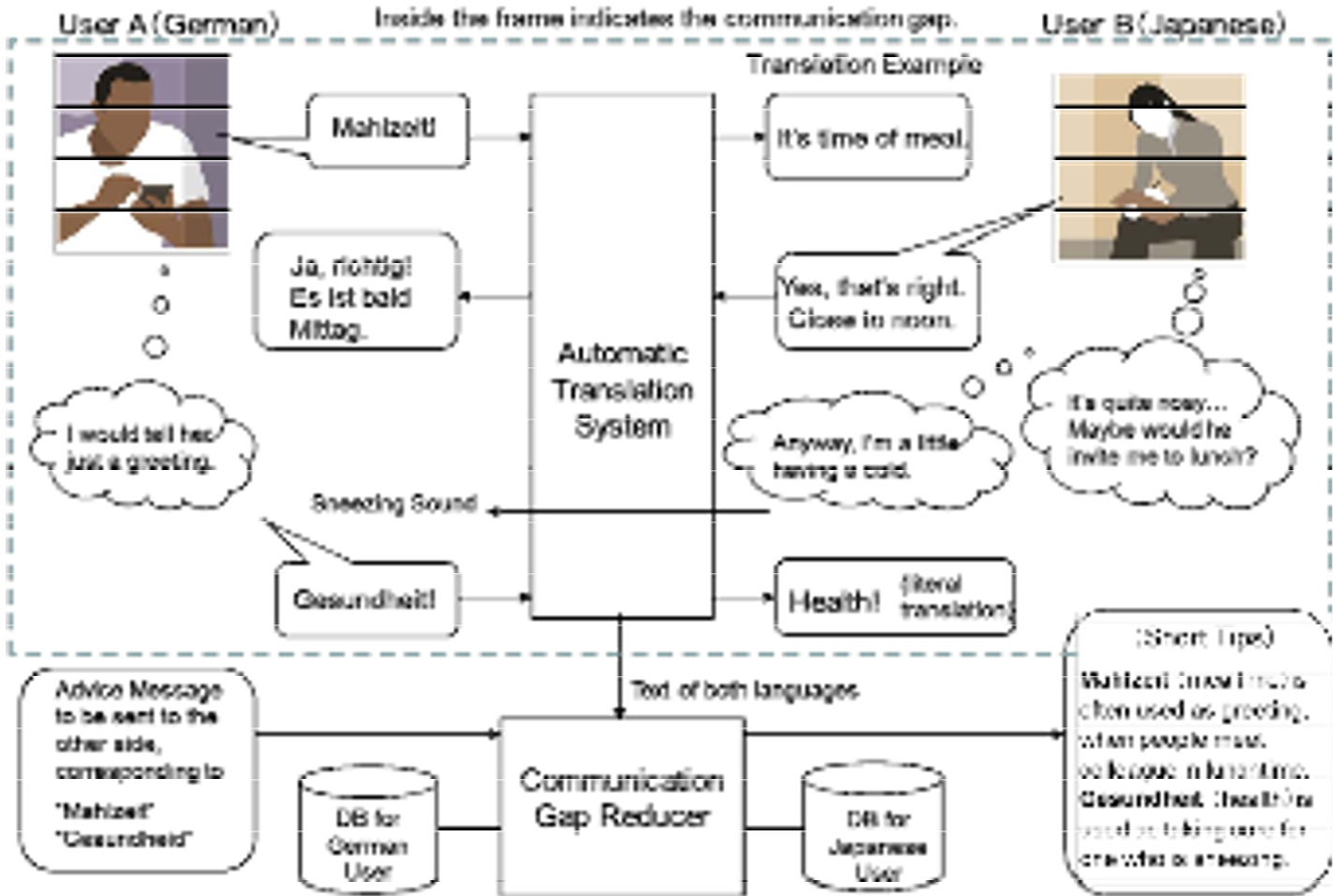
As shown in the architecture above, the system doesn't just display the translation; it provides an alert or explanation (e.g., "In this context, Mahlzeit is used as a greeting") to resolve the gap before it causes social friction.
Experiments & Case Study: The "Mahlzeit" Incident
The paper illustrates the method using a blog post by a Japanese woman in Germany.
- The Experience: She was confused when colleagues said "Mahlzeit" in the canteen, wondering if she should say "That's right" or "As you see."
- The Resolution: Only after her husband laughed and explained it was a greeting did the gap close.
The authors demonstrate that by analyzing such articles, we can extract the specific "Affective Features" of the context. Using their previous research [1] on "Concise Expressions," they show that comparing expressions like "Let it be" vs. "Let it go" through emotional co-occurrence reveals their true usage nuances—a technique they now apply to cultural gaps.
Critical Analysis & Future Outlook
Takeaway
The true value of this paper lies in its data source selection. Instead of using sterile parallel corpora (like UN proceedings), it looks at the "messy" reflections of actual learners. This captures the subjective experience of language, which is where cultural gaps actually live.
Limitations
- Scalability: Manual refinement is currently needed to avoid "nosy detection" (false positives).
- Real-time Latency: Identifying and retrieving these explanations in a live dialogue without breaking the flow of conversation remains a significant UI/UX challenge.
Future Work
As Large Language Models (LLMs) continue to evolve, the framework proposed here could be used to fine-tune models to behave more like "Cultural Mediators" rather than just dictionaries. The next frontier is moving from detection to proactive prevention of cross-cultural dissonance.
References
- [1] Suzuki & Kimura (2014) on Concise Expressions and Affective Features.
- [2] Tomasello (2003) on Usage-based Theory of Language Acquisition.