
Who Helps Whom: Rethinking Energy Efficiency in Cooperative OFDM Networks
15455_Resource Allocation for Multiuser Cooperative OFDM Networks Who Helps Whom and How to Cooperate.
This paper introduces a joint resource allocation framework for multiuser cooperative OFDM networks, addressing the fundamental "who helps whom" and "how to cooperate" questions. By utilizing subcarrier-based Amplify-and-Forward (AF) relaying without dedicated time slots, the proposed scheme achieves significant transmit power savings—up to 54% in multiuser scenarios—while maintaining SOTA bandwidth efficiency.
TL;DR
Power consumption is the Achilles' heel of mobile networks. In this seminal work, researchers move beyond traditional "selfish" resource allocation to a "cooperative" paradigm. By allowing users to lend their OFDM subcarriers to relay data for others, the system dramatically reduces total transmit power (up to 54%) without sacrificing bandwidth.
The "Broadcast Nature" Insight
In a wireless world, every transmission is a broadcast. When User A sends data to the Base Station (BS), User B—who might be closer to the BS—can often hear it. Traditional systems treat this as interference or wasted energy. This paper asks: What if User B could use its own subcarriers to relay User A’s data?
The challenge is twofold:
- Relay Selection: Among dozens of distributive users, who is the optimal partner for whom?
- Resource Partitioning: How many subcarriers should a "helper" sacrifice for others vs. keep for its own high-rate data?
Methodology: The Assignment Matrix
The core of the paper is the definition of a assignment matrix . Unlike standard OFDM where each subcarrier belongs to its own user, here a subcarrier can be assigned to help user .
The Cooperative Protocol
The system employs the Amplify-and-Forward (AF) protocol. The helping user picks up the source signal, amplifies it, and retransmits it on a different subcarrier. The BS then uses Maximal Ratio Combining (MRC) to merge the direct signal and the relayed signal, creating "Cooperative Diversity" that mimics a multi-antenna system.
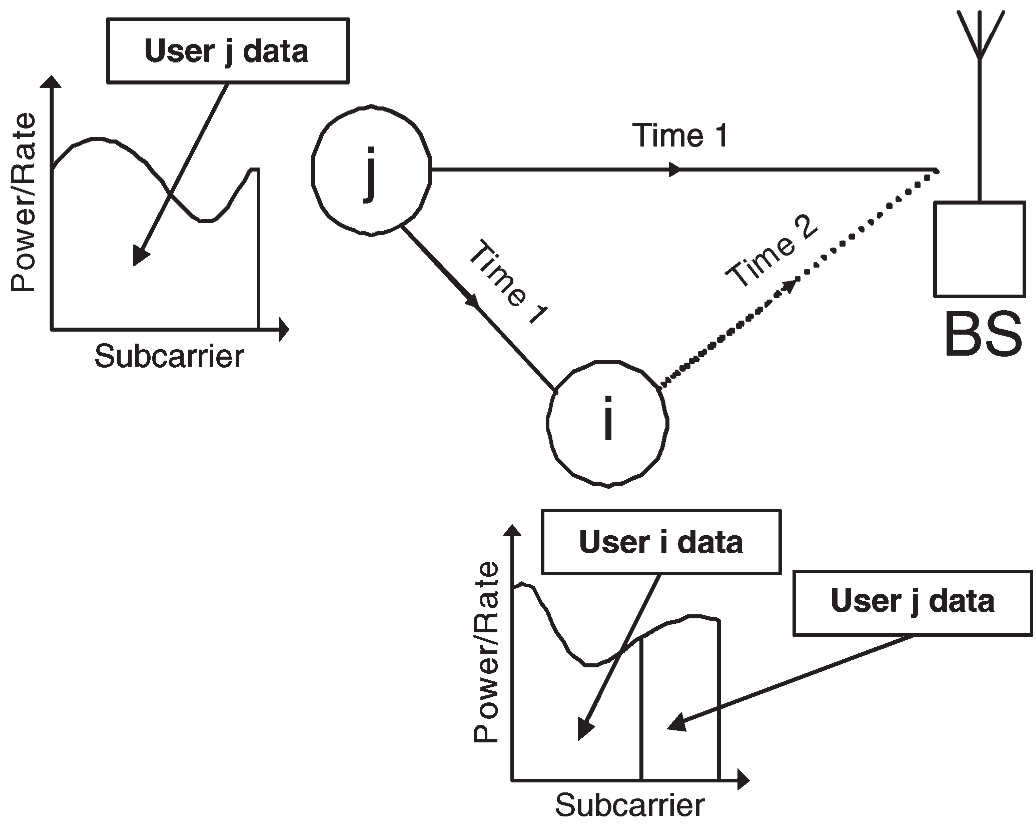 Fig 1: User i helps User j by relaying data on specific subcarriers while maintaining its own transmission.
A Greedy Solution for an NP-Hard Problem
Optimizing and the power vector is an NP-hard problem. The authors propose a Suboptimal Greedy Algorithm:
- Identify Pains: Sort users by transmit power. The user with the highest power (likely far from the BS) is the primary candidate to be "helped."
- Optimize the Helpers: The user with the lowest power (closest to the BS) is the "helper."
- Iterate: The algorithm tries assigning subcarriers one by one, calculating the power reduction, and committing to the change only if the total system power decreases.
Experimental Proof: When is Cooperation Best?
The simulation results yield a fascinating "Cooperation Region" map.
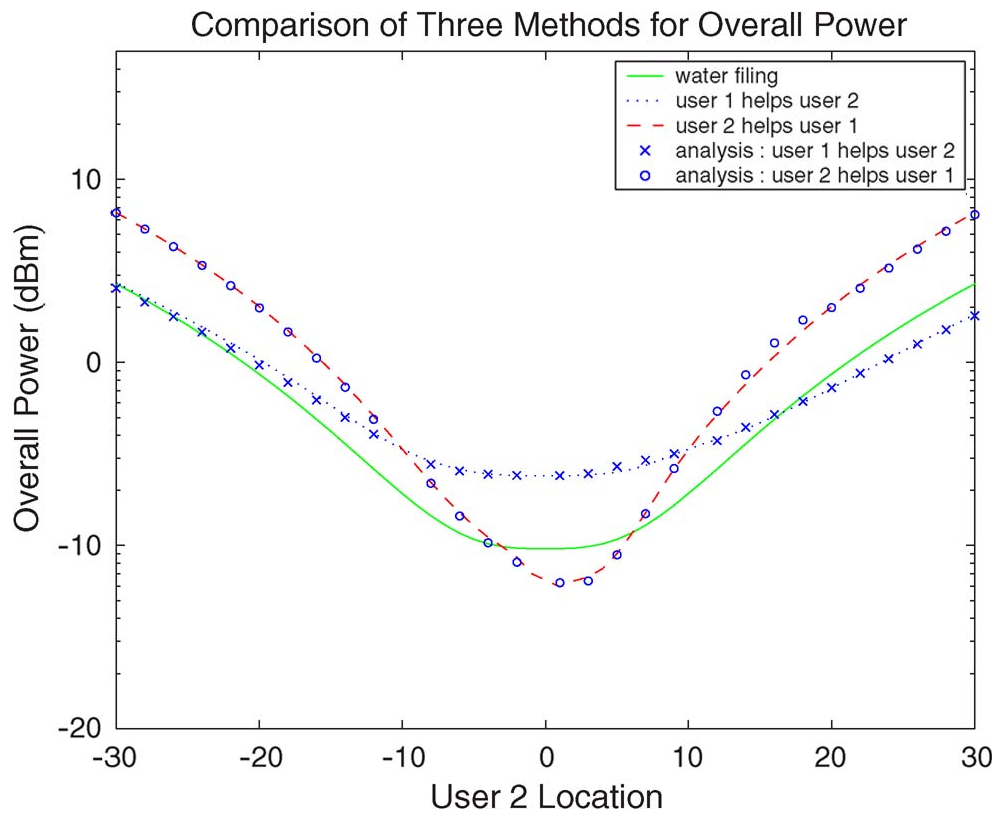 Fig 2: The optimal strategy (User 1 helps 2, User 2 helps 1, or Water-filling) depends heavily on the geographic/channel location of User 2 relative to User 1 and the BS.
Key findings include:
- Asymmetry is Key: If two users are equally far from the BS, cooperation offers little gain. But if one is near and one is far, the near user can relay the far user's data with minimal extra energy, saving massive amounts of power for the far user.
- Shadow Fading Benefits: Counter-intuitively, as environmental "shadowing" (variances in signal strength) increases, the benefits of cooperation increase because the system finds more extreme channel asymmetries to exploit.
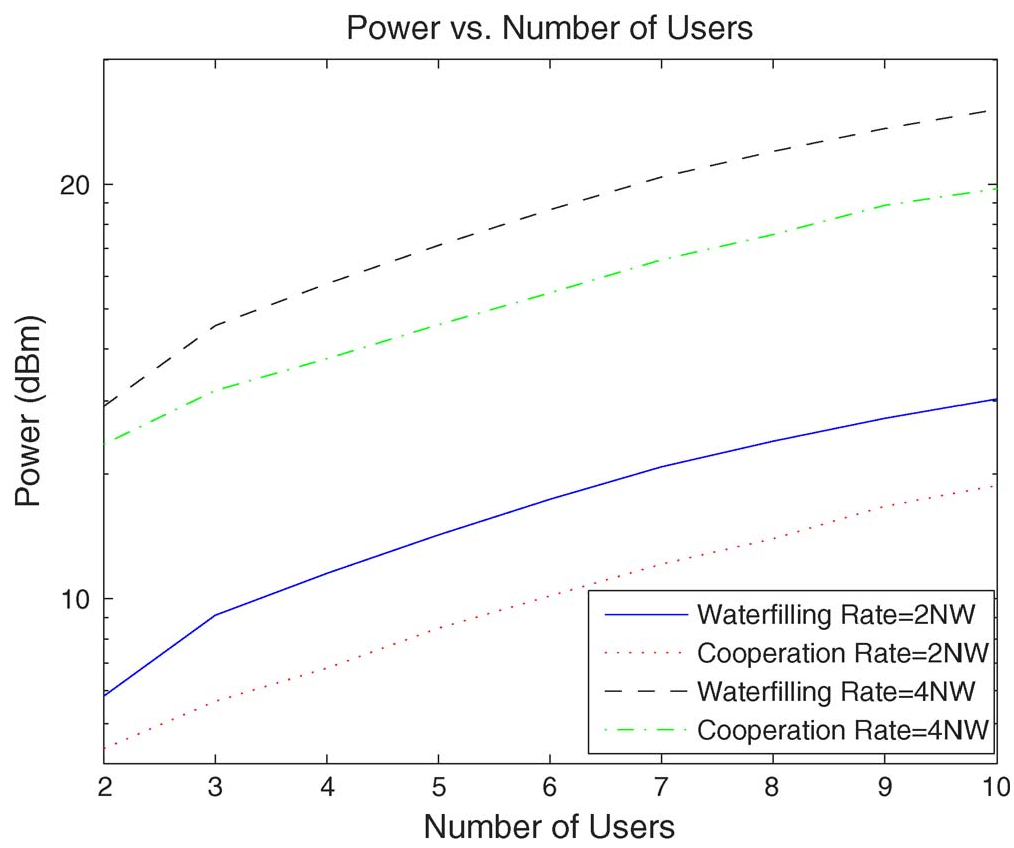 Fig 3: Power savings scale with the number of users, as more users provide more "helping" opportunities.
Critical Analysis & Conclusion
While the paper provides a robust framework, it assumes a "perfectly altruistic" network. In real-world scenarios, a "helper" user may be reluctant to drain their own battery to help a stranger. Future extensions of this work often integrate Game Theory (Stackelberg games) to provide incentives for cooperation.
Takeaway: This work transformed resource allocation from a localized optimization problem into a global social-network-like optimization, proving that in wireless systems, the whole is significantly greater than the sum of its parts.