
MediMap: Bridging Knowledge Technologies and Public Health Planning
Resource Modeling and Analysis of Regional Public Health Care Data by Means of Knowledge Technologies
The paper introduces a knowledge technology framework for public health management in Slovenia, utilizing clustering, decision trees, and the DEXi multi-attribute decision support system. It successfully identifies regional healthcare disparities and models service accessibility in the Celje region to optimize resource allocation.
TL;DR
The MediMap project leverages advanced data mining and decision support tools to revolutionize regional healthcare management in Slovenia. By integrating hierarchical clustering, decision trees, and the DEXi multi-attribute model, the study provides a roadmap for identifying underserved communities and optimizing the distribution of pharmacies and specialists based on actual patient migration patterns.
Contextual Positioning
In the landscape of public health, "Data Rich, Information Poor" is a common trap. This paper stands as a seminal reference model for the Slovenian Public Health Institute (PHI). It moves beyond simple descriptive statistics to establish a predictive and evaluative framework that accounts for geographical and demographic "inductive biases."
The Core Problem: Hidden Inequities
Standard healthcare planning often treats administrative boundaries as closed systems. However, patients migrate between regions for better specialists. Prior works often failed to:
- Account for these migration flows.
- Identify why certain health centers performed differently (e.g., the "pediatrician gap").
- Quantify qualitative factors like "appropriateness" of infrastructure in a standardized way.
Methodology: The Hybrid Approach
1. Understanding Patient Flow through Clustering
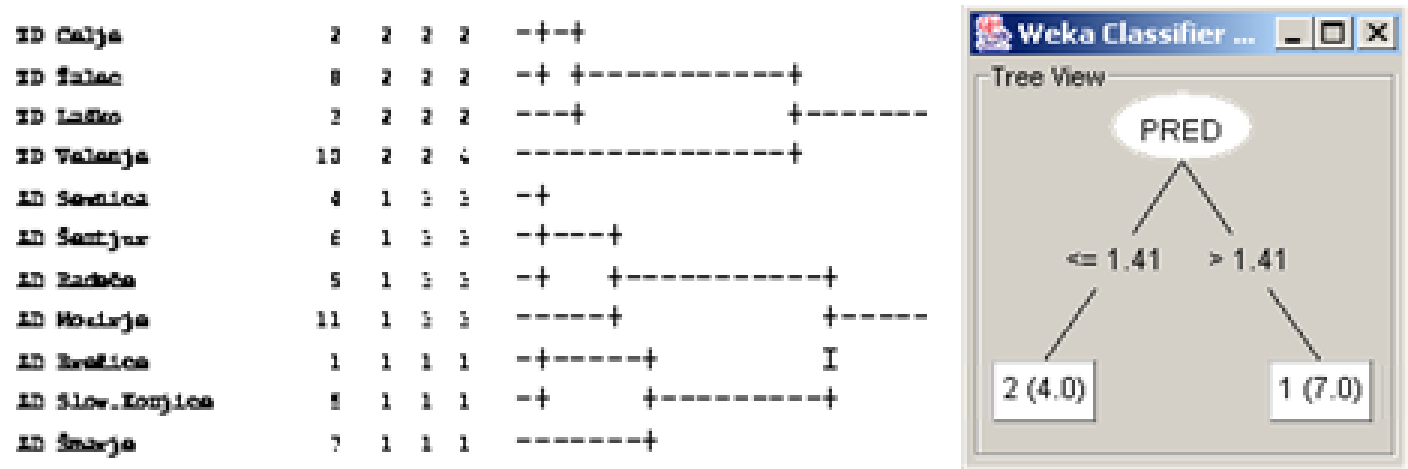
The researchers used four categories (age, social status, organization, and employment structure) to group community health centers. By applying Agglomerative Hierarchical Clustering and refining it with a Decision Tree, they discovered a critical threshold: health centers where pre-school children visits exceeded 1.41% were effectively operating without specialized pediatricians—a vital insight for staffing policy.
2. The DEXi Qualitative Model
For pharmacy capacities, the team utilized the DEXi multi-attribute system. Unlike purely quantitative models that struggle with "soft" variables, DEXi allows for a hierarchical decomposition of criteria (Infrastructure, Human Resources, Inhabitants) into qualitative scales (Excellent, Adequate, Inadequate).
3. The AHSPm Metric
The paper’s mathematical centerpiece is the AHSPm formula, which measures the availability of health services while considering patient migration ():
This ensures that a community isn't just judged by the clinics within its borders, but by the actual time-weighted access its citizens have to surrounding facilities.
Experimental Insights & Results
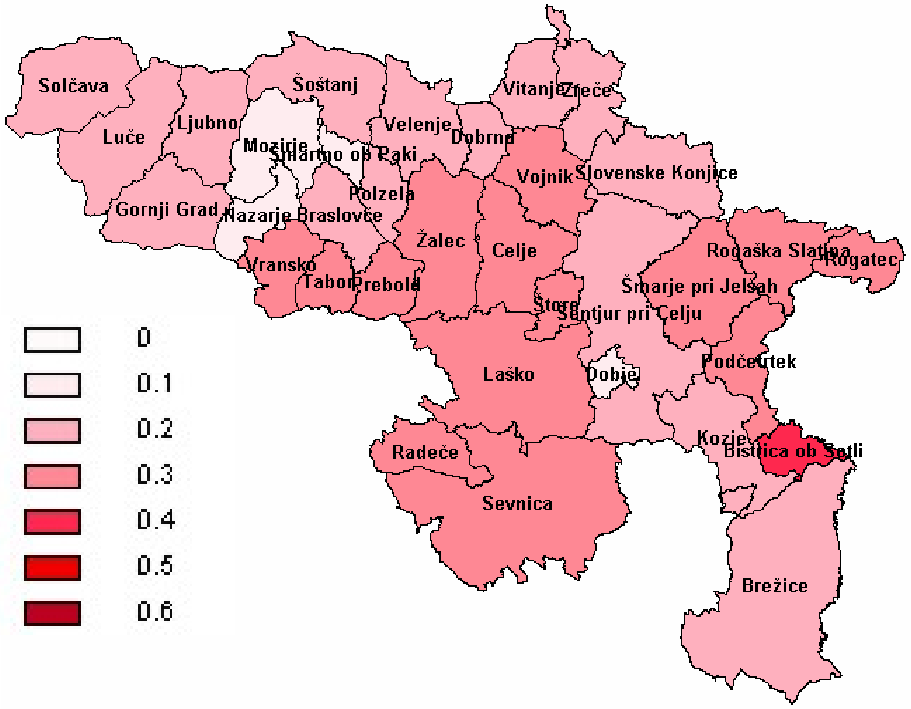
The analysis of the Celje region yielded high-resolution visual evidence of healthcare "deserts" and "oases."
- Pharmacy Outliers: While five regional pharmacies showed a balanced requirement-capacity tradeoff, Žalec and Velenje were identified as significant outliers, suggesting a need for infrastructure reassessment.
- Accessibility Mapping: The migration-aware mapping (Figure 4) revealed that darker-shaded communities enjoyed significantly higher health coverage, providing a clear "heat map" for future government funding.
Critical Analysis & Conclusion
Takeaway: The MediMap project proves that "Knowledge Management" in health care is not just about storing data—it's about the dynamic modeling of accessibility.
Limitations: The model relies on the accuracy of migration data, which can be lagging. Furthermore, the qualitative rules in DEXi depend on expert input, which may introduce subjective bias.
Future Outlook: As we move toward 2026, integrating this framework with real-time electronic health records (EHR) and AI-driven predictive analytics could allow for "Live Resource Rebalancing," shifting specialists to regions before a capacity crisis occurs.