
The Power of Defaults: How UI Design and "Privacy by Default" Shape Social Sharing
Configuration Behavior of Restrictive Default Privacy Settings on Social Network Sites Analyzing the Combined Effect of Default Settings and Interface Style
This paper investigates the "Configuration Behavior of Restrictive Default Privacy Settings on Social Network Sites," specifically testing the impact of Privacy by Default (PbDef) versus permissive defaults. Using a custom-built SNS privacy interface prototype, it explores how default restrictiveness and interface style (List vs. Menu) interact to influence user self-disclosure.
TL;DR
Does pre-setting your social media profile to "Private" actually stop you from sharing, or does your social need to connect override the default? This study of 632 users reveals that defaults are destiny. Users rarely deviate from restrictive settings, and this "stickiness" is amplified by complex, multi-page interfaces that create friction for those wanting to share.
Background: The Clash of Privacy and Social Utility
Social Network Sites (SNS) thrive on disclosure, yet regulators are pushing for Privacy by Default (PbDef)—the principle that the most restrictive privacy setting should be the baseline. This creates a fascinating psychological tension:
- The Status Quo Bias: Humans are inherently "lazy" or cognitively taxed, leading them to accept defaults as the "correct" or easiest choice.
- The Privacy Calculus: Users weigh the benefits of social capital (likes, connection) against the risks of data exposure.
The author, Markus Tschersich, explores whether the "need to share" is strong enough to break the gravitational pull of a restrictive default setting.
Methodology: The Prototype Experiment
To test this, the researcher built a custom SNS privacy interface and assigned 632 participants to four groups based on two dimensions:
- Default Setting: Either "Only Me" (Restrictive) or "Everybody" (Permissive).
- Interface Style: Either a List (all 14 settings on one transparent page) or a Menu (settings hidden across multiple category pages).
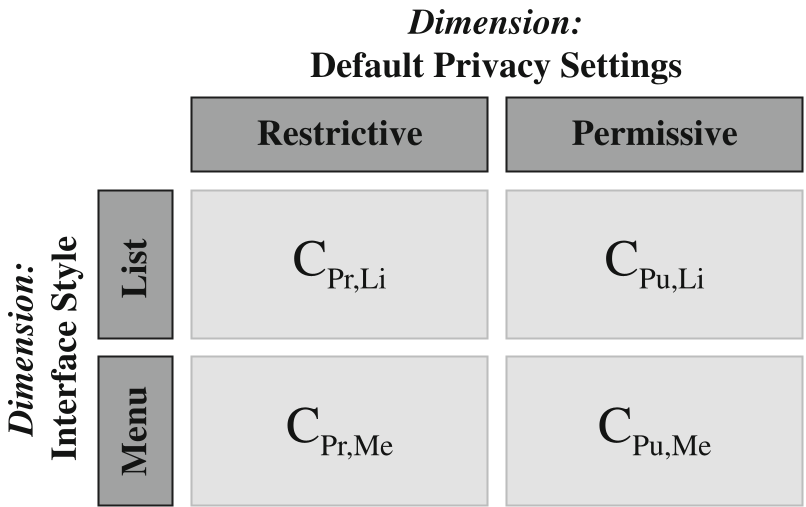
The settings spanned three categories: Profile Information, Status Updates, and Media.
Key Findings: Friction is a Privacy Shield
The study utilized the Scheirer-Ray-Hare (SHR) test, a robust non-parametric tool, to analyze the data. Two major insights emerged:
1. Defaults are Extremely Sticky
Hypothesis 1 was confirmed: users with restrictive defaults shared significantly less than those with permissive defaults. The "need for social capital" did not automatically drive users to open up their profiles if they were closed by default.
2. Multi-Page Menus Kill Active Configuration
The most striking discovery was the combined effect of the interface and the default. For categories like "Status Updates" and "Media," users in the Menu group were far more likely to stick to the default than those in the List group.
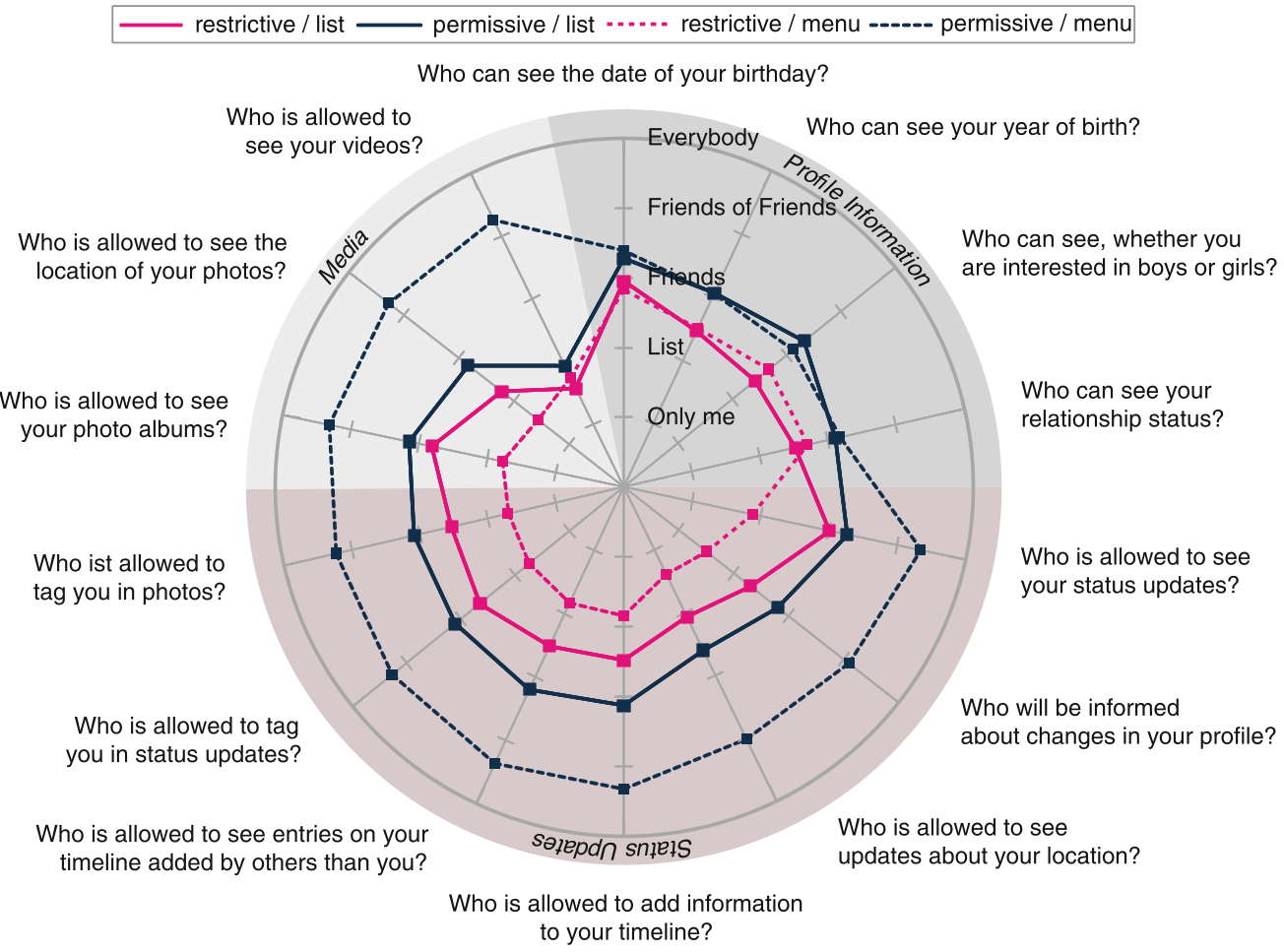 In the radar chart above, notice how the "Menu" groups (dotted lines) stay closer to the extreme ends of the spectrum (1 for Everybody, 5 for Only Me) compared to the "List" groups (solid lines), which converge toward a middle ground (Friends).
Critical Analysis: Why This Matters
The research highlights that transparency is the enemy of inertia.
- In a List interface, users saw all choices at once, reducing the "physical and cognitive laziness" that keeps defaults in place. Most users adjusted their settings to "Friends."
- In a Menu interface, the effort required to click through pages acted as a barrier. If the default was "Private," the info stayed private. If it was "Public," the info stayed public.
Implications for the Industry
- For Regulators: PbDef is highly effective. Even if users want to share, a restrictive default keeps them protected unless they make a conscious, multi-step effort to change it.
- For SNS Providers: To maintain user engagement under PbDef laws, platforms must move away from complex menus. They need high-transparency "List" styles to help users easily find the "Share with Friends" sweet spot.
Conclusion & Future Work
The study proves that the Status Quo Bias outweighs the Privacy Calculus when the interface is complex. However, the study is limited to a student demographic and short-term decisions. Future research must examine whether "social pressure" (e.g., a friend asking why they can't see your photo) eventually forces users to overcome the default's inertia in the long run.
Takeaway: If you want to protect users, set the default to private. If you want them to choose for themselves, make the UI as flat and transparent as possible.