
Rethinking Professional Education: How Podcasts Are Bridging the AI-Design Gap
Rethinking Continuous University Education for Professionals – A Podcast-Based Course on Service Design and AI
The paper explores "Human-Centered Machine Learning," a podcast-based university course designed specifically for senior professionals. It utilizes a mobile learning (m-learning) framework to deliver interdisciplinary content at the intersection of Service Design and Artificial Intelligence, achieving over 3,000 downloads within its initial launch phase.
TL;DR
As AI reshapes the professional landscape, senior practitioners face a "skills obsolescence" crisis. Traditional university models are too slow to help. This paper introduces a podcast-based course architecture that delivers high-level University content on Human-Centered AI directly to professionals' smartphones, proving that "listening in" on expert dialogues is a superior model for time-pressured experts than sitting in a virtual classroom.
The Motivation: The "Senior Pro" Dilemma
We are currently in a race against time. In the EU, approximately 46% of workers fear their skills will be outdated within five years due to the AI revolution. However, a senior UX Designer or a Lead Software Engineer cannot simply quit their job to attend a campus-based Master's program.
The authors identify a critical gap: Traditional Higher Education is "regressive." Even when they go digital, they often just upload 60-minute video lectures that require a student to be tethered to a desk. The researchers’ insight was to leverage the "Push" mechanics of Podcasting—treating the professional learner not as a traditional student, but as a mobile, busy expert who learns while commuting, walking, or at the gym.
Methodology: The Podcast-First Architecture
The researchers moved beyond the "recorded lecture" trope. They formed a multidisciplinary working group to design a 12-episode "show" titled Human-Centered Machine Learning.
Core Structural Design
The course was split into two logical halves to facilitate cross-pollination between "Techies" and "Designers":
- Episodes 1-6: Technical Foundations (Theory, Deep Learning, GANs).
- Episodes 7-12: Applied Design and Ethics (Agentive Tech, Healthcare, Mobility, and Ethical Challenges).

The "A-ha" Moment in Design
The authors realized that credits (ECTS) don't matter to senior professionals as much as frictionless access does. By offering the course as a MOOC (Massive Open Online Course) without formal grading/credits, they eliminated administrative overhead, allowing learners to be 100% self-paced and focus purely on the "Expert Dialogue" format.
Experiments & Quantitative Reach
The course was distributed via major platforms (Spotify, Apple Podcasts). The results suggest a "Long Tail" of interest in technical subjects:
| Episode | Topic | Core Focus | Downloads |
|---|---|---|---|
| 1 | Introduction | Holistic Overview | 552 |
| 5 | Deep Learning | Technical Deep Dive | 187 |
| 12 | Ethical Challenges | Societal Impact | 354 |
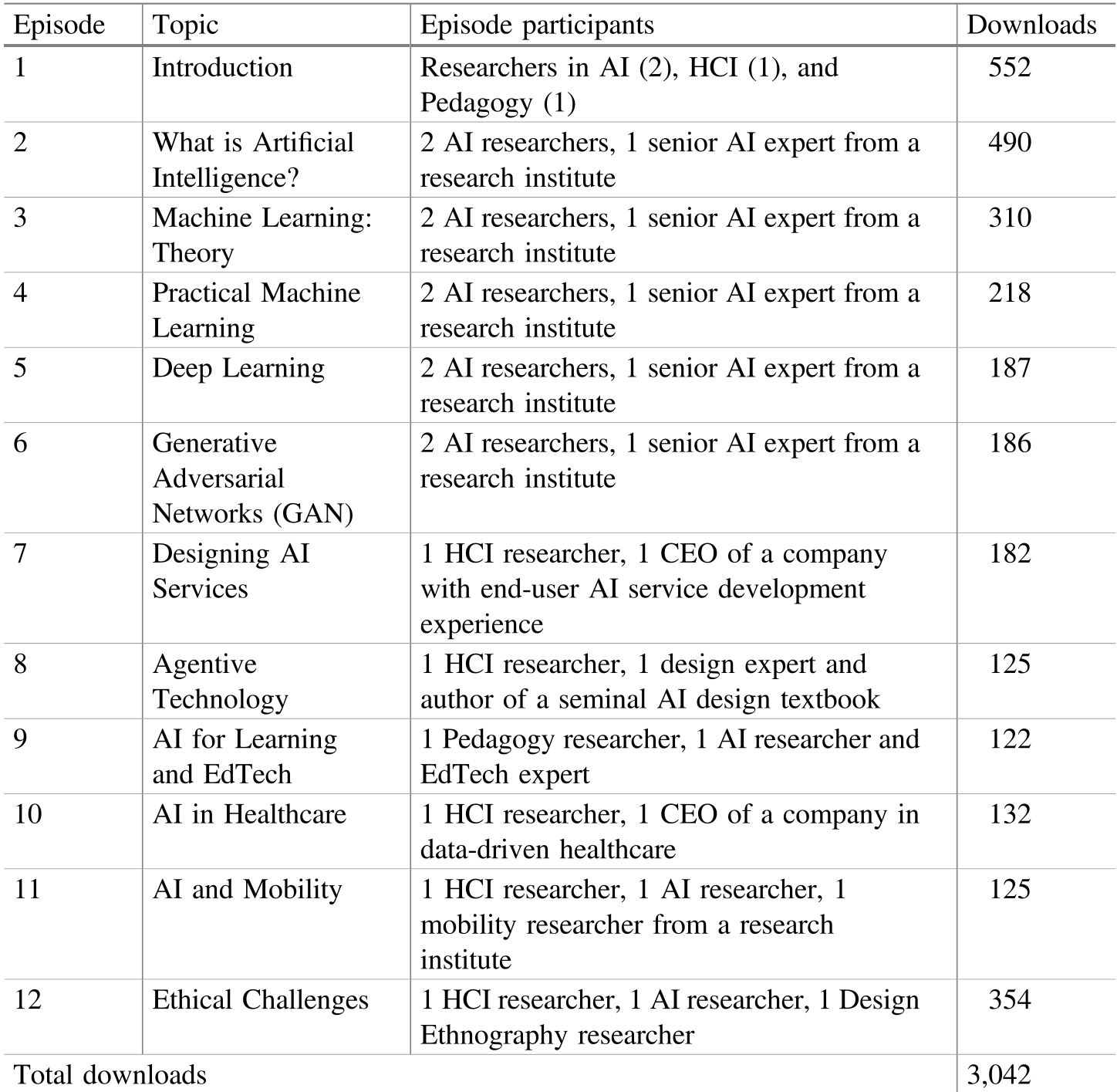
Key Finding: The "Ethics" episode (354 downloads) performed significantly better than some specific technical modules, suggesting that senior professionals are deeply concerned with the implications of AI, not just the implementation.
Critical Analysis & Insights
The evaluation (though based on a small initial sample) reveals critical takeaways for the future of Academic Tech:
- Audio Mobility is King: 100% of participants used the course during "transitional" times (commuting, chores). This "dead time" is the only space senior pros have for upskilling.
- The "Dialogue" Advantage: Participants preferred the interview format over solo lectures. Hearing two experts debate a topic provides "authentic context" that a textbook cannot replicate.
- The Sound Quality Barrier: In m-learning, audio quality is the user interface. Poor levels or background noise aren't just annoying—they break the learning process in mobile environments like subways.
Limitations
The obvious drawback of an audio-only format is the lack of visual evidence (diagrams, code snippets, manifolds). While the authors provided a companion website, only roughly 50% of listeners visited it. Future iterations may need to explore "Enhanced Podcasts" or synchronized video snippets for complex mathematical concepts.
Conclusion
This paper serves as a blueprint for universities looking to stay relevant in the AI era. By moving from a "location-based" mindset to a "lifestyle-integrated" mindset, educators can effectively bridge the gap between complex AI research and professional practice. The future of higher education isn't just in the cloud; it's in the professional's pocket.