
Rethinking the Cross-Cultural Interaction Architecture: From Functional Interfaces to Symbiotic Spaces
Rethinking the cross-cultural interaction architecture
This paper explores a conceptual framework for cross-cultural interfacing, proposing a "Holonic Architecture" to model the complexity of human interactions. It introduces the concepts of cultural holons and "symbiosis" to bridge the gap between objective reality and experienced actuality in digital design.
TL;DR
In an era dominated by multimodal media, our digital interfaces remain stubbornly functionalist. This paper argues that we must look beyond "observed reality" to design for "actuality"—the lived, experienced world. By introducing Holonic Architectures and the concept of Symbiosis, the author provides a roadmap for designing technolgies that respect cultural identity while fostering global interaction.
The "One Best Way" Trap
Traditional interface design suffers from a "techno-centric" delusion: the belief in a single, optimal interaction pattern—the "one best way." This reductionist logic views culture as a mere technical artifact.
The author points out a critical failure in current systems (e.g., UK healthcare or e-governance): they focus on objective data (reality) but ignore the user's subjective context (actuality). This creates a Rationality Gap that leads to social alienation and the breakdown of communication.
Methodology: The Holonic Multi-Cultural Model
To capture the complexity of human societies, the paper proposes a hierarchy of Cultural Holons. A holon is a system that is both a whole and a part of a larger system.
1. The Taxonomy of Complexity
- Linear Holon: Direct one-to-one interaction (e.g., the Internet). Efficient but unstable, lacking mediation or social filtering.
- Trinity Holon: A three-node model allowing for democratic dialogue and mediation.
- Panchtantra, Samurai, & Dragon Holons: Higher-order architectures (5, 7, and 9 nodes) representing the sophisticated social structures of Indian, Japanese, and Chinese cultures respectively.
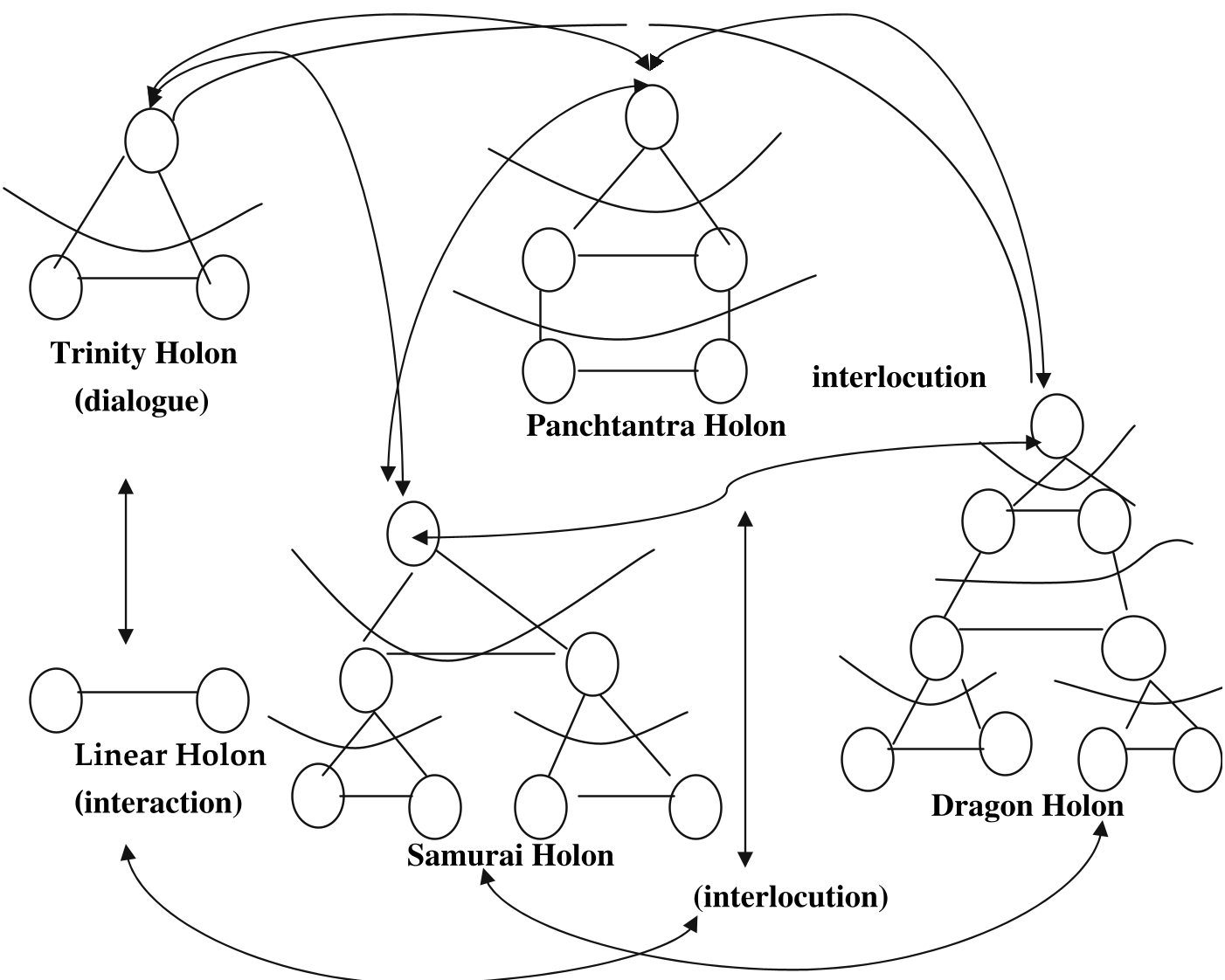
2. Symbiosis and the "In-Between" Space
The most profound insight is the move toward a Symbiotic Interface. Drawing from Japanese philosophy, the author distinguishes between:
- The Real Self: The "experienced" self (objective data).
- The Actual Self: The "experiencing" self (the "now" that includes past expectations and future hopes).
Symbiosis is the "between-ness"—the design framework that bridges the gap between objective records and tacit, personal practice.
Why Reductionism Fails
The paper warns against reducing complex holons (like a "Dragon" architecture) into simple "Linear" ones. When we force complex cultural interactions into linear digital links, we lose Social Cohesion.
For instance, electronic democracy often removes traditional "social filters" (family, community groups) and directs individuals to interact directly with governance. This often excludes the most vulnerable, as the technological architecture lacks the "pastoral care" or "social mentoring" inherent in more complex cultural holons.
Critical Insight: The Culture of the Artificial
How do we meet in a digital world without losing our roots? The author introduces the "Culture of the Artificial"—a third space where different cultures can meet and "valorize" (make the best use of) common experiences while maintaining distinct identities. Diversity here is not a bug to be smoothed over, but a tool for mutual learning.
Conclusion: Design as a Learning Process
The future of cross-cultural technology isn't just about better translation or faster speeds; it's about a conceptual shift. We must first establish a conceptual framework for interaction spaces—recognizing the symbiosis between reality and actuality—before we build the tools. Only then can we create interfaces that truly "see" and "hear" the human user within their specific cultural universe.