
Rethinking MSN Routing: Is GPS Truly Necessary for Data Delivery?
Rethinking routing information in mobile social networks: Location-based or social-based?
This paper presents a comparative study of two fundamental routing paradigms in Mobile Social Networks (MSNs): social-based and location-based strategies. The authors propose two comprehensive schemes, "Soc" (leveraging social centrality and similarity) and "Loc" (integrating mobility pattern similarity and geographical distance), to benchmark performance across real-world and synthetic traces.
Executive Summary
TL;DR: In Mobile Social Networks (MSNs), the debate between using "where you are" (location) versus "who you know" (social) for data routing is long-standing. This paper systematically proves that logical social information is a sufficient substitute for physical location data. Through the introduction of two benchmark schemes, Soc and Loc, the authors demonstrate that the performance difference between these two paradigms is negligible (often <5%), paving the way for more privacy-respecting and hardware-efficient network protocols.
Academic Positioning: This work acts as a critical evaluation of the "Information Utility vs. Privacy" trade-off in delay-tolerant networks. It challenges the assumption that granular physical data is superior to abstract social graphs for predicting future encounter opportunities.
The Core Dilemma: Physical vs. Logical
The fundamental problem in MSNs is predicting which "relay" node has the highest probability of meeting a destination node in an environment characterized by intermittent links.
- Location-based (Physical): Uses GPS coordinates and mobility patterns. Insight: "If we visit the same places, we will likely meet."
- Social-based (Logical): Uses encounter histories and social centrality. Insight: "If we have many common friends or I am socially active, I can deliver your message."
The authors identify a critical friction point: Location data is difficult to collect (requires GPS) and poses severe privacy risks. If social data performs just as well, why take the risk?
Methodology: The Soc and Loc Frameworks
To ensure a fair "apples-to-apples" comparison, the authors did not just look at existing protocols but designed two representative schemes.
1. The Soc Scheme (Social-Based)
Soc uses a sophisticated utility function that incorporates:
- Social Similarity: Common neighbors in the encounter graph.
- Social Centrality: Degree centrality to find "hubs."
- Time-Decay Convolution: A decaying factor ensures recent encounters carry more weight than old ones, capturing the dynamic nature of human movement.
2. The Loc Scheme (Location-Based)
Loc represents the spatial side by combining:
- Mobility Similarity: A matrix approach to calculate the probability of two nodes staying in the same grid square.
- Geographical Distance: The physical proximity of their visited locations.
 Figure 1: Comparison between Physical (Location) and Logical (Social) routing layers.
Experimental Showdown
The authors tested these schemes against three famous real-world datasets: MIT Reality (Campus), DieselNet (Buses), and Cabspotting (Urban Taxis).
Key Findings:
- Near Parity: In almost all tests, Soc and Loc were within 5% of each other.
- Soc's Slight Edge: On the MIT Reality trace, Soc achieved a slightly higher delivery ratio than Loc.
- Efficiency: Soc involves exchanging friend lists—a much smaller data footprint than the complex coordinate history required by Loc.
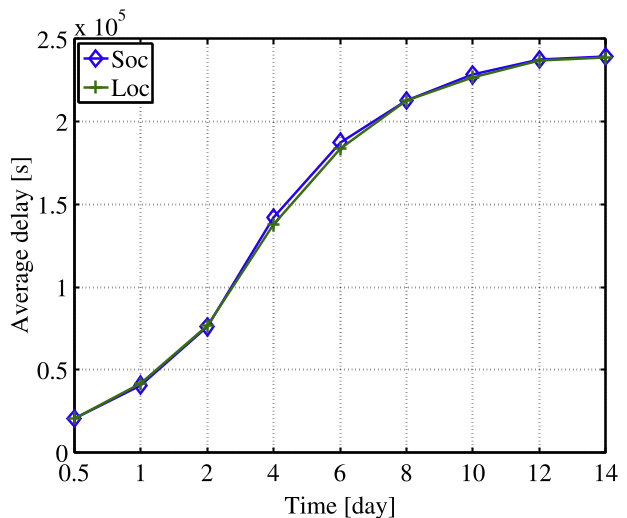 Figure 2: Performance metrics showing Soc and Loc converging in delivery ratio and delay over time.
Technical Insights: Why Does Social Data Succeed?
The effectiveness of the Soc scheme stems from the "Small World" nature of human mobility. Encounters are not random; they are driven by underlying social structures. Therefore, the encounter-based social graph is effectively a compressed, logical representation of physical movement.
By using a time-decaying convolution, the authors successfully filtered the "noise" of random one-off encounters, focusing instead on stable social ties that serve as reliable indicators for future message-passing opportunities.
Critical Analysis & Conclusion
Takeaway: This paper provides a "green light" for MSN developers to move away from GPS-dependent routing. Social-based routing is not only safer for user privacy but also computationally lighter and equally effective.
Limitations: While the study covers various node speeds and densities, it assumes nodes are willing to share their "friend lists." Future research should explore "Hidden Social Routing" to protect even the social metadata.
Future Outlook: As we move toward 6G and decentralized IoT, the ability to route data based on abstract "social" footprints rather than precise physical tracking will be vital for building trust in opportunistic networks.