
XMAS: Securing the Digital Frontier Through Intelligent Multimedia Retrieval
Retrieval of Illegal and Objectionable Multimedia
2008-09-01
Summary
Problem
Method
Results
Takeaways
Abstract
This paper introduces XMAS (X Multimedia Analysis System), a unified framework for detecting objectionable images and retrieving illegal movies. It combines MPEG-7 visual descriptors with multi-class Support Vector Machines (SVM) to achieve high-accuracy detection and classification in real-time.
## TL;DR
The rapid rise of Web 2.0 and User-Created Content (UCC) has made manual monitoring of illegal and objectionable content impossible. **XMAS (X Multimedia Analysis System)** provides a robust response by combining **MPEG-7 visual descriptors** with **Multi-class Support Vector Machines (SVM)**. With an accuracy rate exceeding 91%, XMAS effectively identifies adult content and detects unauthorized movie distributions even when files have been tampered with or re-encoded.
## The Crisis of Content Moderation
In the era of massive multimedia uploads, service providers face two critical threats:
1. **Digital Rights Infringement**: The unauthorized distribution of movies via UCC platforms.
2. **Harmful Content**: The exposure of children to objectionable or adult multimedia.
Prior solutions relied heavily on **hash-based comparison**, which is extremely fragile. If a user changes the video bit-rate or uses a different codec, the hash changes, and the system fails. XMAS moves beyond these superficial checks to analyze the *visual DNA* of the content.
## Methodology: The XMAS Framework
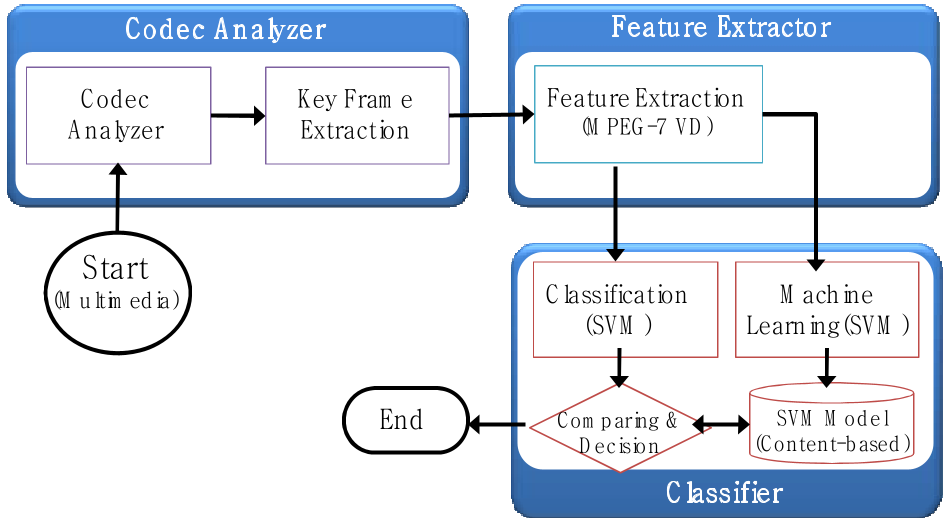
The system is built on a high-efficiency pipeline designed for high-throughput internet traffic.
### 1. Feature Extraction via MPEG-7
Rather than looking at raw pixels, XMAS extracts standardized visual descriptors:
* **Color Layout (CLD) & Color Structure (CSD)**: To capture the spatial distribution and frequency of colors.
* **Edge Histogram (EHD) & Region Shape (RSD)**: Crucial for identifying objectionable content where specific shapes (like close-up facial vs. other body parts) are key indicators.
### 2. Multi-Class SVM Classification
The system employs a non-linear SVM with a **Radial Basis Function (RBF) kernel**.
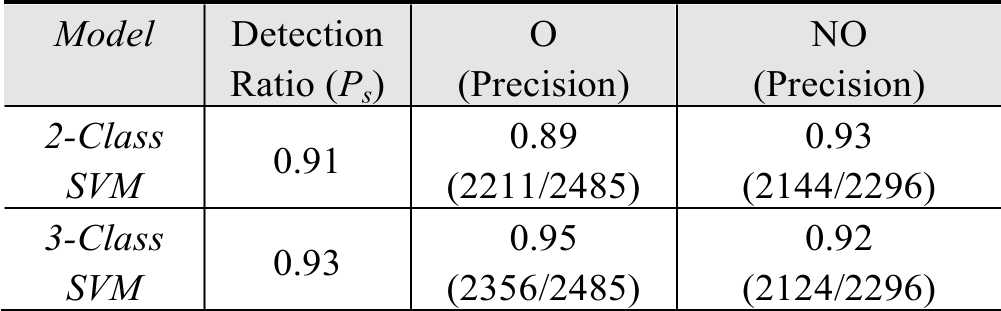
* **Case I (Objectionable Content)**: Uses a 3-class model (Normal, Close-up Facial, Objectionable).
* **Case II (Illegal Retrieval)**: Uses a multi-model approach to match frames against a "knowledge model" of copyrighted material.
### 3. The Probability Aggregator
To ensure stability in video detection, the authors implement a mathematical threshold based on the binomial distribution:
$$ p_{t} = \sum_{m = k}^{n} \binom{n}{m} p_{s}^{m} (1 - p_{s})^{n - m} $$
This formula calculates the total probability ($p_t$) that a video is illegal based on the single-frame detection probability ($p_s$), making the system highly resistant to "attacks" via frame dropping or codec changes.
## Experimental Validation
The authors tested XMAS against a variety of datasets and "attacked" movies (re-encoded via different software).
* **Objectionable Images**: Achieved a 0.95 precision in 3-class models for identifying harmful content.
* **Illegal Movie Retrieval**: Maintained a detection probability of **0.93 - 0.99** even after video attacks.
* **Efficiency**: The processing speed of roughly **12.8ms per frame** indicates that XMAS is viable for real-time monitoring on large-scale web services.
## Critical Analysis & Conclusion
**Strengths**:
The primary value of this work lies in its **robustness**. By using MPEG-7 descriptors, the system ignores the underlying file container (AVI, MKV, etc.) and focuses on visual structure. The multi-class SVM approach allows for more nuanced filtering than binary "Yes/No" classifiers.
**Limitations**:
While state-of-the-art at its inception, modern "deep-fake" technologies and highly complex adversarial attacks might require the transition from hand-crafted MPEG-7 descriptors to Convolutional Neural Network (CNN) feature extractors.
**The Bottom Line**:
XMAS serves as a foundational blueprint for automated internet governance. It demonstrates that combining standard multimedia descriptors with rigorous machine learning can create a "clean internet" environment while protecting the intellectual property of creators.