
Retweet Prediction: Leveraging the Intersection of Topic, Emotion, and Personality
Retweet Prediction based on Topic, Emotion and Personality
This paper introduces a retweet prediction framework that integrates explicit content features with high-dimensional implicit behavioral features—namely Topic, Emotion, and Personality (TEP). The authors propose two distinct modeling paradigms: a classification approach using XGBoost/Random Forest and a Matrix Factorization (MF) approach with novel tweet-similarity regularization terms, achieving 5%-9% and 4%-6% F1-score improvements over respective baselines.
TL;DR
Retweeting is the heartbeat of Twitter's information diffusion. While early models focused on "what" was said (hashtags, keywords), this paper dives into "who" is sharing and "how" they feel. By merging Twitter-LDA topics, 10-dimensional emotion vectors, and 35 personality facets, the researchers built a prediction engine that outperforms traditional baselines by up to 9% in F1-score using both XGBoost and custom Matrix Factorization.
Problem & Motivation: Beyond Keywords
Why do we retweet? It’s rarely just about a hashtag. Existing research often hit a glass ceiling by ignoring the psychological "Inductive Bias" of the user. Most models utilized binary sentiment (Positive vs. Negative), but human emotion is a spectrum (Joy, Fear, Disgust, etc.). Furthermore, personality traits—like Neuroticism or Openness—dictate our propensity to spread information.
The authors observed a critical gap: Personality conflict or emotional divergence can stop a retweet even if the topic matches the user's interest. Their insight was to treat a user's past timeline as a psychological mirror to predict future "virality" susceptibility.
Methodology: The TEP Framework
The core of this work lies in the Profile Generator, which translates raw text into a multidimensional behavioral space.
1. The Feature Trio
- Topic (Twitter-LDA): Unlike standard LDA, Twitter-LDA assumes one tweet has one topic, reducing noise in short-form text.
- Emotion (Plutchik’s Wheel): Using NRC lexicons, the model builds a 10D vector (8 emotions + 2 sentiments).
- Personality (Big Five): 35-dimensional scores covering traits and facets (e.g., Curiousness, Temperament) derived from Linguistic Inquiry and Word Count (LIWC) correlations.
2. Matrix Factorization with a Twist
While the classification approach (XGBoost) calculates similarity scores between user and tweet, the Matrix Factorization approach introduces a "Content-Aware" latent space.
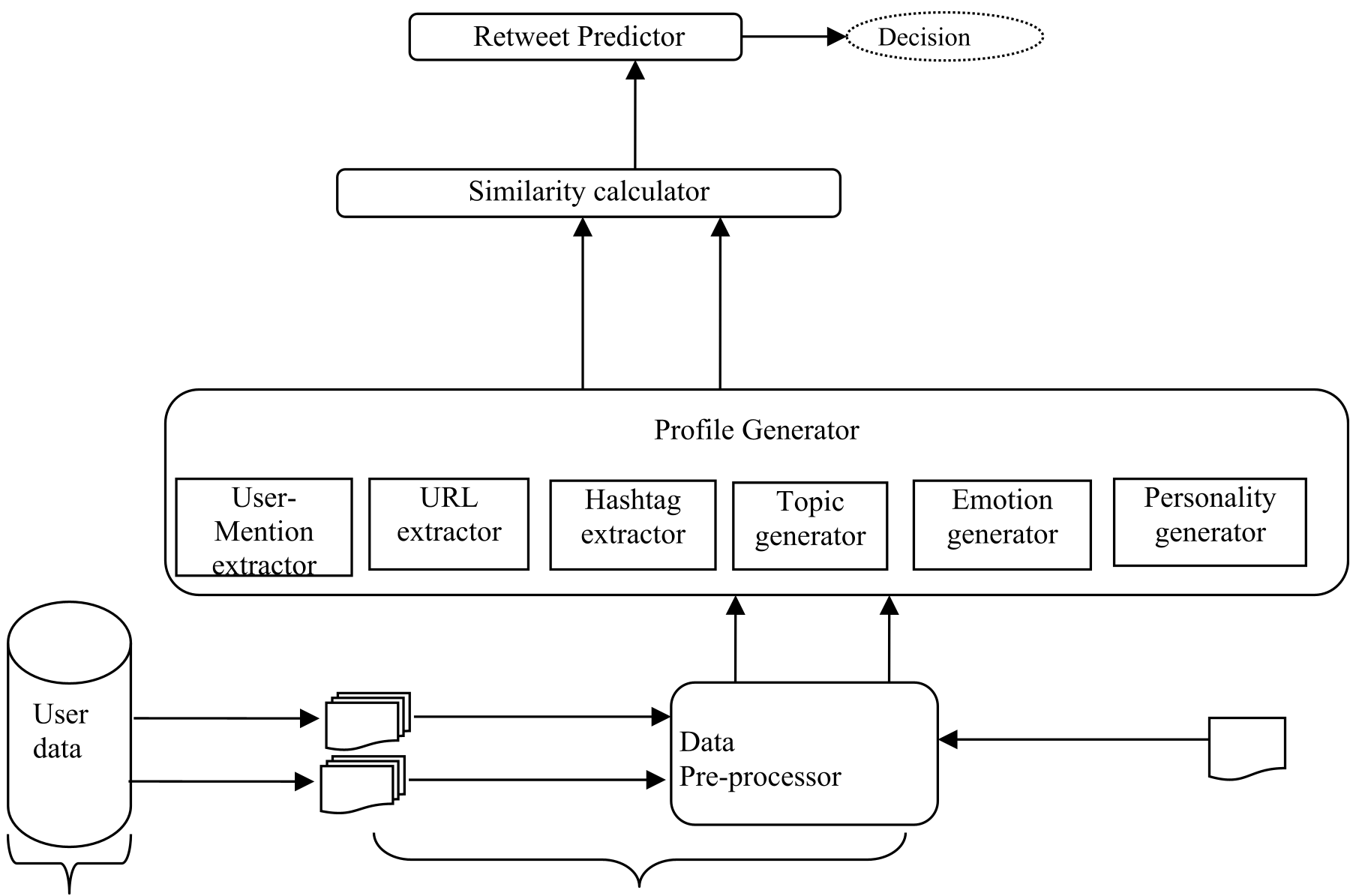
The authors proposed a new regularization term: If two tweets are similar in the observed space (Topic/Emotion/Personality), they must remain close in the latent space. This effectively forces the model to learn that "similar people retweet similar-vibe content."
Experiments & Results
The researchers tested their models on 1.6 million posts from 1,136 users.
Key Breakthroughs:
- Information Source: A major discovery was that retweet-only profiles are nearly as effective as "tweet+retweet" profiles but much faster to process. This suggests that the act of "curating" (retweeting) reveals more about our sharing behavior than the act of "creating" (tweeting).
- Model Performance:
- XGBoost (F-full): Highest F1-score, providing a 5-9% lift over TF-IDF and standard LDA baselines.
- Matrix Factorization (Approach 2): Bested the basic MF baseline by 6% in F1-score, notably excelling in Recall.
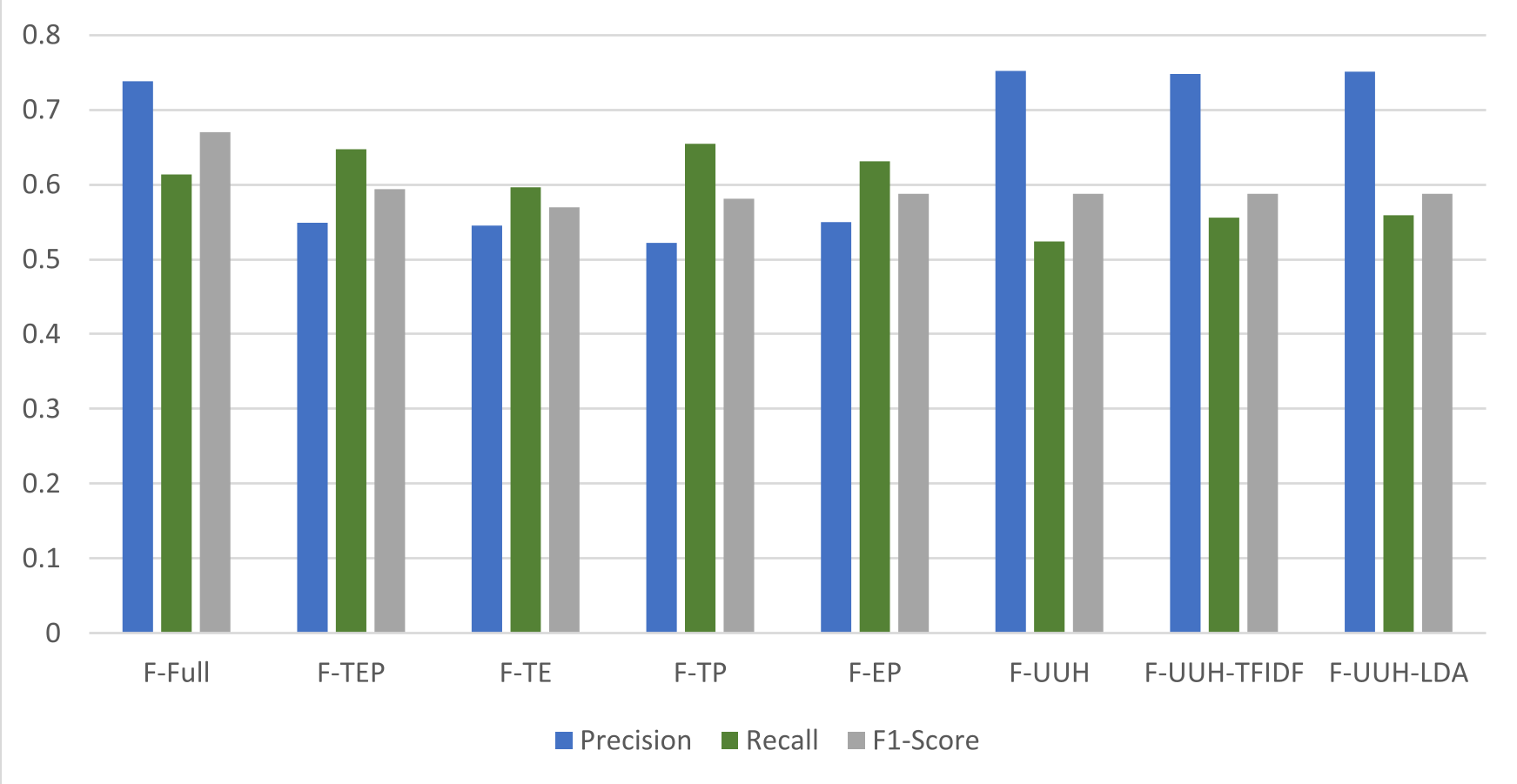
Precision vs. Recall Trade-off
An interesting academic takeaway: Machine Learning (Classification) provides higher Precision (avoiding false positives), making it ideal for Tweet Recommendation. However, Matrix Factorization provides higher Recall (finding all potential spreaders), making it the superior choice for Marketing Campaigns.
Deep Insight & Conclusion
This paper shifts the retweet prediction paradigm from "content-matching" to "psychological-profiling." The fact that Personality features consistently improved the Recall across all models proves that personality is a "subtle but strong" anchor for social behavior.
Limitations: The model is currently optimized for active users (100+ posts). For "lurkers" or less active accounts, the sparsity of emotional data remains a challenge.
Future Outlook: The next frontier is Behavioral Drift—how our personality stays static while our topical interests and emotional states shift over time. Integrating temporal dynamics into this TEP framework could unlock true real-time social sensing.