
Twitter as a Political Palantir: Decoding the 2016 Italian Referendum
Revealing Political Sentiment with Twitter: The Case Study of the 2016 Italian Constitutional Referendum
This study presents a sentiment analysis framework to determine the political orientation of Twitter users during the 2016 Italian Constitutional Referendum. Utilizing a dataset of 1.2M+ tweets and the Naive Bayes Multinomial Text algorithm, the method accurately classifies voter sentiment into YES, NO, or UNCERTAIN classes, demonstrating Twitter's role as a robust platform for political deliberation.
TL;DR
Researchers have developed a methodology to extract political leanings from Twitter by combining Multinomial Naive Bayes text classification with individual user behavioral analysis. By processing 1.2 million tweets from the 2016 Italian Constitutional Referendum, the study demonstrates that social media isn't just noise; it’s a high-resolution reflection of real-world political deliberation.
Context: This work positions itself as a robust ex-post analysis that validates Twitter as a legitimate arena for measuring public sentiment, bridging the gap between simple volume-based counting and complex predictive modeling.
Problem & Motivation: The "Loud" Minority Problem
Predicting shifts in public opinion is notoriously difficult on social networks. Traditional research often falls into the trap of assuming that the volume of mentions equals support. However, politics on Twitter is plagued by:
- Echo Chambers: Users primarily interact with like-minded individuals.
- Vocal Minorities: A small percentage of users generate the vast majority of content, potentially skewing results.
- Sarcasm and Ambiguity: Identifying whether a hashtag like #referendum implies a specific stance or mere neutral discussion.
The authors' insight was to move beyond simple keyword counting and implement a classifier that understands the probability of sentiment while accounting for user-level consistency.
Methodology: The Two-Tiered Approach
The core of the methodology lies in the Naive Bayes Multinomial Text algorithm, chosen for its computational efficiency and effectiveness in high-dimensional document classification.
1. The Bag-of-Words Pipeline
Text is converted into numerical feature vectors based on word frequency. To handle the nuances of the Italian language and Twitter-specific data, the authors developed a custom tokenization pipeline.
2. User-Behavioral Correction
Recognizing that a single tweet might be "UNCERTAIN," the researchers introduced a secondary check. If the classifier's confidence (prediction error) falls below a certain threshold, the system looks at the user's history. If that user consistently posts "NO" oriented content, the uncertain tweet is reclassified as "NO."
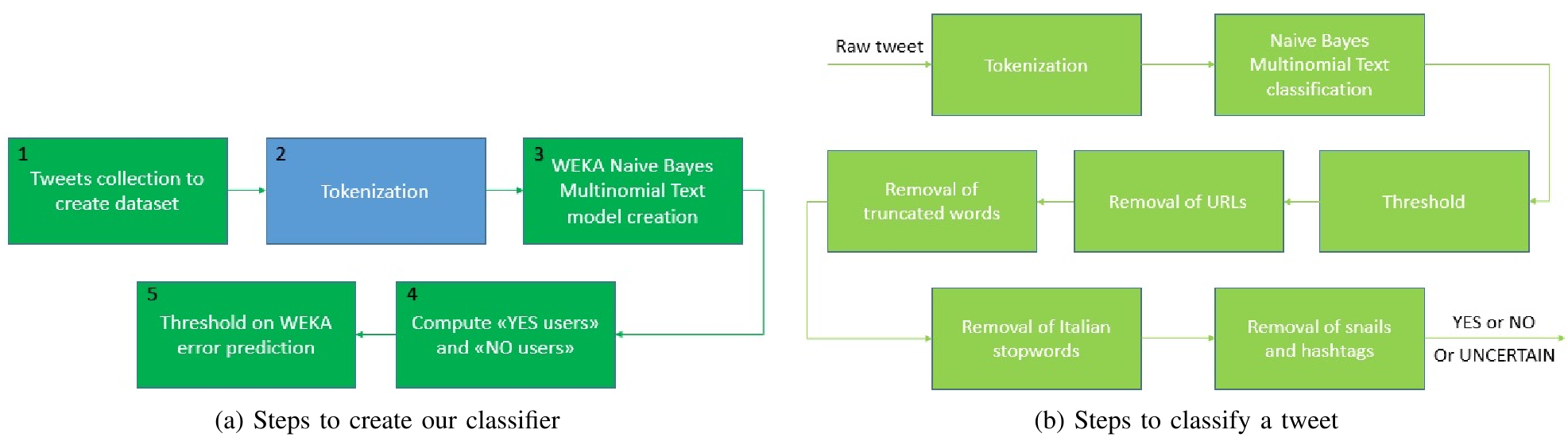 Fig 1: The dual-phase workflow integrating text processing and user-level labeling.
Experiments & Results: Validating the Model
The model was trained on a balanced dataset of ~310k tweets. The results were tested across different scenarios, specifically looking at how the "UNCERTAIN" class affects accuracy.
- Validation Accuracy: 99% (in a binary YES/NO split).
- Real-world Test Set: ~84.5% accuracy when excluding uncertain tweets.
- Threshold Impact: The authors found that setting a prediction threshold of 0.8 to 0.98 significantly increases precision, though it forces more tweets into the "UNCERTAIN" category.
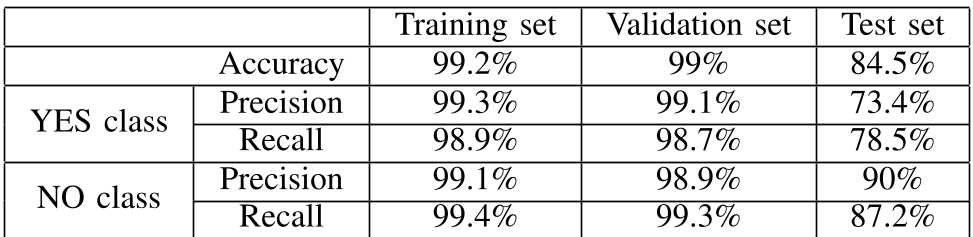 Table 1: Comparison of Accuracy, Precision, and Recall across Training, Validation, and Test sets.
The study successfully identified the prominence of the "NO" camp (59.11% in reality), matching the social media surge that correlated with televised debates.
Critical Analysis & Conclusion
Takeaway
The integration of user-level profiling with probabilistic text classification provides a much more resilient framework than keyword matching alone. It accounts for the fact that a user’s political identity is often more stable than a single, potentially ambiguous, tweet.
Limitations
The model struggles with the "UNCERTAIN" class because it lacks specific training examples for neutral content, relying instead on a mathematical fallback (thresholding). Furthermore, current Natural Language Processing (NLP) challenges like sarcasm remain difficult for Naive Bayes to disentangle.
Future Work
The authors suggest moving toward N-gram models (size 3-4) and Semantic-based approaches to better understand context. Integrating Big Data tools for real-time scalability could transform this from an ex-post analysis tool into a real-time political "weather map."
Editor's Note: This paper reaffirms that while Twitter may not be a perfect representative sample of a population, it provides a powerful, real-time reflection of the "public square" if handled with the right statistical rigor.