
Revealing the Ghost in the Pixels: Countering JPEG Anti-Forensics
11249_Revealing the Traces of JPEG Compression Anti-Forensics.
This paper introduces a "recompress-and-observe" detector to identify images treated with JPEG anti-forensics methods. The core approach leverages the idempotency property of quantization and a Total Variation (TV) metric to detect the grainy noise signatures left behind by anti-forensic dither, achieving over 93% average accuracy and 99% for standard quality factors.
TL;DR
Digital forensic analysts typically use JPEG artifacts—like the "comb" shape of DCT histograms—to catch photo forgeries. However, "Anti-Forensics" (AF) techniques were developed to hide these traces using clever noise dithering. This paper proves that these AF methods aren't perfect: they leave behind a "grainy" noise signature. By recompressing an image and watching how this noise disappears, the proposed method catches anti-forensic attempts with up to 99% accuracy.
Background: The Forensic Arms Race
When you save an image as a JPEG, the Discrete Cosine Transform (DCT) coefficients are quantized (rounded). This leaves a statistical fingerprint. If someone "photoshopped" an image, forensic tools look for inconsistent JPEG traces to prove the manipulation.
To counter this, a "knowledgeable adversary" uses Stamm’s Anti-Forensics method. It adds a specific dither signal to the DCT coefficients to fill in the gaps in the histogram, making a compressed image look like an uncompressed one to a computer.
The Problem & Insight: Noise Cannot Replace Content
The authors identify a fundamental flaw: Dithering noise is not image content. While the histogram looks "correct," the spatial domain now contains a grainy noise that wasn't there before. The key insight of this paper is the Idempotency Property: if you re-quantize a signal with the same step size used to create it, the added noise (within that quantization bin) will be "reabsorbed" or suppressed.
Methodology: The Recompress-and-Observe Paradigm
The researchers developed a detector that recompresses a suspicious image multiple times using different "Analysis Quality Factors" ().
1. The Metric: Total Variation (TV)
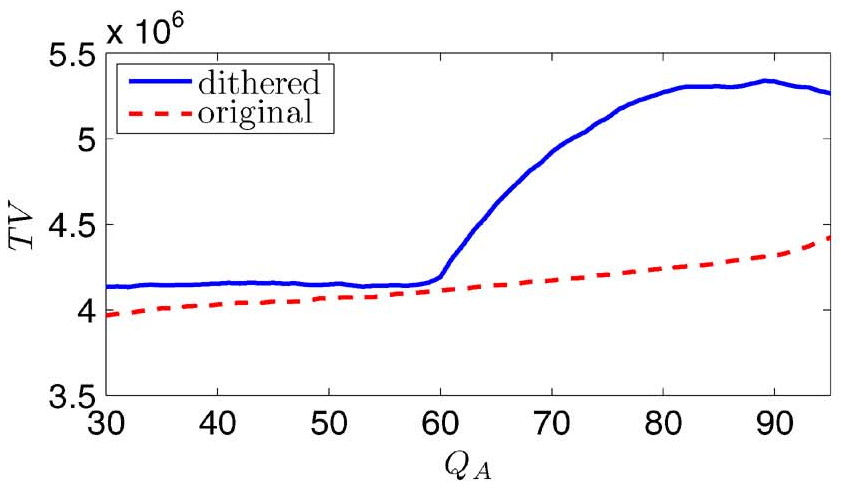
They use Total Variation to measure the "noisiness" of the image. As they change , they look for a specific behavior in the TV curve. If an image is a genuine uncompressed original, the TV curve increases smoothly. If it has been anti-forensically treated, there is a sharp "slope change" when matches the original hidden compression factor.
2. Implementation: Known vs. Unknown Matrix
- Known Template: If we know the camera or software (e.g., Photoshop), we simply sweep through quality factors 1-100.
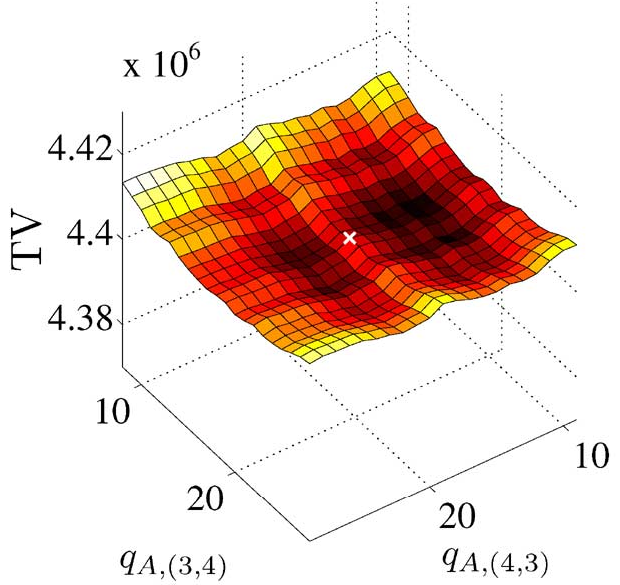
- Unknown Template: The authors propose a 2D sweep across symmetric DCT subbands (like (7,2) and (2,7)), detecting local noise annihilation.
Experimental Results: High Sensitivity and Specificity
Tested on the UCID and NRCS datasets, the results were definitive:
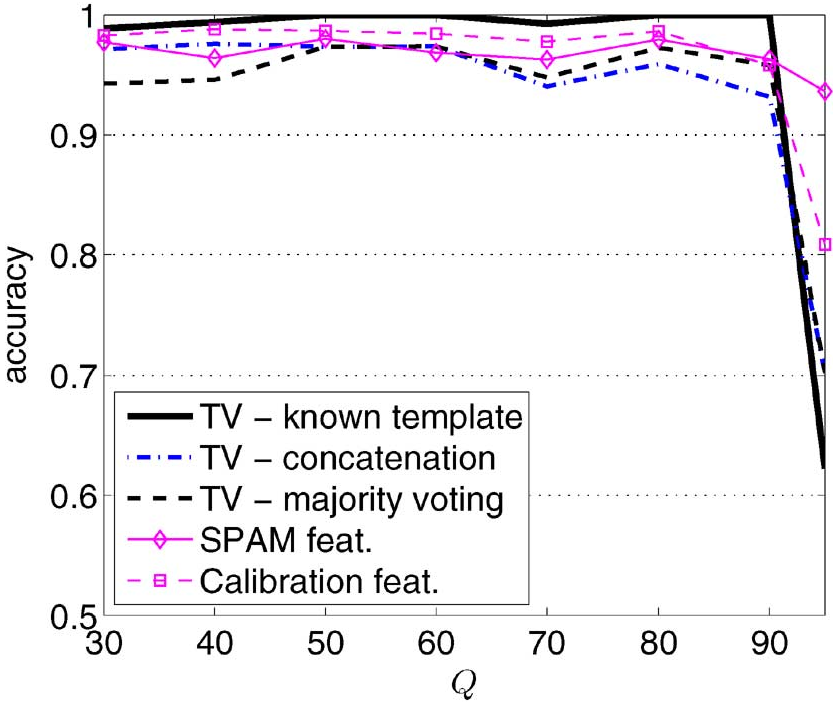
- Accuracy: For standard JPEG quality factors (30-90), the detector is nearly perfect ().
- Robustness: Unlike standard steganalysis tools (like SPAM), this method is Specific. It doesn't give false positives just because an image has random Gaussian noise; it specifically seeks out the structure of JPEG-quantization noise.
Deep Insight & Conclusion
This paper serves as a warning for those attempting to hide digital forgeries: footprint removal is a zero-sum game. By fixing the histogram in the transform domain, the adversary inevitably creates artifacts in the spatial domain.
Takeaway for Forensics: The "recompress-and-observe" strategy is a powerful way to reveal the hidden history of an image, even when standard statistical tests fail.
Limitations: The method struggles with "nearly lossless" JPEGs (Quality Factor > 95) because the quantization steps are too small to generate significant dithering noise.
Future Work
The authors suggest that the next frontier is Video Forensics. Motion compensation in video adds a whole new layer of complexity that both attackers and defenders can exploit.