
RecEvent: Bridging the Gap Between Online Socializing and Offline Attendance
RecEvent: Multiple Features Hybrid Event Recommendation in Social Networks
RecEvent is a hybrid event recommendation framework that integrates multiple features such as event influence, host impact, fee, social relationships, and spatiotemporal characteristics in social networks. By employing Latent Dirichlet Allocation (LDA) for semantic mining and a Neural Network-based RankNet for weight optimization, it achieves superior performance over traditional collaborative filtering methods.
TL;DR
RecEvent is a sophisticated hybrid recommendation framework designed for Event-Based Social Networks (EBSN). By moving beyond simple collaborative filtering, it fuses semantic analysis (LDA), host influence, and spatiotemporal constraints into a Learning-to-Rank (RankNet) model. The result is a system that effectively mitigates data sparsity and the cold-start problem, delivering highly personalized and novel event suggestions.
Context: The Challenge of the "Offline" Link
Unlike traditional movie or book recommendations, event recommendation is inherently "spatiotemporal." An event has a finite duration, a physical location, and a specific "Host" whose reputation often dictates success. Previous SOTA methods relied heavily on RSVP data, which is notoriously sparse and plagued by privacy settings. RecEvent shifts the focus from "who attended what" to "why would this user match this event's profile?"
Methodology: The Multi-Feature Engine
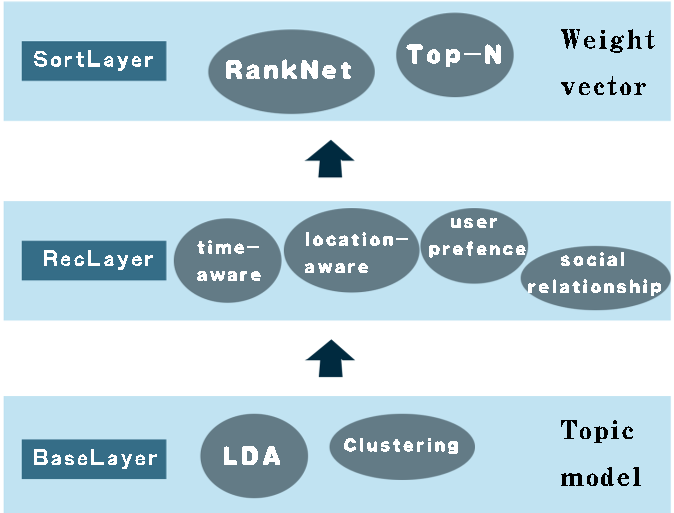
The core of RecEvent lies in its three-layer architecture: the Base Layer for semantic extraction, the Recommender Layer for feature scoring, and the Sort Layer for final ranking.
1. Semantic Mining with LDA
Since manual annotation of event descriptions is unscalable, the authors employ Latent Dirichlet Allocation (LDA). This allows the system to calculate:
- User-Event Similarity: How well does the event content match user interests?
- User-Host Similarity: Does the user resonate with the host's historical profile?
- K-L Divergence: A mechanism to measure the difference between interest distributions, helping uncover "interest niches" that users might ignore, thus enhancing novelty.
2. The Influence of the "Host"
A unique contribution of this work is the modeling of Host Impact. Using a Gaussian Distribution, the system measures the social influence coverage of the event organizer. For new users (the Cold Start problem), a recommendation from a "high-impact" host acts as a powerful trust signal that offsets the lack of historical interaction data.
3. Neural Learning to Rank (RankNet)
Instead of manually tuning weights for time, location, and fee, RecEvent uses a Pairwise RankNet implemented via a neural network. This converts the ranking problem into a probabilistic classification of which event in a pair is "more likely" to be chosen.

Experimental Validation
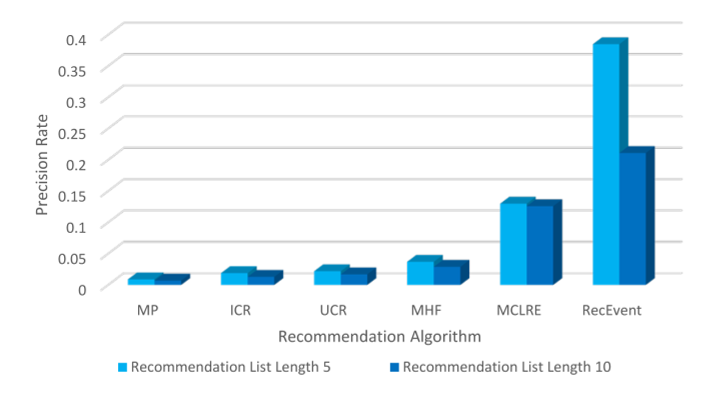
Using a real-world dataset from Meetup (covering New York, San Francisco, and Chicago), the authors compared RecEvent against the most popular (MP) and Collaborative Filtering (UCF/ICF) baselines.
Key Findings:
- Superiority in Sparsity: RecEvent consistently outperformed Collaborative Filtering, confirming that content and social features are better predictors than sparse attendance records.
- The Power of Fusion: The multi-feature hybrid (MHF) approach proved that "Location" and "Time" are not enough—"Host Impact" and "Semantic Matching" are the secret sauce for precision.
Critical Insight & Future Outlook
RecEvent successfully identifies that in the world of offline events, the Organizer (Host) is just as important as the Content. By treating the recommendation as a Learning-to-Rank task, the model avoids the "one-size-fits-all" trap of linear weighting.
However, the current model relies on a static snapshot of data. As the authors admit, the next frontier for RecEvent is Real-Time Recommendation. In a world where events are created and filled in minutes, the ability to update the RankNet weights on the fly will be the ultimate test of this architecture's scalability.
Takeaway: If you are building a recommendation engine for high-stakes, offline activities, don't just look at what the user liked—look at who is hosting it and how far the user is willing to travel.