
Bridging Logic and Learning: Enhancing Review-Level ABSA with Ontologies
Review-aggregated aspect-based sentiment analysis with ontology features
This paper presents a semantic-enhanced framework for review-level Aspect-Based Sentiment Analysis (ABSA) using a domain-specific ontology integrated with a Linear Support Vector Machine (SVM). The method, evaluated on the SemEval 2016 restaurant dataset, achieves performance comparable to top unconstrained SOTA systems by leveraging ontological reasoning to capture implicit sentiment.
TL;DR
While modern sentiment analysis often relies on raw statistical power, this paper argues for the return of "reasoning." By integrating a domain-specific ontology into a Support Vector Machine (SVM), the authors demonstrate that structured knowledge about restaurants significantly boosts the accuracy of identifying sentiment for specific aspects (like Service or Food) across entire reviews.
Background & Positioning
In the landscape of Sentiment Analysis, Aspect-Based Sentiment Analysis (ABSA) is the surgical tool. It doesn't just ask "Is this review positive?"; it asks "How do they feel about the Price versus the Ambiance?"
This work sits at the intersection of Knowledge-Based Systems and Supervised Machine Learning. Traditionally, ABSA is done at the sentence level. This research pushes the boundary to the Review Level, comparing whether it's better to analyze the review as a whole or to sum up the sentiments of individual sentences.
The Problem: The Gap in Implicit Knowledge
Existing machine learning models often struggle with "Implicit Mentions." If a reviewer says "The pasta was overcooked," a standard model might not inherently know that pasta is a subset of Food Quality.
Furthermore, sentence-level analysis often misses the forest for the trees. Reviewers write with a coherent flow; aggregating isolated sentence scores (the "Sentence Aggregation" approach) often loses the contextual nuance of a full review.
Methodology: The Power of Ontological Features
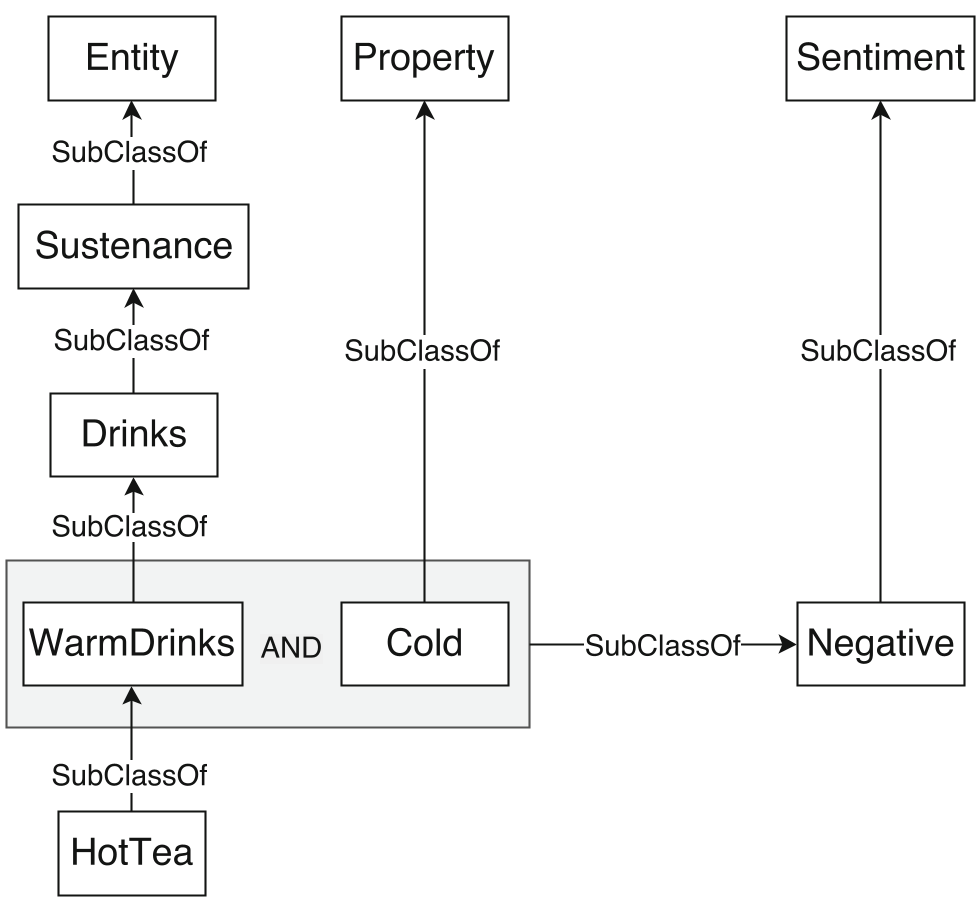
The core innovation lies in the Lexicalized Ontology. The authors designed a hierarchy where classes like Sustenance are linked to specific aspects (e.g., FOOD#QUALITY).
1. Hierarchical Reasoning
When the model encounters the word "cramped," the ontology identifies it as a subclass of AmbienceNegativeProperty. Because this property is linked to the AMBIENCE aspect, the SVM receives a clear, structured feature indicating a negative sentiment specifically for that aspect.
2. The Dependency Word Window
Instead of a simple "Bag-of-Words," the authors use a Grammatical Word Window.
 Algorithm 1: Using dependency parsing to find related words within 'k' grammatical steps, rather than just adjacent words.
3. Feature Enrichment
The model incorporates:
- Negation Handling: Flipping sentiment when "not" or "never" precedes an ontology hit.
- Synonym Expansion: Using WordNet to map unknown words to known ontological concepts.
- TF-IDF Weighting: Scaling the importance of terms to ensure common words don't drown out specific sentiment carriers.
Results & Analysis
The results confirm a clear hierarchy of performance:
- Review-Based + Ontology (Winner): 81.19% F1-score.
- Review-Based Baseline: 80.20% F1-score.
- Sentence Aggregation: Substantially lower performance, confirming that "the whole is different from the sum of its parts" in sentiment reviews.
 Table 5: The final model shows a statistically significant lead (p < 0.0001) over the baseline.
Interestingly, the authors' hypothesis that the ontology would reduce the need for training data was refuted. The "Data Size Sensitivity" analysis showed that while the ontology model was always better, it still improved at the same rate as the baseline as more data was added. This suggests that the model still needs a significant amount of data to learn how to interpret the ontological features correctly.
Critical Insight: Why it Works
The "Information Gain" analysis (Table 9) reveals that the most critical features are those that expose negativity. In a dataset where most reviews are positive (a common bias in restaurant apps), the ability to precisely identify negative ontological concepts (like ServiceNegativeProperty) becomes the deciding factor in overall accuracy.
Conclusion & Future Outlook
This work proves that "Old School" symbolic logic (Ontologies) still has a vital role in the age of Machine Learning. While the manual construction of these ontologies is a bottleneck, the performance gain is undeniable.
Future Direction: The authors suggest moving toward Automated Ontology Learning and exploring how Attention-based LSTMs could be combined with these structured knowledge bases to handle even more complex, multi-layered sentiments.
Note: This review is based on the paper "Review-aggregated aspect-based sentiment analysis with ontology features" published in Applied Network Science (2018).