
Beyond Triple-Store Silos: Deep Dive into Linked Data Ontology Enrichment
Review of Approaches for Linked Data Ontology Enrichment
2017-11-28
Summary
Problem
Method
Results
Takeaways
Abstract
This paper provides a comprehensive review of methodologies for Linked Open Data (LOD) ontology enrichment, specifically focusing on T-Box (schema) augmentation. It categorizes research into discovering property axioms, class axioms, and new terminological entities using instance-based and schema-based statistical techniques.
## TL;DR
The current state of Linked Open Data (LOD) is data-rich but "schema-poor." While we have millions of facts (A-Box), we lack the logical rules (T-Box) that allow machines to truly understand and reason over them. This review by Subhashree et al. dissects the latest technical frameworks—ranging from association rule mining to tensor factorization—designed to turn flat data into a semantically mature Knowledge Graph.
## The Motivation: The "Individual" Bottleneck
Modern AI applications like Google’s Knowledge Graph and IBM Watson rely on Linked Data. However, the LOD initiative has a major structural flaw: most datasets focus on specific instances (e.g., "Barack Obama born in Honolulu"). Without a robust **T-Box (Terminological Box)**, systems cannot infer that a `birthPlace` relation implies the subject is a `Person` and the object is a `Place`.
The challenge lies in the **incomplete evidence** inherent in the Semantic Web (the Open World Assumption). Traditional data mining fails because a missing triple doesn't necessarily mean a fact is false; it might just be unknown.
## Methodology: Two Paths to Semantic Maturity
The paper categorizes enrichment into two distinct technical tracks:
### 1. Property and Class Axiom Discovery
This involves finding logical constraints between existing properties (e.g., Subsumption, Equivalence, Inverse).
* **AMIE (Association Mining under Incomplete Evidence)**: This is a standout method that uses "Partial Completeness Assumptions" (PCA) to mine Horn rules even when data is sparse.
* **PARIS**: A probabilistic framework that aligns relations across heterogeneous datasets by iterating between instance matching and schema matching.
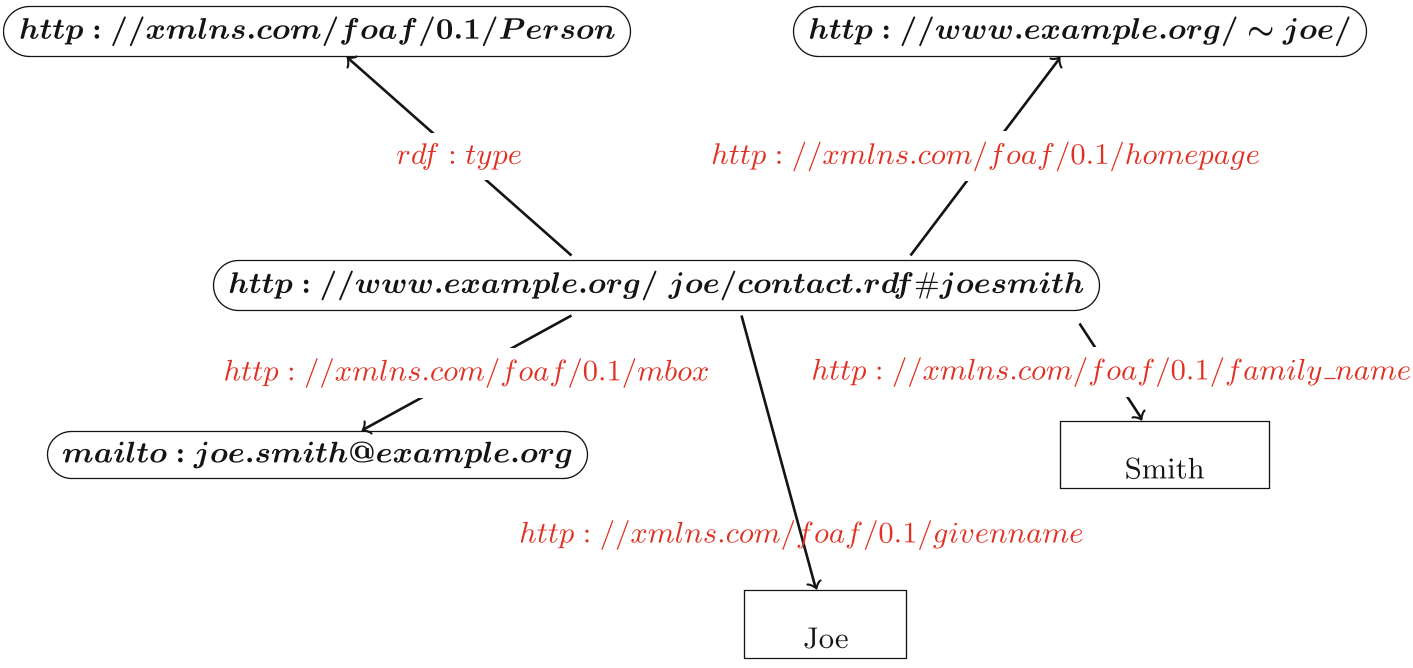
*Fig 1: The bridge between graph-based triples and formal XML/RDF representations.*
### 2. Discovering "New" Knowledge (OpenIE Integration)
When internal data isn't enough, we look to the web. The survey highlights systems like **NELL (Never Ending Language Learner)** and **DART**. These tools use Natural Language Processing (NLP) to extract patterns from text (e.g., "[River] flows through [City]") and cluster them to propose entirely new properties for an ontology.
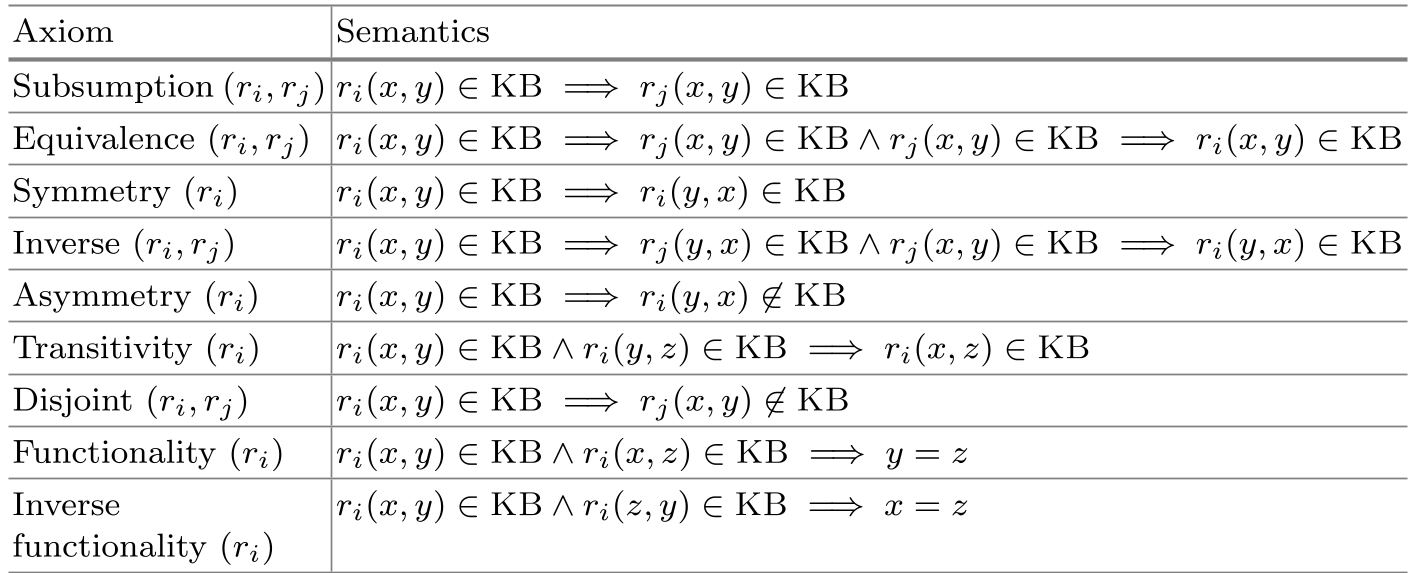
*Table 1: Essential axioms required for a consistent T-Box, from Symmetry to Functional properties.*
## Deep Insight: Why Statistical Methods Win
Static, manually curated ontologies cannot keep up with the growth of the web. The authors argue that the future of enrichment is **Inductive Learning**.
* **DL-Learner**: This framework uses "refinement operators" to navigate a search space of possible class expressions (e.g., `Parent ≡ Person ⊓ ∃hasChild.Person`).
* **Tensor Factorization**: By modeling noun phrases and verbs as a multi-dimensional tensor, researchers can "fill in the blanks" of a knowledge graph and even induce relation schemas automatically.
## Critical Analysis & Future Outlook
While the reviewed methods are powerful, they have limitations:
1. **Functionality Bias**: Methods like PCA work best on functional predicates (1-to-1 relations) but struggle with 1-to-many or many-to-many relations common in the real world.
2. **Noise Sensitivity**: OpenIE extraction is notoriously noisy. Grounding extracted text to an existing ontology (e.g., DBpedia or YAGO) remains the "holy grail" of this field.
**Conclusion**: Ontology enrichment is shifting from a manual "knowledge engineering" task to a high-scale "machine learning" problem. Moving forward, the integration of Large Language Models (LLMs) and neural-symbolic reasoning will likely be the next frontier in automating the T-Box enrichment process described in this paper.
---
**Key Takeaway**: Don't just publish triples; publish the logic that governs them. A Knowledge Graph without an enriched T-Box is just a database; with it, it becomes an intelligent brain.