
Beyond Global Sentiment: Mastering Review-Level Aspect Analysis with Domain Ontologies
Review-level aspect-based sentiment analysis using an ontology
The paper introduces an ontology-enhanced approach for review-level Aspect-Based Sentiment Analysis (ABSA) in the restaurant domain. By integrating a domain-specific ontology with a linear Support Vector Machine (SVM), the authors propose two distinct algorithms: a direct review-based classifier and a sentence aggregation method, ultimately achieving performance comparable to top-tier SemEval-2016 contenders.
TL;DR
While most sentiment analysis tools tell you IF a customer is happy, Aspect-Based Sentiment Analysis (ABSA) tells you WHY. This paper presents an ontology-driven framework that bridges the gap between raw text and structured domain knowledge. By mapping restaurant reviews to a formal hierarchy of entities and properties, the authors achieved an F1-score of 0.8119, rivaling top-performing systems in the SemEval-2016 competition.
Context: The Granularity Gap
In the world of online reviews, "The food was great but the waiter was rude" is a common scenario. A global sentiment classifier might label this "Neutral," losing the critical feedback for the kitchen and the floor staff. ABSA solves this by targeting specific nodes like FOOD#QUALITY and SERVICE#GENERAL.
However, machine learning models (specifically SVMs) are "data-hungry" and often lack the common sense to know that "cramped" usually implies a negative AMBIENCE. This paper argues that Ontologies—structured maps of domain concepts—are the "missing link" for more intelligent sentiment engines.
Methodology: Infusing "Common Sense" into SVMs
The authors focus on the restaurant domain using a linear multiclass SVM. The real innovation lies in the Ontology-Enhanced Feature Engineering.
1. The Ontology Architecture
The ontology is organized into three primary branches:
- Entity: Domain terms (Subclasses: Ambience, Food, Service, etc.).
- Property: Descriptive adjectives (Subclasses: GenericPositive, AmbienceNegative).
- Sentiment: Polarity values (Positive, Negative, Neutral).
2. Strategic Feature Generation
Instead of just using Bag-of-Words, the model uses:
- Ontology Concept Expansion: When a word like "pasta" is detected, the model automatically adds its superclass "Sustenance" to the feature vector.
- Negation & Synonyms: Using WordNet to catch variations and flipping polarities for phrases like "not bad."
- Word Windows: Using grammatical dependencies to link descriptive adjectives to their specific targets.
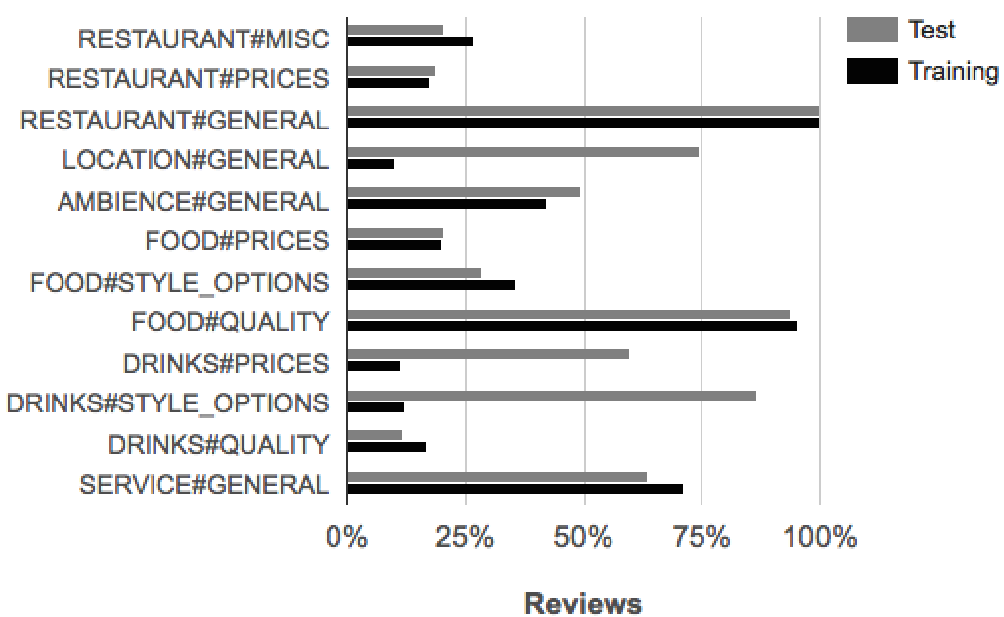 Figure 1: A snippet of the logic—how "HotTea" and "Cold" intersections lead to a "Negative" sentiment classification.
Experiments: Review-Level vs. Sentence Aggregation
The study explores two architectures for final review labels:
- Review-Based: Direct classification of the entire review text.
- Sentence Aggregation: Classifying each sentence individually and then summing the polarities (similar to a voting mechanism).
The Result? The Review-Based approach won. Why? Because reviews are cohesive units. Sentences often share context (anaphora, transitions) that is lost when they are analyzed in isolation.
Performance vs. Competition
The ontology-enhanced model achieved an accuracy that trails the world-best UWB and ECNU submissions by less than 1%, despite using more traditional SVM architectures compared to some unconstrained competitors.
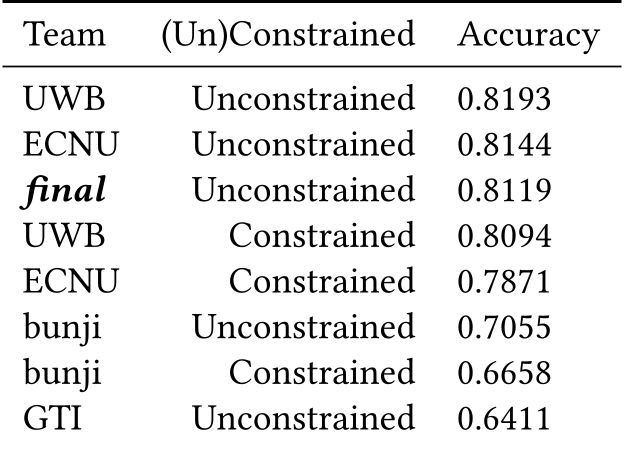 Table 1: Final model performance compared against SemEval-2016 elite submissions.
The Reality Check: Data Sensitivity
One common hypothesis in AI is that "Knowledge-based methods require less training data." The authors tested this by reducing the training set size. Interestingly, they disproved the hypothesis. While the ontology model consistently performed better than the baseline, the slope of the performance drop was the same. This implies that even with an ontology, the model still needs enough data to learn how to "weight" those knowledge features effectively.
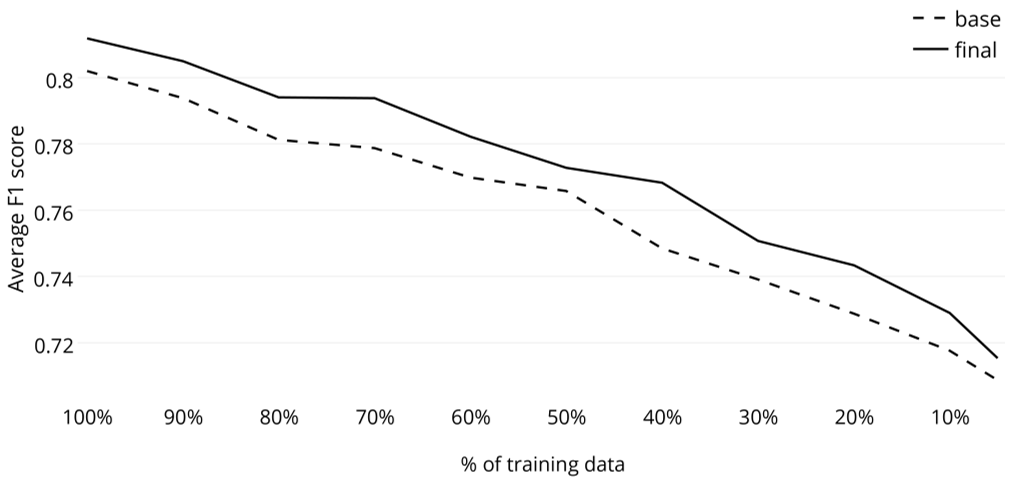 Figure 2: Performance vs. Training Data Size. Note that the ontology model (Final) maintains a consistent lead over the baseline (Base).
Critical Insight & Conclusion
The "Gold value" upper bound in Table 3 (0.9633) shows there is still a significant gap between current algorithms and human-level context understanding.
Takeaway for Practitioners: If you are working in a niche domain (like medical equipment or specialized legal reviews), don't just throw more data at a generic LLM. Building a lightweight domain ontology can provide the structured "scaffold" your classifier needs to reach SOTA performance.
Future Outlook: The next logical step is Automated Ontology Learning. Manually crafting these hierarchies is slow; using LLMs to extract ontologies which then prime specialized classifiers might be the "best of both worlds" for industrial AI.