
Re-evaluating Social Influence: Accuracy and Robustness in SNRS
A revisit to social network-based recommender systems
This paper presents an enhanced Social Network-Based Recommender System (SNRS) that leverages probabilistic graphical models. By introducing bipolar user correlation classification and temporal influence links, the authors significantly improve recommendation accuracy (MAE) over traditional collaborative filtering and the baseline SNRS.
TL;DR
Social network-based recommendation is built on the intuition that we trust our friends' tastes. However, this paper argues that simple social ties are insufficient. By distinguishing between "liking" and "disliking" patterns and tracing the chronological "flow" of influence, the authors achieve a 26% improvement in accuracy over traditional methods.
Background: The Social Signal
The baseline Social Network-Based Recommender System (SNRS) treats a social network as a Bayesian network. It estimates the probability of a user rating an item based on three factors:
- The user's own preference for similar item attributes.
- The item's general popularity (prior probability).
- The influence of immediate friends' ratings.
However, the "Signal-to-Noise" ratio in social data is often low due to differing personal standards and sparse connections.
The Problem: The "Lenient Friend" and The "Sparse Wall"
Traditional SNRS faces two major hurdles:
- Personal Bias: A "3/5" from a strict critic might mean the same as a "5/5" from a lenient friend. Using raw rating differences creates a distorted correlation.
- Sparsity: If your immediate friends haven't rated an item, the model hits a "wall" and cannot provide a recommendation.
Methodology: Beyond Simple Adjacency
1. Bipolar Correlation Classification
Instead of raw scores, the authors use Rating Deviations (). They categorize interactions into LIKE and DISLIKE groups.
- If a friend likes an item you typically dislike, that specific influence is "filtered" or treated as a negative correlation.
- This allows the model to handle "conflict ratings" where friends disagree, focusing only on the subset of history where behaviors align.
2. Temporal Influence Links
To break the "Sparsity Wall," the authors introduce a directed, time-aware graph. A link exists only if friend rated an item before user . By following these chains, the system can reach "friends-of-friends" (and further) who actually exerted a chronological influence, effectively expanding the candidate pool for evidence without inviting irrelevant noise.
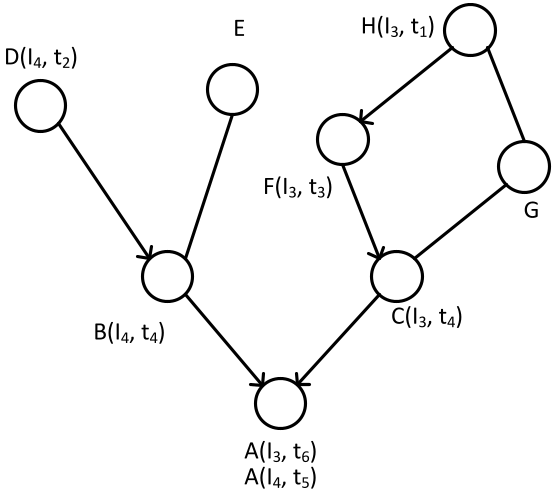 Figure: Temporal influence links allow UA to be influenced by UH through a chain of chronological interactions.
Experimental Validation
Using the Dianping dataset (a Chinese restaurant review platform), the authors compared their enhanced versions (SNRS* and SNRS**) against standard Collaborative Filtering (CF).
| Metric | CF | SNRS (Baseline) | SNRS** (Ours) |
|---|---|---|---|
| MAE (Lower is better) | 0.8062 | 0.6941 | 0.5910 |
| Coverage | 0.7153 | 0.7033 | 0.7416 |
Key Insights from Results:
- Significant Accuracy Gain: SNRS** outperformed CF by over 26%. This proves that social context, when properly filtered for bias, is far more predictive than anonymous item similarity.
- Robustness: The temporal links (SNRS**) successfully increased coverage when training data was reduced, proving the method's effectiveness in "cold-start" or sparse environments.
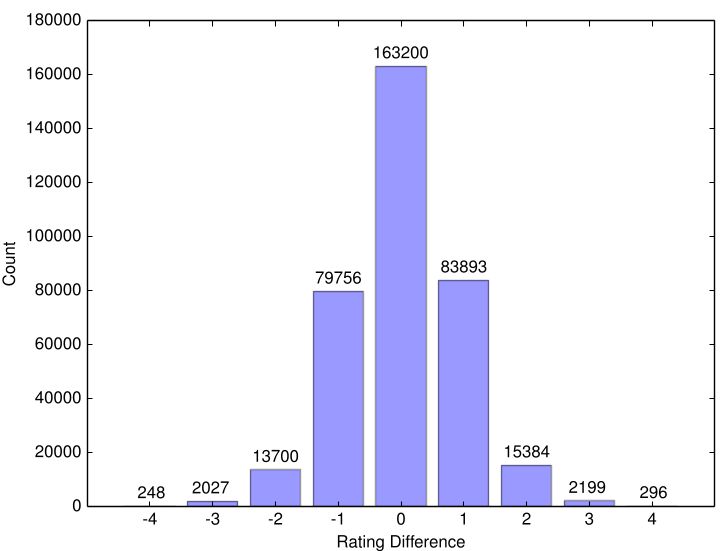 Figure: The distribution of rating differences between friends justifies the need for deviation-based modeling.
Critical Analysis & Conclusion
The brilliance of this work lies in its "revisit" of the social intuition. It acknowledges that social influence isn't a static broadcast but a dynamic, directed, and subjective phenomenon.
Limitations: While accuracy is high, the "Like/Dislike" filtering can sometimes reduce coverage if a user's history is too short to establish a reliable average ().
Future Outlook: Integrating these temporal influence chains into modern Graph Neural Networks (GNNs) could lead to even more powerful "Social Transformers" that understand not just who you know, but whose timing you follow.