
Beyond the Binary: Why Your Web Form is a Gatekeeper
Revisiting Gendered Web Forms: An Evaluation of Gender Inputs with (Non-)Binary People
This research evaluates five diverse gender input form designs—ranging from traditional binary radio buttons to open-text fields—across healthcare, social media, and dating contexts. Using a survey of 350 binary and non-binary participants, the study establishes that inclusive design significantly impacts user comfort and willingness to access digital services, with open-text boxes emerging as the gold standard.
TL;DR
A new study from CHI '21 reveals that the standard "Male/Female" radio button isn't just outdated—it’s a barrier that drives users away. Researchers found that trans and non-binary users are significantly less likely to use a service if the signup form fails to represent them. The solution? Move toward open-text fields and context-aware data collection.
The Hidden Power of the Input Field
We often treat web forms as mundane data-gathering tools. However, for non-binary and trans individuals, these forms are digital gatekeepers. When a system forces a user to choose between "Male" and "Female," it performs an act of "institutional erasure."
The authors argue that gender is "baked into" our technical infrastructures. From social media algorithms to medical records, the way we ask for gender dictates how a user is treated, marketed to, and fundamentally seen by the system.
The Experiment: Five Forms, Three Contexts
The researchers tested five distinct UI patterns to see how they affected user perception in Healthcare, Social Media, and Dating apps.
 Figure 1: The five experimental form designs, ranging from binary-only to open-ended and checkbox-based models.
The Variables:
- Inclusiveness: Does the form feel welcoming?
- Misgendering: Does the form force me to lie?
- Comfort: How much stress does this form cause?
- Willingness to Access: Will I actually use the site if I see this?
Key Insights: "Othering" is a Bug, Not a Feature
The study’s most striking finding is the rejection of the word "Other." While many developers add an "Other" option thinking they are being inclusive, participants described this as "dehumanizing" and "creating an island of misfit toys."
Quantitative Results
As shown in the charts below, the Open Text Box (Option 4) was the undisputed winner for inclusiveness, even among binary users.
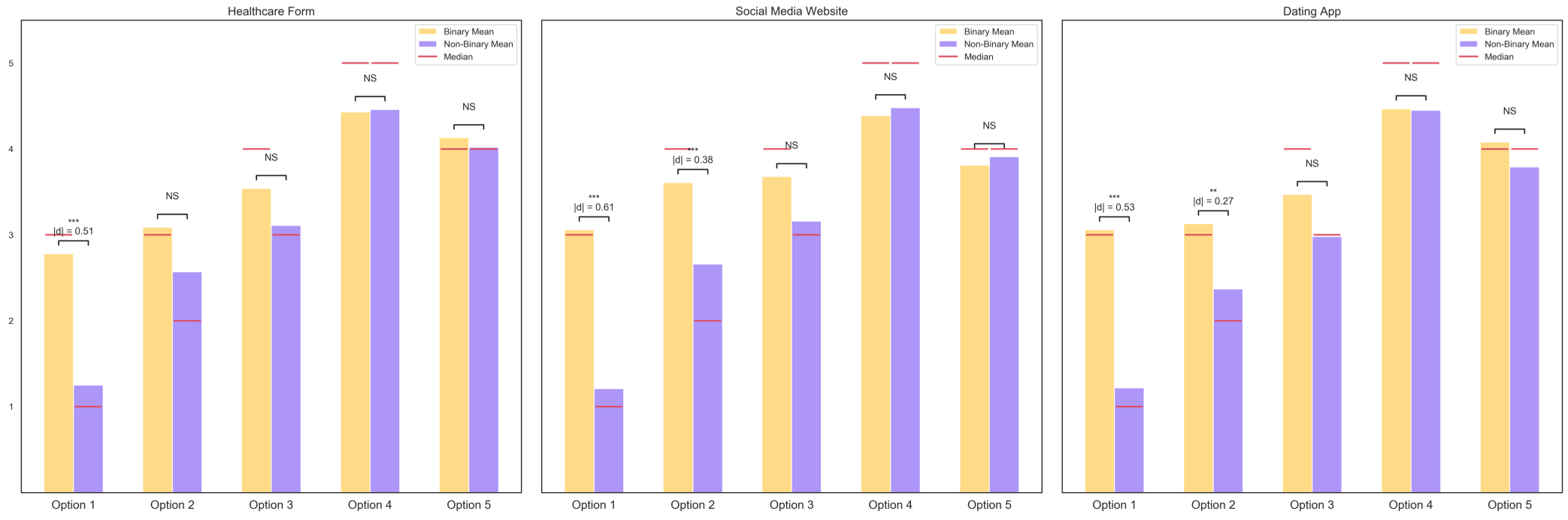 Figure 2: Non-binary participants (dotted lines) showed significantly higher rates of discomfort and misgendering for binary and "other" options compared to binary participants.
Context Matters:
- In Dating: Participants were more tolerant of checkboxes because they understood that "matching algorithms" need structured data to work.
- In Healthcare: Users wanted to provide anatomical details or pronouns rather than a broad "gender" label.
- In Social Media: Many felt gender was completely unnecessary and its collection was invasive.
The Infrastructure Problem
The blog post identifies that forms are just the "front-end" of a deeper problem: Calcitrant Infrastructure.
- Databases: Many systems use
Booleanvalues (0 or 1) for gender. - Marketing: Ad-tech is built on gendered segmentation.
- Safety: Trans users in dating apps fear "violent reactions" if they cannot accurately self-describe their identities before a match occurs.
Design Recommendations: How to Do Better
Based on the empirical evidence, the authors offer a roadmap for developers:
- Ask if you even need it: Can you ask for pronouns instead?
- Avoid "Male/Female" labels: Use "Man/Woman" (gender) instead of "Male/Female" (sex) where appropriate.
- Prioritize Agency: If your database supports it, use open-text fields.
- Context-Specific Revision: In medical settings, separate "Gender Identity" from "Anatomical/Biological" needs and "Pronouns."
Conclusion: A Call for Technical Empathy
The takeaway is clear: Inclusion is a design choice. By refusing to update legacy binary systems, we aren't just collecting "clean" data; we are actively excluding a growing demographic and generating "bad data" from users forced to self-misgender just to get past a login screen.
Future Work: The authors call for similar studies in non-Western contexts, where concepts of gender vary significantly from the Eurocentric binary model.