
The Reward-Competition Paradox: Why Big Prizes Aren't Always Enough in Crowdsourcing
Exploring the effects of reward and competition intensity on participation in crowdsourcing contests
This study investigates the dynamics of crowdsourcing contests by examining how task rewards and competition intensity influence solver participation. Using data from Taskcn.com and applying Expectancy-Value Theory (EVT), the authors propose a two-stage model (registration and submission) to quantify the impact of financial incentives and the inhibiting effects of perceived competition from highly experienced peers.
TL;DR
In the world of crowdsourcing contests, higher rewards do attract more people, but the presence of "sharks" (highly experienced winners) creates a chilling effect. This research reveals that competition intensity—measured by the past success of rivals—directly discourages submission and actually devalues the incentive of a high reward.
Academic Positioning: This work moves beyond counting participants to analyzing the quality of competition through the lens of Expectancy-Value Theory (EVT). It proves that solver behavior is a two-stage process where initial interest and final effort respond to different psychological triggers.
The "Shark in the Tank" Problem
Traditional crowdsourcing logic suggests that if you offer more money, you get more solutions. However, the "Motivation" side of the equation is more complex. Solvers don't just look at the prize; they look at their probability of winning.
Existing literature often treats competition as a simple numbers game (more solvers = more competition). This paper argues that one "Grandmaster" solver with 100 wins is more discouraging to a newcomer than ten amateur solvers combined. This perceived competition intensity creates a psychological barrier that suppresses active participation.
Methodology: The Two-Stage Filter
The authors argue that participation isn't a single click; it’s a funnel.
- Registration Stage: Driven primarily by "Incentive Value" (The Reward).
- Submission Stage: Driven by "Expectancy" (Can I actually win?).
The Research Model
The authors built a two-equation model to track how variables shift from the first click to the final upload.
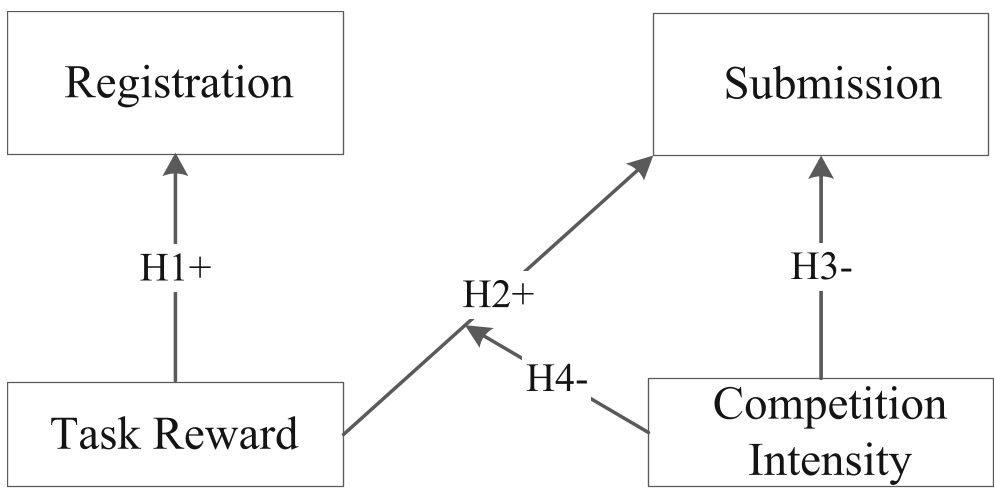
They measured competition using three innovative proxies:
- Participation Times: How active is the crowd?
- Winning Times: How "lethal" are the competitors?
- Credit Values: How much total wealth have they extracted from the platform?
Key Findings: The "Winner's Curse" for Seekers
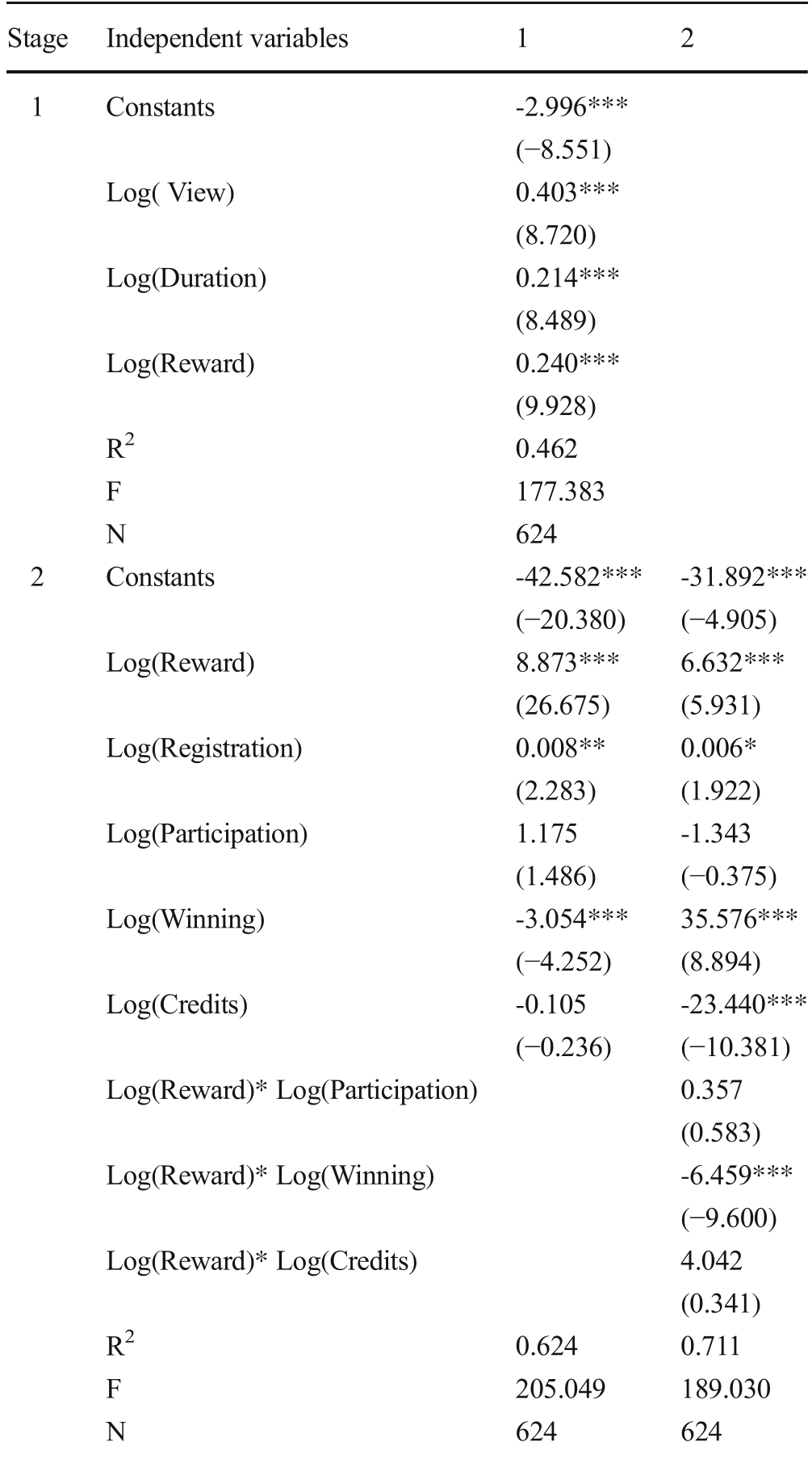
The study analyzed 624 tasks from Taskcn.com (logo and website design). The results were eye-opening:
- Rewards Work... Mostly: As expected, higher rewards increase both registrations and submissions.
- The Power of "Winning History": Of the three competition proxies, only Winning Times had a significant negative impact. Solvers are selectively intimidated by proven winners, not just "busy" participants.
- The Negative Moderator: This is the paper's "smoking gun." High competition intensity (rival wins) weakens the attractive power of a big reward. In a high-competition environment, doubling the prize money yields diminishing returns because solvers assume the "pros" will just try harder to sweep the prize.
Critical Analysis & Professional Insights
Why does this happen?
From an EVT perspective, Behavior = Expectancy × Value. If "Expectancy" (perceived win rate) drops to near zero because a TopCoder champion joined the task, the "Value" (Reward) doesn't matter anymore. Mathematically, any number multiplied by zero is zero.
Strategic Takeaways
- For Task Seekers: If you see experts flocking to your task, don't assume you'll get more submissions. You might get higher quality from the experts, but you will lose the "wisdom of the crowd" and the diversity of solutions from amateurs.
- For Platform Designers: To maximize submission volume, consider hiding solver credentials during the submission phase. If solvers can't see that they are competing against a "shark," their expectancy of success remains high, keeping them engaged in the work.
Limitations & The Road Ahead
While the paper proves that average competition levels matter, it doesn't yet account for how an individual's own experience counters the intimidation. A "shark" isn't afraid of another "shark." Future research using panel data could track how these power dynamics evolve in real-time as a contest nears its deadline.
Conclusion
This paper serves as a vital reminder for the platform economy: Incentives are not just about the size of the carrot, but also the perceived height of the fence. By understanding the moderating role of competition, companies can better design contests that balance professional expertise with broad-based crowd participation.