
Breaking the Legal Bottleneck: Rhetorical Role Identification for Portuguese Petitions
Rhetorical Role Identification for Portuguese Legal Documents
This paper introduces the first Portuguese corpus specifically designed for Rhetorical Role Identification (RRI) in legal petitions, departing from traditional research focused on judicial decisions. The authors propose a schema of eight legal rhetorical roles and demonstrate that an end-to-end fine-tuned BERTimbau model achieves a SOTA F-score of 80.50.
TL;DR
Legal petitions are the lifeblood of the Brazilian judicial system, yet their unstructured nature creates a massive manual overhead for judges. This paper presents the first attempt to automate the analysis of these documents through Rhetorical Role Identification (RRI) using a novel Portuguese corpus and fine-tuned BERT models, achieving a robust F-score of 80.50.
Background: From Common Law to Civil Law
Most legal AI research has traditionally focused on "Court Decisions" in "Common Law" (e.g., US, UK, India). However, Brazil operates under a Civil Law paradigm where the Petition (the initial filing by a complainant) is the critical document. These petitions are often noisy, unstructured, and manually scanned, creating a significant "intermediary" bottleneck in legal proceedings.
The Challenge: Noisy Text and Interspersed Roles
Unlike judicial decisions, which follow a somewhat predictable sequence of facts and rulings, petitions are persuasive documents. Lawyers often interweave facts, legal arguments, and precedents to build a narrative. The authors identified two primary technical hurdles:
- Data Quality: Petitions often exist as scanned PDFs with varied encodings and watermarks.
- Semantic Overlap: The boundary between an "Argument" and a "Legal Basis" is often blurred in legal writing.
Methodology: BERTimbau to the Rescue
The authors developed a corpus of 10,784 sentences from 70 civil lawsuits filed in the TJMS court. They defined eight specific roles: Identification, Facts, Arguments, Legal Basis, Precedents, Requests, Remedy, and Others.
To solve the classification task, the team moved beyond classical NLP (TF-IDF/SVM) and leveraged BERTimbau, a BERT model pre-trained specifically on Portuguese.
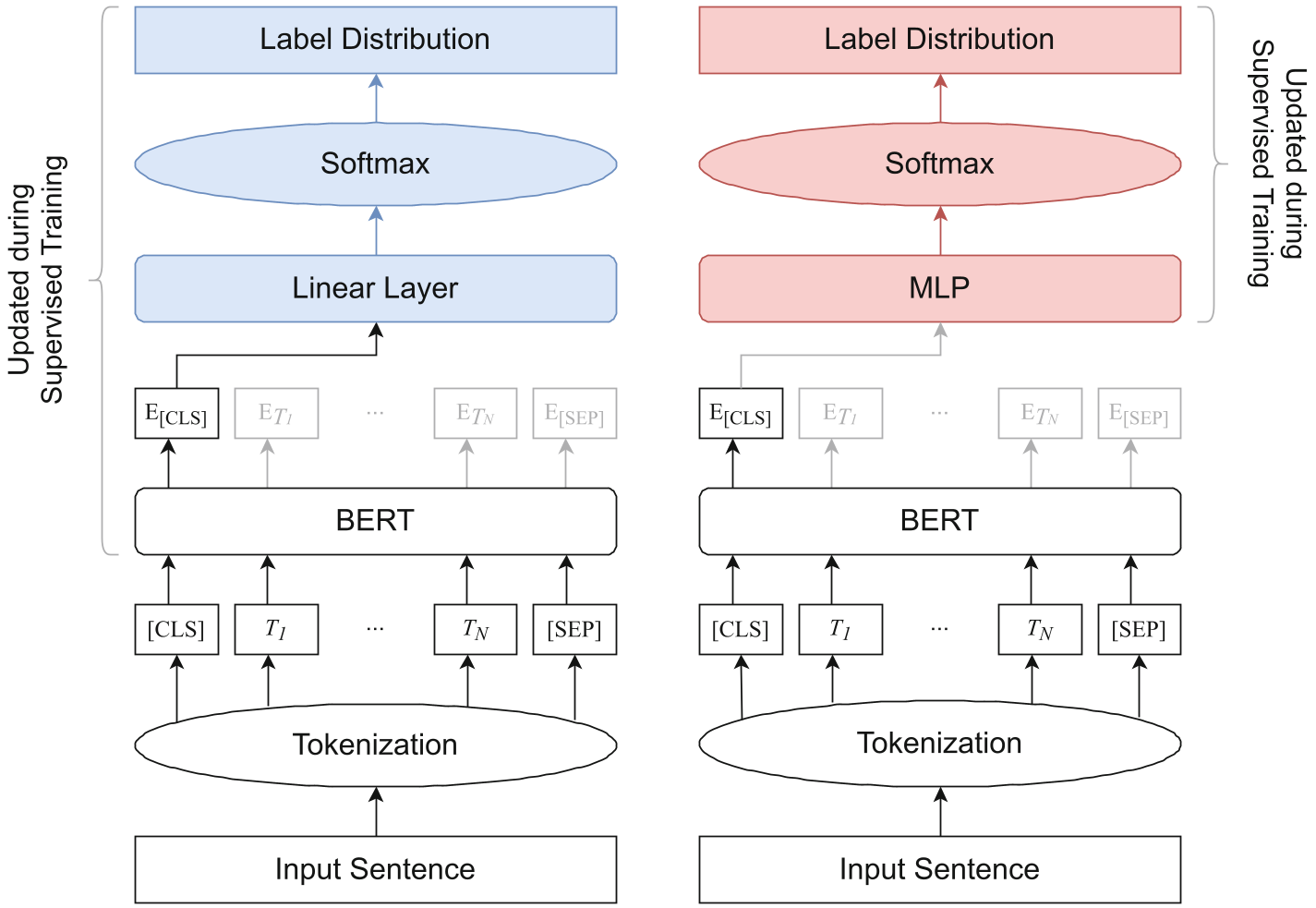
The study tested two neural approaches:
- BERTf (Fixed): Using BERT as a static feature extractor with a Multi-Layer Perceptron (MLP).
- BERT (Fine-tuned): An end-to-end approach where the Transformer layers are updated specifically for legal role identification.
Experimental Results
The results highlight the tectonic shift from classical features to deep learning. The fine-tuned BERT model outperformed the best SVM baseline by nearly 20 F-score points.
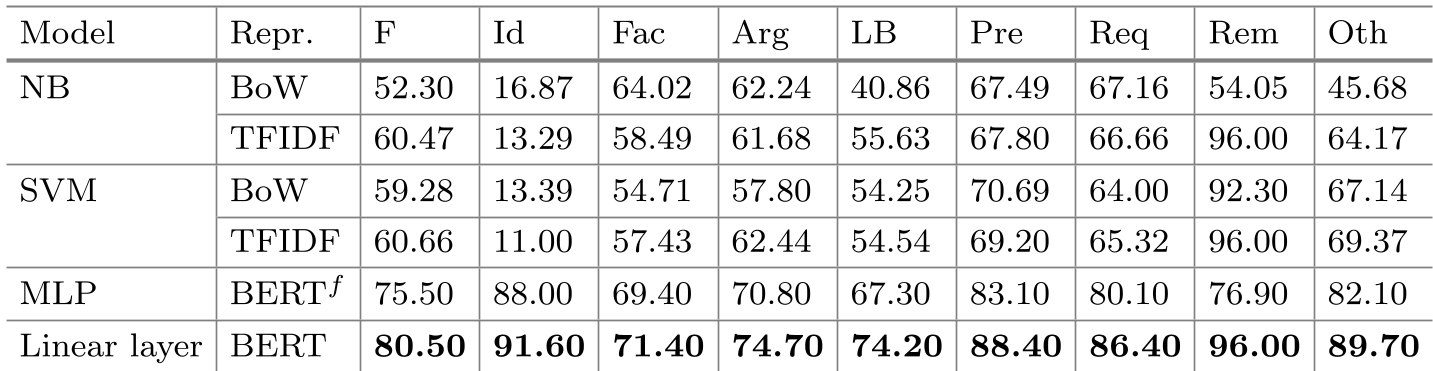
Key Finding: The "Remedy" (Valor da Causa) class, despite being the least frequent, was the easiest to identify because of its highly formulaic language. Conversely, the "Facts" and "Arguments" classes saw the most confusion, as lawyers frequently mix factual accounts with persuasive reasoning.
Critical Analysis & Conclusion
The value of this work lies in its domain-specific focus. By tailoring the rhetorical roles to the Brazilian Civil Procedure code, the authors created a tool that directly addresses the needs of a judge's office (e.g., verifying if a petition meets minimal legal requirements).
Limitations and Future Outlook:
- Sequential Context: The current models classify sentences in isolation. Incorporating the sequence (e.g., using a BiLSTM-CRF or a long-context Transformer) could help resolve the confusion between interspersed classes.
- Domain Adaptation: While BERTimbau is powerful, a BERT model pre-trained exclusively on Legal Portuguese (LegalBERT-PT) would likely push performance even further.
This work sets the stage for automated legal summarization, potentially transforming how Brazilian courts handle the hundreds of thousands of lawsuits filed annually.