
RiMOM: Revolutionizing Ontology Alignment through Dynamic Strategy Selection
RiMOM: A Dynamic Multistrategy Ontology Alignment Framework
RiMOM is a dynamic multistrategy ontology alignment framework that automatically selects and combines matching strategies based on the quantitative characteristics of input ontologies. It leverages textual metadata and structural information, achieving top-tier performance in the OAEI 2006 and 2007 campaigns.
TL;DR
RiMOM (Risk Minimization Ontology Matching) addresses the inflexibility of traditional schema matching by introducing an automated, dynamic framework. By quantitatively assessing the "personality" of ontologies through label and structure similarity factors, it intelligently decides whether to trust text, structure, or a combination of both. Its success at the OAEI campaigns proves that adaptability is the key to semantic interoperability.
The Motivation: Why One Strategy Is Not Enough
In the expanding Semantic Web, ontologies are heterogeneous. One pair of ontologies might share identical English labels but have totally different tree structures; another pair might be structurally identical but defined in different languages (e.g., English vs. French).
Static systems often force a weighted average of name-matching and structure-matching. However, if the labels are random strings, the name-matching strategy adds "noise" rather than value. The authors of RiMOM realized that a system must first characterize the alignment task before executing it.
Methodology: The Dynamic Brain of RiMOM
The core innovation lies in the definition of two metrics that act as a "pre-scan" for the alignment task:
- Label Similarity Factor (F_LS): Measures how much lexical overlap exists between the names of entities.
- Structure Similarity Factor (F_SS): Measures the similarity of hierarchical profiles (sub-concept counts and depth).
The Processing Flow
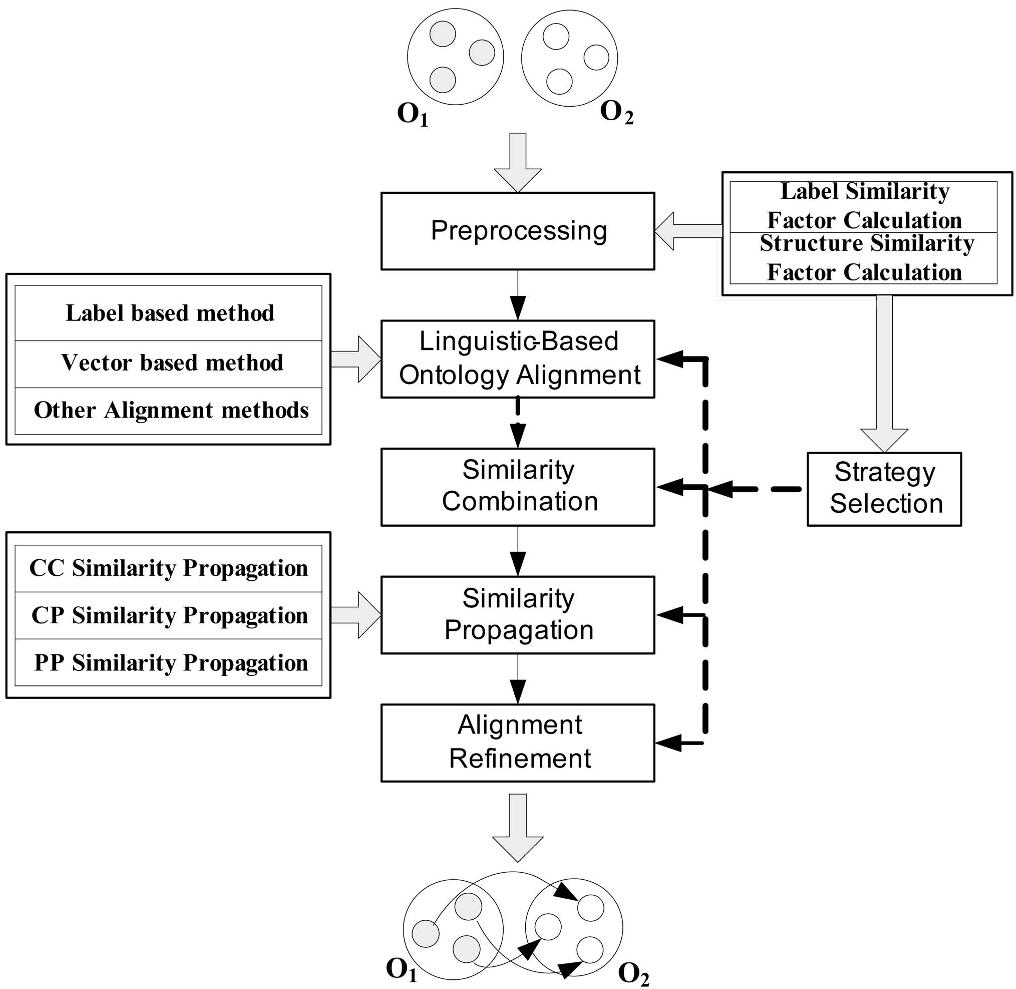
As illustrated in the architecture, RiMOM follows a systematic pipeline:
- Preprocessing & Factor Estimation: Calculating F_LS and F_SS.
- Linguistic Alignment: Running Edit-Distance and Vector-Distance (VD) strategies.
- Dynamic Combination: Using the factors as weights to merge linguistic results.
- Similarity Propagation: Utilizing an adaptive version of Similarity Flooding (SF) to spread confidence across the graph structure.
The Intuition behind Similarity Flooding
RiMOM doesn't just look at an entity in isolation; it assumes that if "Person" matches "Individual," then their children (e.g., "Student" and "Learner") are also likely to match. This structural "flow" of confidence is what allows RiMOM to find matches even when the text is obscured.
Experiments: Proving the Power of Adaptability
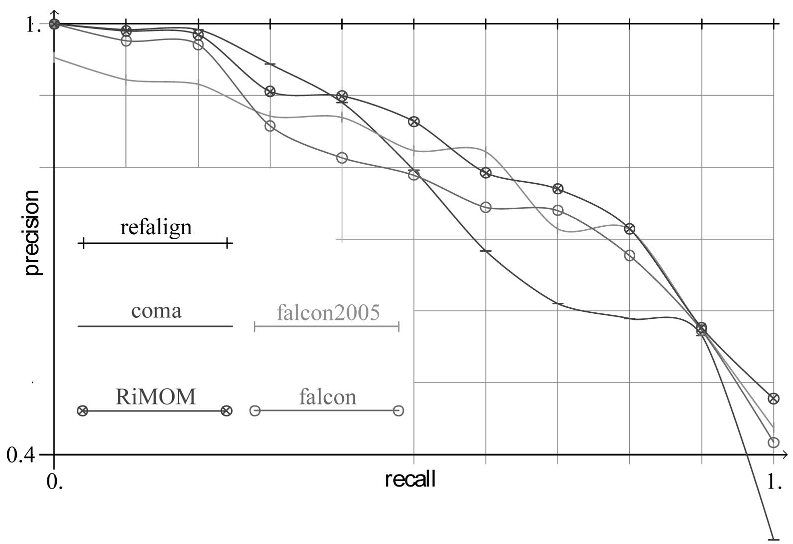
The authors tested RiMOM against the OAEI Benchmark, a rigorous test suite where ontologies are systematically altered (names replaced by random strings, hierarchies flattened, etc.).
Key Findings:
- Strategy Selection Matters: Without dynamic selection, the F1-measure dropped significantly in the D4 dataset (complex alterations).
- Similarity Flooding (SF) is a Game Changer: SF improved the overall Recall from 78.6% to 88.1%. In datasets where labels were completely destroyed but structures remained, SF was the only reason the system could function.
Critical Analysis & Future Outlook
While RiMOM dominated the 2006-2007 era, it faces a modern challenge: Scale. The authors noted that large-scale ontologies (thousands of entities) require significant memory and time due to the iterative nature of Similarity Flooding.
Takeaway: RiMOM's legacy is its shift from "stiff" algorithms to "intelligent" selectors. In the current era of LLMs, the "Label Similarity" might be replaced by "Embedding Cosine Similarity," but the fundamental need for Structure-Awareness and Dynamic Weighting remains the cornerstone of robust data integration.
Conclusion
RiMOM stands as a landmark in the field of Knowledge Engineering. By formalizing how to balance textual and structural signals, it provides a blueprint for any system attempting to reconcile disparate data sources in a decentralized world.