
RIP: Using Psychological Inoculation to "Immunize" Students Against IT Stereotypes
RIP - The Use of Inoculation Theory and Online Social Networking for Enhancing Attractiveness of IT Occupations
This research paper presents "RIP," a framework utilizing Inoculation Theory and Web 2.0 social networking (Facebook, YouTube, Wikipedia) to improve the perception of IT occupations among high school students. It aims to bridge the gap between student misunderstandings and the reality of the IT profession to boost recruitment.
TL;DR
The IT industry faces a talent pipeline crisis, not just due to skill gaps, but due to a "image problem." This paper introduces a novel approach using Inoculation Theory—a psychological method of building resistance to persuasion—delivered via social media to correct high school students' misunderstandings about IT careers. By exposing students to "weakened" stereotypes and then refuting them, the researchers aim to create a more resilient and attracted future workforce.
The Perception Crisis: Why "Fixing Computers" is a Deadly Stereotype
Despite the ubiquity of technology, high school students' understanding of IT remains remarkably shallow. When asked what a software engineer does, the common refrain is still "fix computers."
The researchers identify two primary blockers:
- Misinformation: A lack of understanding regarding the diverse functional roles in IT.
- Negative Attitudinal Attacks: Cultural narratives that paint IT professionals as "unsocial geeks" or suggest that certain demographics (like women) are less capable in the field.
Traditional recruitment materials often ignore these "attacks," leaving students vulnerable to negative social pressure.
Methodology: The "Vaccine" for Career Choice
The core innovation of this work is the application of Inoculation Theory (Pfau & Burgoon, 1986) to career choice. The logic follows a medical analogy:
- Forewarning: Alerting the student that they will encounter negative stereotypes about IT.
- Weakened Attack: Presenting a mild version of the stereotype (e.g., "Some people say IT is lonely work").
- Refutation: Providing evidence and personal narratives that debunk the stereotype (e.g., showing the collaborative, high-impact nature of modern dev teams).
The Web 2.0 Delivery Mechanism
Instead of a static brochure, the authors built a multi-platform portal:
- Facebook: For spontaneous, informal networking.
- YouTube: Hosting 25+ "video vignettes" that provide realistic views of IT life.
- Wikipedia/Wiki: A collaborative space for knowledge creation between current IT professionals (insiders) and students (outsiders).
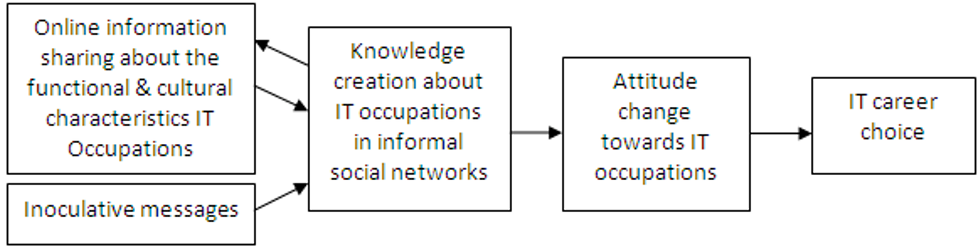 Figure 1: The Research Model illustrating the path from social network interaction to attitude change and career choice.
Experimental Design & Early Insights
The project utilizes a mixed-methodology approach. In its exploratory phase, the team:
- Developed video vignettes focused on "occupational culture" and "cultural fit."
- Conducted focus groups to ensure the "inoculative messages" were strong enough to trigger a psychological response but not so strong they became off-putting.
- Created a "Wiki" for students to ask the "real" questions they might be too intimidated to ask in a formal school setting.
The "Threat" mechanism is a crucial part of the experiment. By making students aware of the "threat" to their potential career interests (the stereotype), it triggers a counter-arguing process that actually strengthens their positive attitude toward the IT field.
Critical Analysis & Future Outlook
While the paper is a "Research in Progress," its theoretical grounding is robust. It recognizes that Occupational Socialization starts long before the first day of a job—it starts with childhood fantasies and social class influences.
Limitations:
- The study was designed during the early Web 2.0 era (2009). The "social networking" landscape has drastically changed from Wikis to short-form algorithmic video (Reels/TikTok).
- Measuring "attitude change" via surveys can be prone to social desirability bias.
Takeaway for Today: In an era of deepfakes and rapid misinformation, the "Inoculation" approach is more relevant than ever. Tech recruiters shouldn't just talk about high salaries; they need to acknowledge the "lonely geek" or "bro-culture" stereotypes head-on and provide students with the psychological tools to debunk those myths themselves.
Conclusion
The "RIP" project suggests that we cannot simply "market" IT to the next generation; we must "immunize" them against the cultural biases that prevent them from seeing themselves in the field. By leveraging the informal power of social networks, we can move from passive recruitment to active socialization.
Keywords: Inoculation Theory, IT Workforce, Social Networking, Occupational Culture, Recruitment.