
Rise of the Expert Amateur: How DIY Communities Are Redefining Creativity and Learning
Rise of the expert amateur: DIY projects, communities, and cultures
The paper investigates the motivations and practices within Do-It-Yourself (DIY) communities (e.g., Instructables, Ravelry, Etsy) through a survey of over 2,600 "expert amateurs." It identifies core values of open sharing, learning, and p-creativity, positioning DIY as a cultural movement supported by social computing and HCI technologies.
TL;DR
This seminal work by Kuznetsov and Paulos explores the "Expert Amateur"—highly skilled hobbyists who dominate DIY communities like Instructables and Ravelry. By surveying 2,600+ makers, the authors uncover a culture where learning beats profit and individual creativity is validated by a "field of experts" through open sharing. The paper challenges HCI to support messy, iterative processes rather than just finished products.
Background: Beyond the Amateur Label
The term "amateur" often carries a connotation of lack of skill. However, in the context of this study, it refers to motivation rather than ability. The "Expert Amateur" often possesses professional-grade skills in electronics, craft, or design but operates outside of commercial markets. This movement is a rebellion against mass production, rooted in a history of pirate radio and punk 'zines.
The Problem: The High Cost of Sharing
While DIY practitioners are eager to create, there is a significant "creativity barrier" when it comes to documentation. The study identifies a paradox:
- Motivation: Makers want to express themselves and learn.
- Friction: Lack of time and "imposter syndrome" regarding the novelty of their work prevent many from sharing.
- Medium Gap: Video is the most influential way to learn but the least used due to the effort required to produce it.
Methodology: A Taxonomy of Makers
The researchers looked at six distinct "ecosystems" to ensure a cross-domain perspective:
- Instructables: The "How-To" documentation hub.
- Dorkbot: In-person "strange things with electricity" meetings.
- Adafruit: The electronics troubleshooters.
- Ravelry & Craftster: The massive knitting and "hip craft" communities.
- Etsy: The marketplace for the handmade.
 Figure: Examples of the diverse output from DIY communities—from high-voltage physics to intricate fiber arts.
Key Insights: Why do they do it?
The survey data shattered several myths about online participation:
- Learning by Teaching: The most frequent contribution is answering questions. Makers reported that "teaching" others ingrained knowledge in their own minds.
- Creativity over Fame: 97% work for self-expression; "Internet fame" was the least significant motivator.
- Solo Work, Social Sharing: Most DIYers prefer to work alone for full creative control but crave a "social intersection" to validate their work.
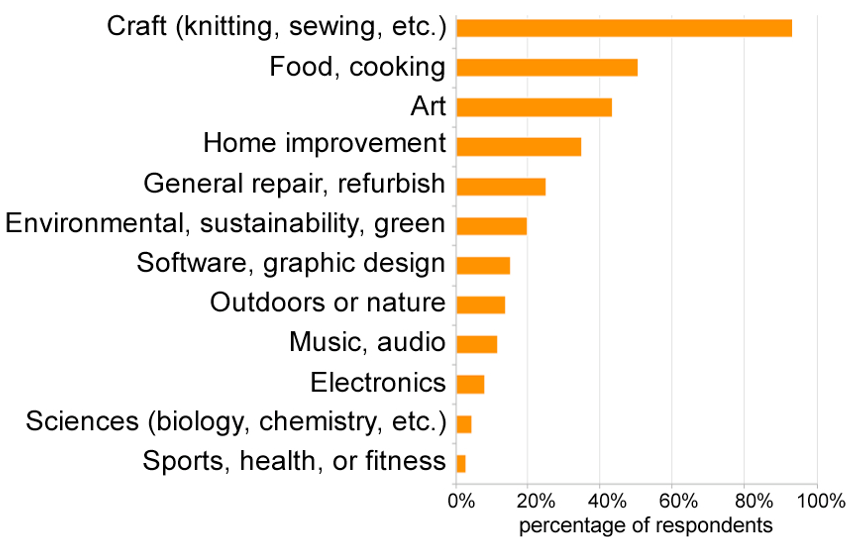 Figure: Inspiration and learning dominate as the primary drivers for community engagement.
Methodology Behind the Results
The study found a strong correlation between Time Invested and Likelihood to Share. If a project took over 30 hours, 95% of practitioners shared it. This suggests that "substantial" work creates a sense of pride that overcomes the documentation barrier.
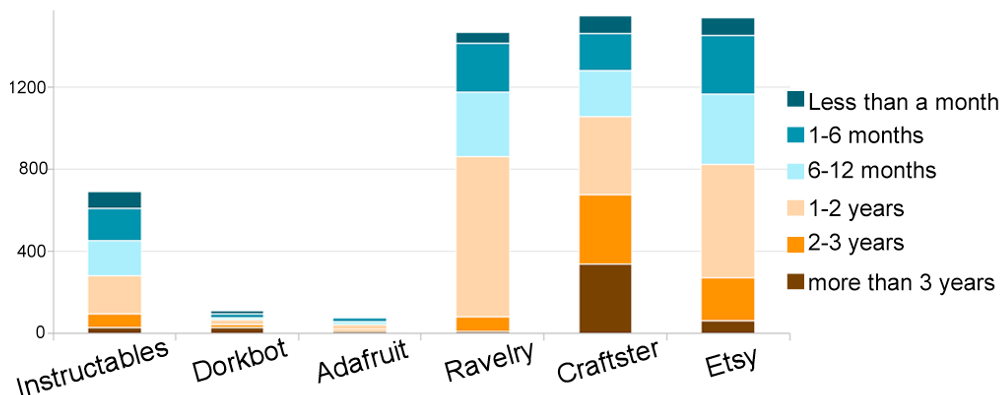 Figure: Most users engage via comments and images, but few venture into complex video or tutorials.
Critical Analysis & Future Outlook
Supporting "Studio Culture"
The paper’s most profound design implication is the move toward Iterative Studio Culture. Future HCI tools should not wait for a "finished" product. Instead, they should:
- Facilitate "live" status updates (similar to Twitter/Instagram but for builds).
- Link small sub-projects (e.g., a specific circuit or a stitch pattern) to larger, complex results.
- Enable "lightweight" knowledge transfer—using voice or interactive tagging to reduce the time-cost of tutorials.
Limitations
The study acknowledges a strong female skew (due to Ravelry/Craftster's massive size) and potential self-selection bias. However, the core values—openness, anti-consumerism, and peer-validation—remain universal across the DIY spectrum.
Conclusion
The "Expert Amateur" is not just a hobbyist; they are a critical source of innovation for the HCI field. By understanding their drive for p-creativity (personal creativity), developers can build better tools that bridge the gap between physical making and digital storytelling.