
FS-ELM: Predicting the Next Generation of Influencers in Geo-Social Networks
Rising Star Evaluation Based on Extreme Learning Machine in Geo-Social Networks
The paper introduces FS-ELM, a novel framework for identifying "Rising Stars"—junior users with high future potential—in Geo-Social Networks (GSNs). By leveraging Extreme Learning Machines (ELM) and multi-dimensional features, it transforms rising star evaluation into a high-efficiency binary classification task, achieving state-of-the-art performance on check-in datasets.
TL;DR
In the fast-moving world of Geo-Social Networks (GSNs) like Yelp or Foursquare, identifying who will be influential is more valuable than seeing who already is. This paper presents FS-ELM, a high-speed framework using Extreme Learning Machines to detect "Rising Stars"—users currently under the radar who are destined for expert status. By combining check-in patterns, social topology, and a unique temporal labeling strategy, FS-ELM achieves a 10% accuracy boost and a massive 60x speedup in training over traditional models.
The "Rising Star" Dilemma: Beyond Static Influence
Most social analysis tools are reactive: they find "Topic Experts" based on current follower counts or historical engagement. But for decision support and talent scouting, we need to be proactive.
The challenge in Geo-Social Networks is three-fold:
- Heterogeneity: How do you reconcile a user's social graph with their physical check-in locations (POIs)?
- The Oracle Problem: How do you get "ground truth" labels for a future state that hasn't happened yet?
- Real-time Constraints: Can we evaluate potential in milliseconds during an online query?
Methodology: The FS-ELM Framework
The authors break down the problem into three logical stages: Construction, Extraction, and Classification.
1. Feature Engineering (The Digital Footprint)
Instead of just looking at follower counts, the model extracts a holistic feature set:
- Social Topology: Degree, Clustering Coefficient (local density), and Betweenness Centrality.
- POI Attributes: The reputation and popularity of the venues a user visits (e.g., does this user discover "cool" hidden spots?).
- Behavioral Patterns: Topical expertise based on the categories of sites they check into.
2. Time-Lagged Supervised Labeling
This is the paper’s "Aha!" moment. To train a model to see the future, the authors look at historical snapshots. If a user was NOT an expert at time but BECAME one by time , they are labeled as a Rising Star at time .
3. The Power of Extreme Learning Machine (ELM)
While Deep Learning focuses on iterative backpropagation (which is slow), ELM uses a Single-hidden-layer Feedforward Network (SLFN) where input weights are randomly assigned and only output weights are calculated via simple matrix inversion.
 Figure 1: The SLFN structure utilized by the Extreme Learning Machine (ELM) for high-speed classification.
Experiments: Speed Meets Precision
The researchers tested FS-ELM against standard baselines (SVM, Decision Trees, KNN) across four categories: Food, Sport, Shopping, and Literature.
Key Findings:
- Accuracy: FS-ELM consistently maintained an accuracy between 0.8 and 0.9, outperforming SVM by a significant margin.
- The Velocity Advantage: The most startling result was the efficiency. FS-ELM's training time was 0.1572 seconds, compared to 9.6512 seconds for SVM.
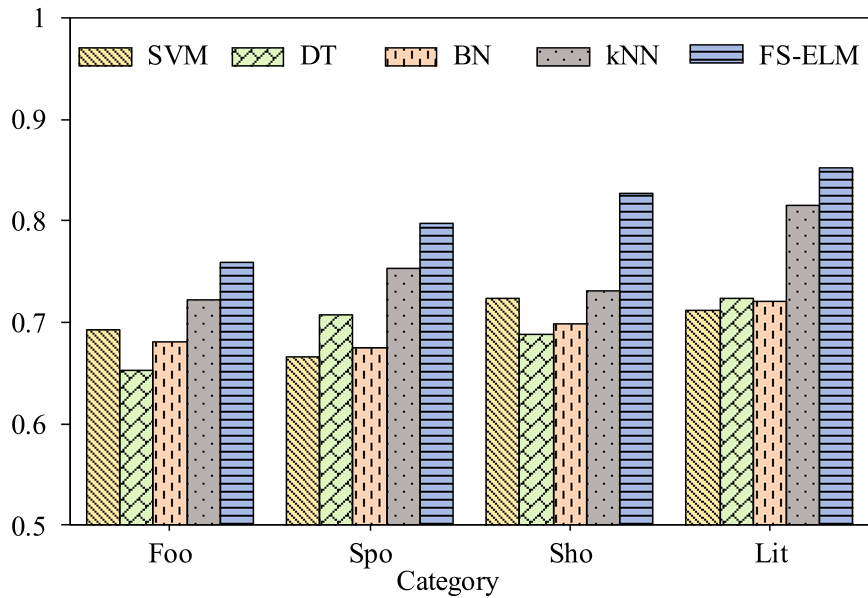 Figure 2: Performance metrics across different topic categories. FS-ELM shows superior Precision, Recall, and F1-score.
Critical Insight: Why Does It Work?
The effectiveness of FS-ELM boils down to the Inductive Bias of the chosen features. By incorporating Clustering Coefficients, the model captures "clique" behavior—often a precursor to influence. Furthermore, the use of an Ensemble Strategy (dividing data into fragments and voting) prevents the ELM from overfitting to the random noise inherent in sparse check-in data.
Conclusion & Future Look
FS-ELM proves that you don't always need massive, computationally expensive Transformers to solve complex social prediction problems. For real-time GSN applications, a well-engineered ELM can provide the necessary speed and accuracy.
Limitations: The model relies on the availability of check-in data, which is becoming scarcer due to privacy regulations (GDPR/CCPA). Future iterations will likely need to explore Differential Privacy or Federated Learning to maintain the same predictive power without compromising user anonymity.
Takeaway for Architects:
If your system requires low-latency "potential" scoring—whether for recruiters, marketers, or urban planners—look toward temporal labeling and non-iterative learning frameworks to balance performance with ROI.