
Decoding the Female Financial Lens: A Machine Learning Approach to Risk Profiling
Risk Profiles of Financial Service Portfolio for Women Segment Using Machine Learning Algorithms
This research develops a machine learning-based framework to define financial risk profiles for the women's segment in Mexico using census data. By integrating PCA, K-Means clustering, and Decision Trees, the study achieves a classification accuracy of 95.5%, identifying distinct regional and demographic financial archetypes.
Executive Summary
TL;DR: This paper tackles the "blind spot" in traditional banking: the specific financial risk profile of women. By applying a robust Machine Learning pipeline (PCA + K-Means + Decision Trees) to Mexican census data, the researchers moved beyond simple statistics to discover how geography, education, and household authority create unique financial identities, achieving a 95.5% classification accuracy.
Context: This isn't just about "better banking"—it's a socio-economic intervention. Positioned at the intersection of Financial Engineering and Social Policy, this work argues that the financial industry’s failure to differentiate gender leads to "one-size-fits-none" portfolios that ignore the specific risk-aversion and resilience traits of the women's segment.
Problem & Motivation: The Data Complexity Gap
Why do we need AI for this? Most banks use linear models or human intuition. However, human behavior—especially in a volatile economy like Mexico—is stochastic and non-linear.
The authors identify a paradox: While women are statistically "lower risk," the variables that lead to this outcome are poorly understood. Original census data is a "high-dimensional nightmare" (200+ attributes), filled with redundancy and noise. Traditional methods fail to scale or provide the interpretability required for regulatory financial decisions.
Methodology: The Three-Pillar AI Pipeline
1. Feature Engineering and PCA
To handle 196,025 localities, the researchers first filtered for 23 relevant attributes (Men-women ratio, economic activity, education, etc.). They then applied Principal Component Analysis (PCA) to compress the search space while retaining 90% of the information.
- Insight: PCA effectively removed noise from variables like longitude and latitude, allowing the model to focus on the "signal"—the socio-economic indicators.
2. Unsupervised Segmentation (K-Means)
Using the Elbow Method and Davies-Bouldin scores, the authors identified that the Mexican population naturally clusters into four groups.
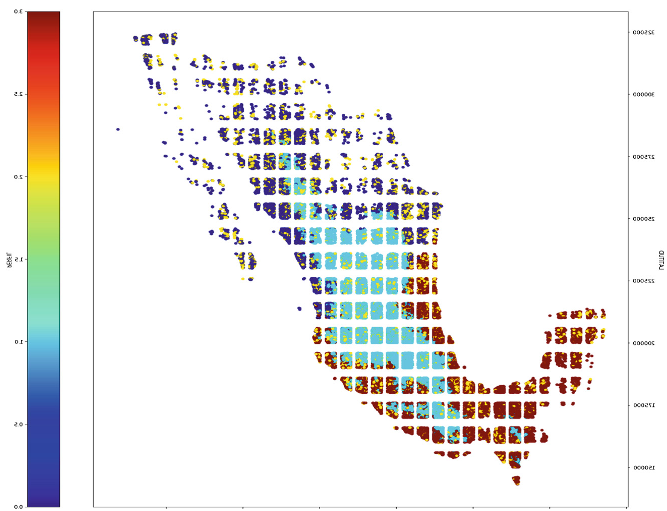 Fig 1: Geographical distribution of the four identified clusters (North, South, Central, and Small Populations).
3. Interpretability via Decision Trees
The final layer used a Decision Tree (Entropy criterion). Unlike "black box" neural networks, Decision Trees provide a "White Box" model—essential for financial advisors who need to explain why a client was assigned a specific risk profile.
Deep Dive: Key Findings & Visualization
The researchers found fascinating trends that refute common stereotypes:
- Household Authority vs. Activity: In men, authority grows with economic activity. In women, the trend is more complex, showing a positive growth trend only after reaching certain economic thresholds.
- Education Equality: Both genders show nearly identical academic grade trends across localities, suggesting that "access to education" is no longer the primary differentiator for financial risk; instead, "access to formal credit" is the bottleneck.
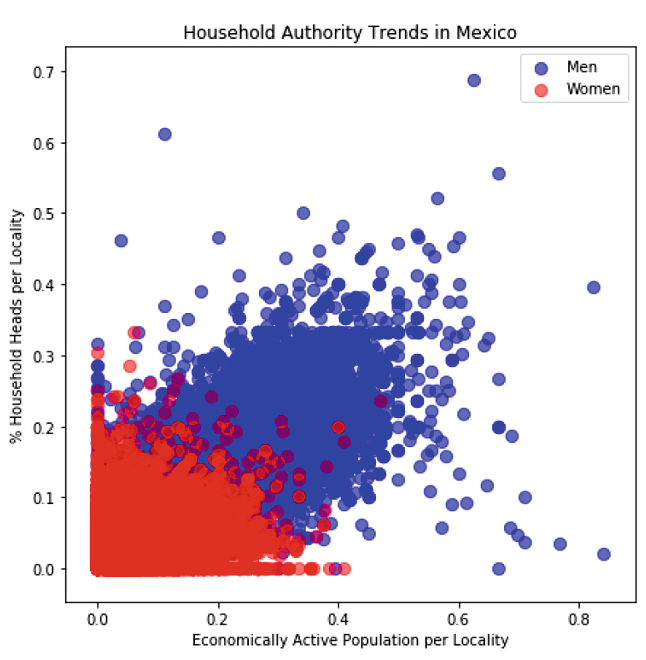 Fig 2: Correlation analysis showing the divergence in household authority vs. economic activity between genders.
Critical Analysis & Conclusion
The Takeaway
The study proves that geography is a proxy for financial behavior. The "North" cluster's higher education levels and household assets (rooms per dwelling) correlate with distinct risk tolerances compared to the "Small Populations" cluster, which is geographically dispersed but socio-economically uniform.
Limitations
- Small Population Bias: The "Small Populations" cluster produced "inflated values" due to small sample sizes, leading to its exclusion from some deep analyses.
- Static Snapshot: Using 2010/2016 census data may not capture the rapid digital transformation (Fintech/Mobile Banking) that has occurred in Mexico post-2020.
Future Outlook
The road ahead lies in the Risk Calculator. By turning these insights into a real-time tool, banks can move from "guessing" risk to "calculating" it, finally providing Mexican women with financial products that match their actual economic reality.