
Beyond the Profile: Quantifying Privacy Risk Through Friendship Dynamics
Risks of Friendships on Social Networks
The paper proposes a novel risk assessment model for Online Social Networks (OSNs) that quantifies the privacy risk of "friends" based on their friendship patterns. It utilizes logistic and multiple linear regression on real-world data to determine how mutual friends (friends of friends) influence a user's risk perception, ultimately categorizing friends into risk levels.
TL;DR
Is your privacy at risk not because of what you share, but because of who you choose to be friends with? This paper introduces a quantitative model to measure the "Risk of Friendships." By analyzing how mutual friends influence our perception of strangers, the authors move beyond static profile analysis to dynamic, graph-based risk assessment.
The Hidden Source of OSN Risk
Most research in Social Network privacy focuses on the what: what photos are visible, what data is public, or what rules are set. However, users rarely meet "strangers" randomly; they are introduced through the social graph.
The authors argue that friends act as "gatekeepers" or "diluters" of risk. A "risky" stranger might seem less dangerous if introduced by a trusted friend (Positive Impact), while a neutral stranger might be avoided if they are associated with a friend the user already distrusts (Negative Impact). Identifying these patterns is the key to automating privacy settings.
Methodology: The Regression Pipeline
The architecture of the model relies on separating intrinsic risk (the stranger's features) from external risk (the influence of the mutual friend).
1. The Baseline Label ()
First, the model calculates how risky a stranger would be if they had no mutual friends. Using Logistic Regression on features like gender, friend-list visibility, and profile locale, the model assigns a baseline score.
2. The Social Frequency Matrix
To handle the high dimensionality of social data, the authors use the concept of Homophily (the tendency of individuals to associate with similar others). They transform categorical data into a "Social Frequency Matrix," allowing for more robust clustering (-means).
3. Calculating Impact
By comparing the user's actual assigned label () with the baseline (), the system isolates the Friend Impact.
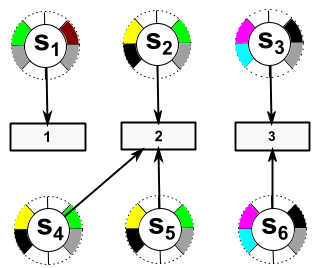
The paper tests two hypotheses:
- Single Impact: One friend from a cluster is enough to influence perception.
- Multiple Impact: More mutual friends from the same group amplify the effect. The results surprisingly showed that Single Impact was often more reflective of user behavior in undirected networks like Facebook.
Experimental Insights: 6 Clusters of Risk
The experiments yielded a profound discovery regarding the granularity of social circles.
- Optimal Clustering: Friends can be grouped into 5 or 6 clusters based on how they affect risk perception. Strangers, being more diverse, require roughly 26 clusters to achieve the best predictive accuracy (lowest RMSE).
- Positive vs. Negative Bias: On average, mutual friends have a "softening" effect, making strangers appear less risky than their profile features might initially suggest.
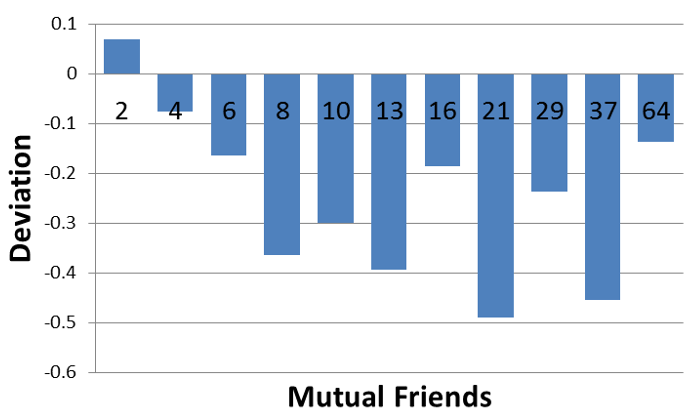
As shown in the charts, as the number of clusters () increases, the model's ability to explain the variance () improves, but only up to a point before data sparsity (not enough strangers in a cluster) causes performance to drop.
Critical Analysis & Real-World Validation
To prove this isn't just theoretical, the authors cross-referenced their "Very Risky" friend labels with deleted friendships. They found a high correlation: users were significantly more likely to have already deleted or restricted friends that the model flagged as having a high negative impact frequency.
Limitations
- API Constraints: The model relies heavily on friend profile data to approximate stranger data due to restricted social network APIs.
- Evolving Networks: The study uses an undirected graph (Facebook). The dynamics might shift significantly in directed graphs (Twitter/X or Instagram) where the "friend" relationship is asymmetrical.
Takeaway for the Future
This work provides a logical foundation for the next generation of "Privacy Wizards." Instead of asking users to navigate complex settings menus, social platforms could identify "risky clusters" in a user's graph and proactively suggest restrictions, ensuring that a single bad choice in a friend doesn't compromise an entire digital footprint.