
Beyond the Screen: Decoding Adolescent Risk-Taking on Social Media
Risks Associated With Posting Content on the Social Media
This study investigates the risk behaviors of children and teens (ages 9-17) regarding content sharing on social media and messaging apps. Using a sample of 856 students, the researchers identify significant correlations between age, gender, and the type of platform used (notably Snapchat) in relation to inappropriate online posting.
TL;DR
A comprehensive study of 856 minors reveals that digital native status does not equate to digital safety. As adolescents age, their propensity for risky online posting increases, with Snapchat emerging as the primary site for inappropriate content. Crucially, the study identifies a "gender split" in risk: girls lack privacy oversight, while boys are more likely to engage in intentional harmful posting.
The "Safety" Gap: Why Access is Not Competence
In Spain, over 95% of minors access the internet, yet the researchers argue we are witnessing a new form of the Digital Divide. This isn't a divide of access, but of competence.
The authors anchor their work in the DIGCOMP framework, specifically the "Safety" dimension. They identify a phenomenon called Digital Anomie: a state where young users break rules not out of rebellion, but out of ethical indifference or a total lack of awareness that their actions (like sharing a friend's photo without consent) constitute a risk.
Methodology: Mapping the Risk Landscape
The research utilized a sample of 856 students in the Basque province of Guipúzcoa. By employing a 39-item questionnaire, the team analyzed eight specific "Risk Postings" ranging from posting without parental permission to sharing content that encourages bullying.
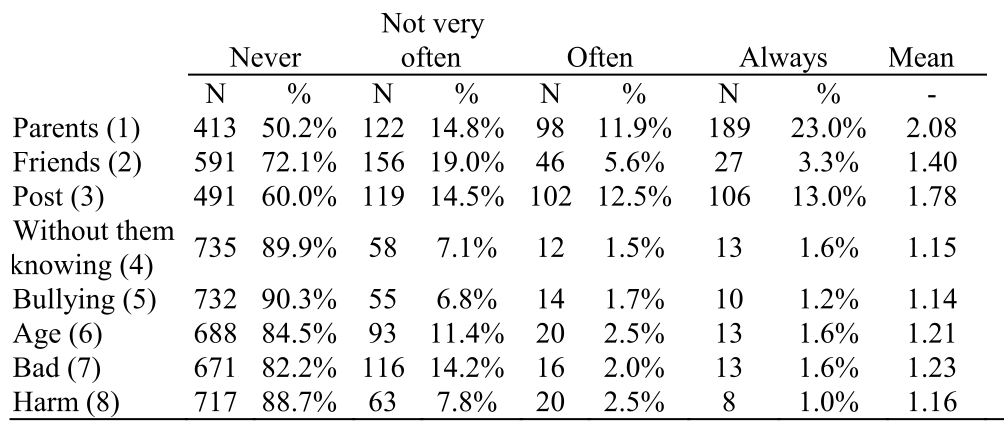 Table 1: Frequency of risk actions. Note that 23% of participants "Always" post photos of themselves without parental permission.
Key Findings: The Snapchat Effect and Gender Dynamics
One of the most striking insights is the platform-specific risk. While WhatsApp and Instagram are more widely used, Snapchat and Twitter showed the highest mean scores for risk-associated behaviors.
1. The Age Escalation
Risk actions are minimal below age 12 but rise sharply from 13 onwards, peaking and stabilizing at age 17. This suggests that the "autonomy" granted to older teens is often not matched by an increase in digital judgment.

2. The Gender Paradox
The study found that while overall risk levels are similar between genders, the nature of the risk differs significantly:
- Girls: Score higher on sharing personal content (photos/videos) without parental or friend permission. This is often non-malicious but increases vulnerability to grooming and sexting.
- Boys: Score higher on items involving intent to harm, such as posting embarrassing photos of classmates or content that encourages bullying.
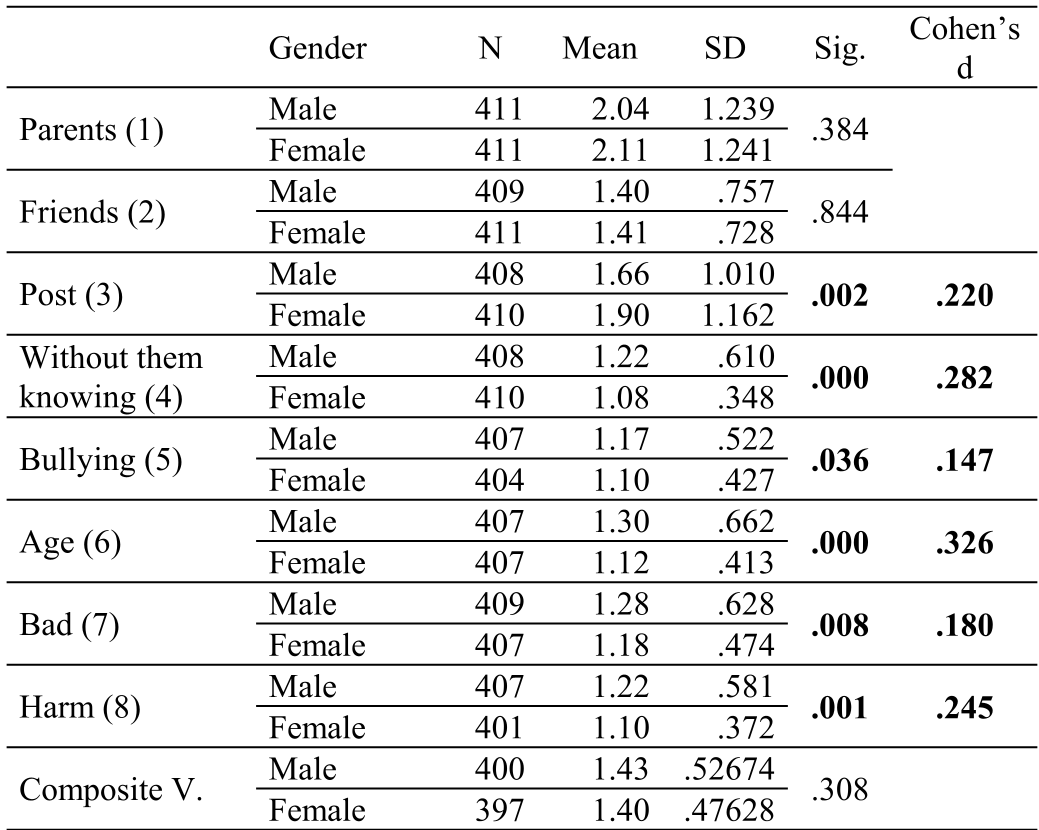 Table 3: Statistical differences showing girls lead in "Post (3)" while boys lead in "Harm (8)" and "Bullying (5)".
Critical Insight: The Ephemeral Trap
Why is Snapchat the outlier? The paper suggests that the perceived "privacy" and "ephemerality" (photos that disappear) of Snapchat creates a false sense of security. Users are more likely to violate traditional codes of conduct on these platforms than on "persistent" platforms like Instagram.
Conclusion & Future Advocacy
The study concludes that digital competence training must be multimodal. Schools and parents cannot simply focus on the most popular apps; they must address the "darker corners" like Snapchat where risk behaviors are concentrated.
Takeaway for Educators:
- Tailor by Gender: Focus on privacy awareness for girls and empathy/impact training for boys.
- Target the Age Gap: Intensify "Digital Identity" training around age 13-14, before risk behaviors stabilize.
- Broaden the Scope: Include non-formal educators (social workers, leisure instructors) in safety training to reach adolescents in their recreational digital spaces.