
RLVE: Escaping the Data Saturation Trap with 400 Adaptive Environments
RLVE: Scaling Up Reinforcement Learning for Language Models with Adaptive Verifiable Environments
RLVE (Reinforcement Learning with Adaptive Verifiable Environments) is a framework that scales up language model reasoning by utilizing 400 procedurally generated, algorithmically verifiable environments. It achieves a 3.37% absolute improvement on reasoning benchmarks over state-of-the-art 1.5B models by dynamically shifting problem difficulty to stay at the model's capability frontier.
TL;DR
The "Scaling Law" of LLMs isn't just about parameter counts; it's about the quality and difficulty of the feedback loop. RLVE (Reinforcement Learning with Adaptive Verifiable Environments) introduces a suite of 400 "gyms" that procedurally generate problems. By adjusting difficulty in real-time to match the model's evolving skill, it shatters the performance ceilings of static datasets, achieving significant reasoning gains even on models previously thought to be "saturated."
The Problem: The "Stalling" Gradient
Current RL for reasoning (like RLVR) typically uses static datasets. This creates a Goldilocks problem:
- Too Easy: The model gets 100% rewards; no gradients are generated.
- Too Hard: The model never finds the "correct" path; rewards are consistently zero, and training stalls.
- Static Distributions: Even a "diverse" static dataset becomes useless once the model learns its distribution.
Methodology: The Verifiable "Gym"
The core of RLVE is the Verifiable Environment (E = I, P, R). Unlike a static JSON file, these are living programs:
- Procedural Generation (P): Can create an infinite stream of problems (e.g., Sudoku, sorting, Hamiltonian paths).
- Algorithmic Verification (R): Uses code or math properties (not LLM-based labeling) to check answers, enabling cheap, 100% accurate rewards.
- Adaptive Difficulty (d): This is the secret sauce. If the model is winning too much at level d, the system bumps it to d+1.
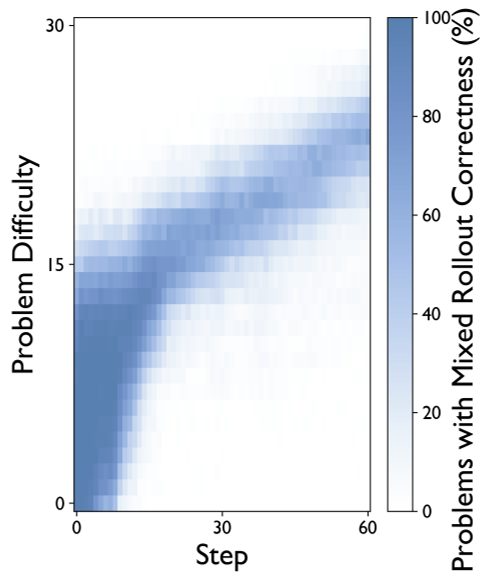 Figure 1: Comparison between Static RL data and the Adaptive RLVE loop where difficulty shifts as the policy improves.
The Insight: Verification Asymmetry
The authors leverage a brilliant mathematical trick: it is often easier to verify a solution than to find one (P vs NP). For a Hamiltonian path problem, the environment doesn't need to know how to solve the graph; it only needs a script to check if the model's output visits every node exactly once. This allows training models on tasks that exceed the trainer's own solving ability.
Experiment: Scaling the Environments
The paper confirms that Environment Scaling is more important than data volume. Moving from 1 environment to 256 environments consistently boosts Out-of-Distribution (OOD) performance.
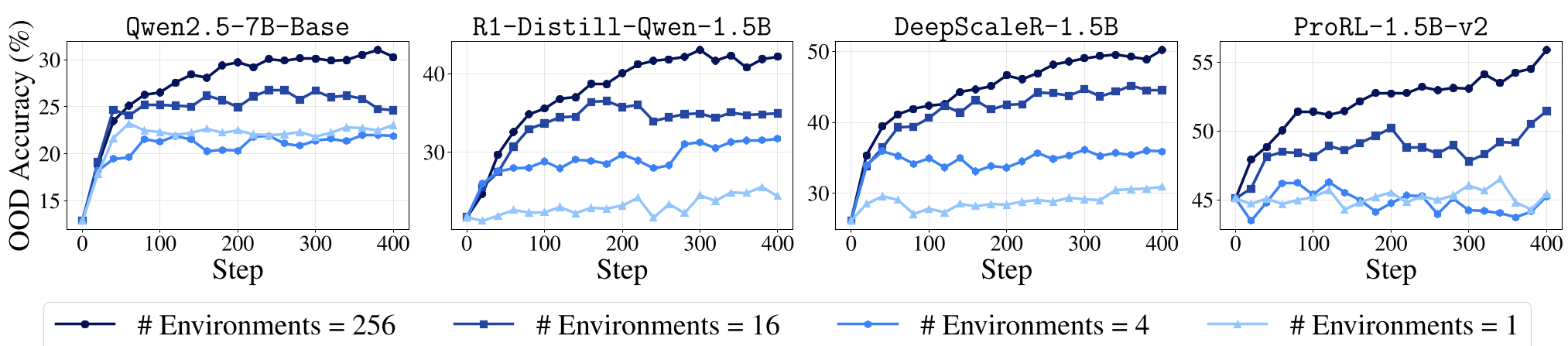 Figure 2: Scaling the collection of training environments leads to better generalization on unseen tasks.
Results: Breaking Through the Ceiling
The most impressive result is the "Deep Data Saturation" test. They took ProRL-1.5B-v2, a model already trained for 20,000 GPU hours until its performance plateaued.
- Continued Static RL: +0.49% improvement.
- RLVE (Adaptive): +3.37% improvement.
This proves that the "saturation" wasn't a model capacity limit, but a data complexity limit.
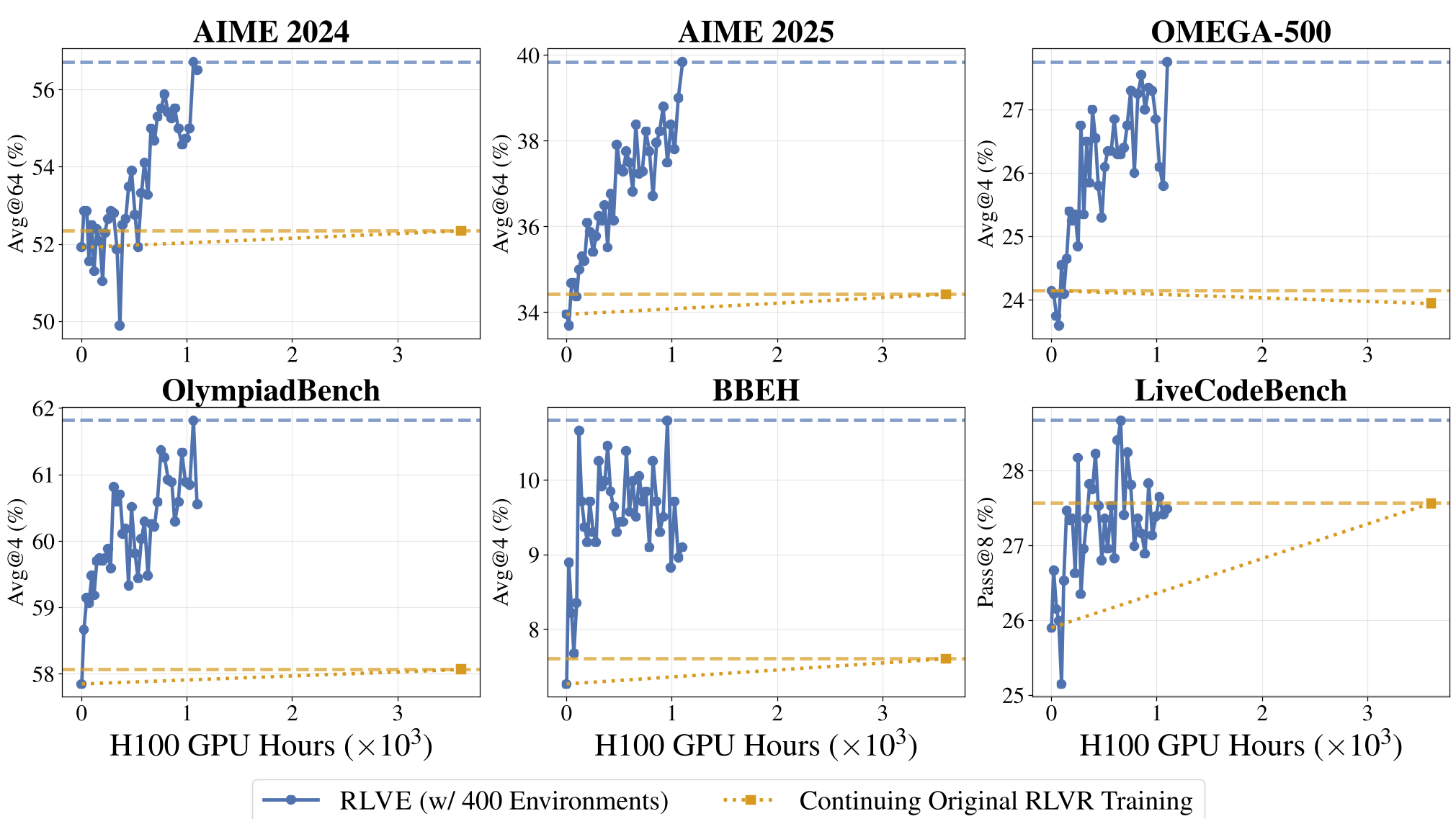 Figure 3: Performance growth across various benchmarks (AIME, LiveCodeBench) showing RLVE's superior scaling efficiency.
Critical Insight & Future Outlook
RLVE suggests a paradigm shift: Environment Engineering is the new Prompt Engineering.
- Pedagogical focus: The 400 environments are like a gym for the brain—they don't teach the model "facts," they teach the "meta-ability" of reasoning (backtracking, decomposition, etc.).
- Human in the loop: While the environments generate data automatically, the design of the environments (defining how difficulty scales) still requires expert human intuition.
Limitations: Currently, RLVE is limited to "verifiable" tasks (math, code, logic). The next frontier is Adaptive Non-Verifiable Environments—how do we adaptively "scale" the difficulty of creative writing or deep research where no "sorting algorithm" exists to provide a ground-truth reward?
Conclusion
RLVE proves that for LLMs to become smarter, we don't just need more data; we need a smarter curriculum. By treating RL as a dynamic interaction with a gymnasium rather than a static reading of a textbook, we can push models far beyond current reasoning bottlenecks.